
Markets
Many balls going through a hoop
Getty Images
Rollercoaster

Should you buy the dip the day after stocks drop? Maybe

When the going gets tough the tough get going.

David Crowther

Yesterday’s market mayhem, in which the Nikkei 225 recorded its worst one-day drop since 1987, US stocks fell 3%, and the Magnificent 7 shed some $650 billion of market cap, saw Wall Street’s “fear gauge” hit levels not seen since the pandemic.

It was, as Luke Kawa put it, what panic looks like.

Whenever stocks make the headlines, there’s always an army of people — from professional fund managers to retail traders — ready to tell you exactly what to do next: buy the dip.

But, what does the data say about that strategy? A simple inspection of every single day the S&P 500 has fallen more than 2% since 1970 reveals that, a slim majority (54.5%) of the time, stocks do indeed rise the day after a 2%+ fall. On average, per our calculations, the S&P 500 Index rose 0.14% the day after a 2%+ drop.
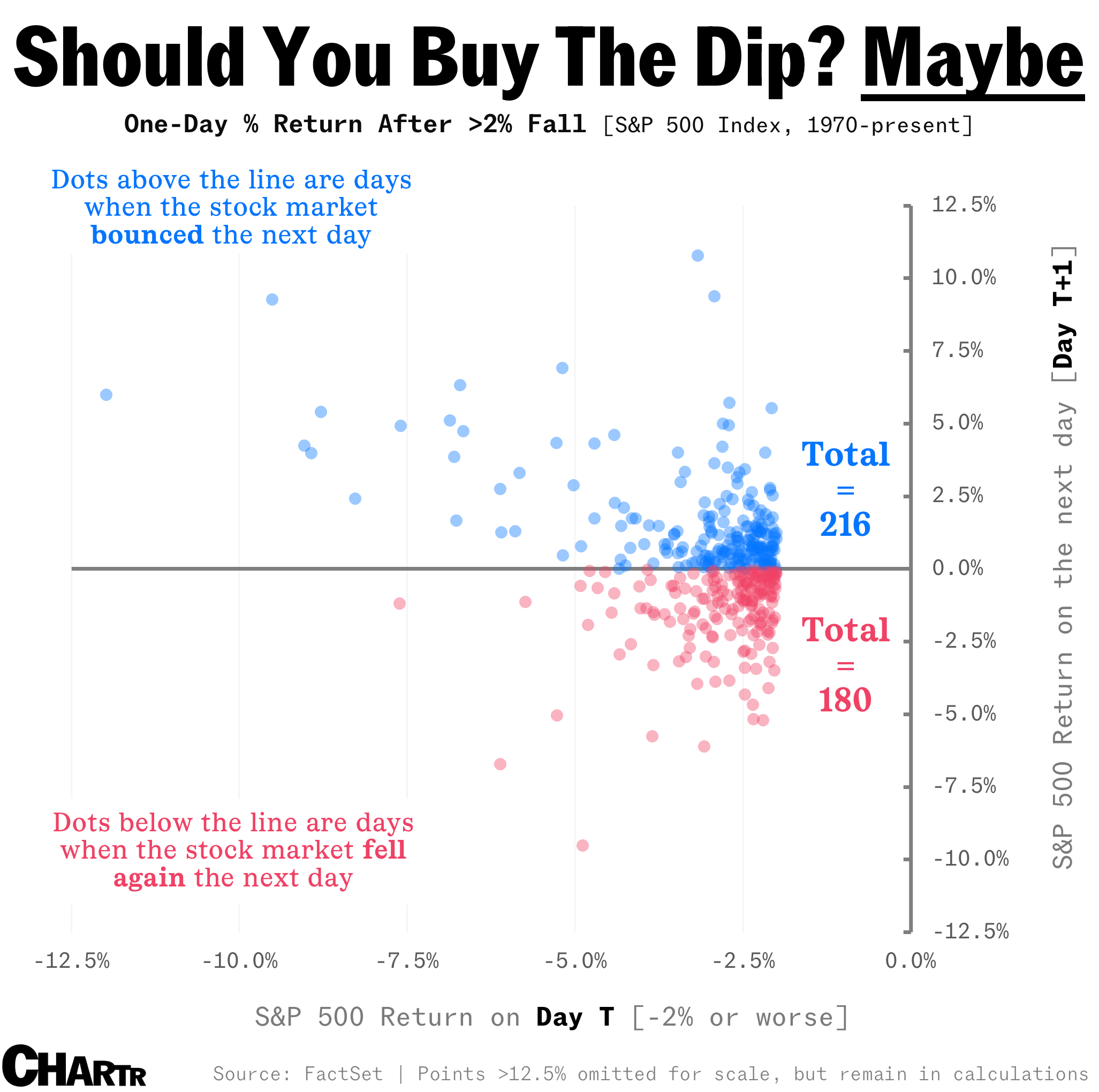
Should you buy the dip? Maybe
Sherwood News

The Nikkei 225 obviously didn’t get the memo: the Japanese index which cratered yesterday has rebounded sharply, up 10% this morning.

What about a longer time horizon: A tome of academic research has found evidence of both mean reversion (stocks reversing course) and momentum (stocks continuing to trend in the same direction) in equity markets. How can they both be true? The difference lies usually in how long a time period you’re measuring.

In the long run, stocks tend go up.

More Markets

See all Markets
markets

SpaceX gets a wave of bullish ratings from Wall Street analysts

SpaceX received more than a dozen positive analyst calls on Tuesday — including from major Wall Street banks — as they initiate coverage on Elon Musk’s space and AI company.

SpaceX went public on June 12 at a $2.2 trillion valuation, the largest debut in history. While the company hasn’t yet posted a profit, it seems to have convinced Wall Street that it will get there and grow its valuation on the way.

Of the at least 17 analysts that gave a rating on Tuesday, all but one gave it a “buy” or “outperform” rating. MoffettNathanson was "neutral."

The ratings come as SpaceX joined the Nasdaq 100 index, a benchmark tech-heavy basket of companies that underpins millions of portfolios. The inclusion adds built-in demand for the stock from index funds and ETFs.

Still, SpaceX fell more than 5% on Tuesday amid a broader sell-off, and is currently effectively flat from its opening price of $150 a share.

Latest Stories

Sherwood Media, LLC and Chartr Limited produce fresh and unique perspectives on topical financial news and are fully owned subsidiaries of Robinhood Markets, Inc., and any views expressed here do not necessarily reflect the views of any other Robinhood affiliate, including Robinhood Markets, Inc., Robinhood Financial LLC, Robinhood Securities, LLC, Robinhood Crypto, LLC, Robinhood Money, LLC, Robinhood U.K. Ltd, Robinhood Derivatives, LLC, Robinhood Gold, LLC, Robinhood Asset Management, LLC, Robinhood Credit, Inc., Robinhood Ventures DE, LLC and, where applicable, its managed investment vehicles.

