

Markets
markets
Luke Kawa

SoftBank founder Masayoshi Son was “crying” over selling Nvidia, says “I wish to have unlimited money”

SoftBank’s CFO made it clear a few weeks ago that the Japanese investment firm’s sale of its $5.8 billion Nvidia position in October had “nothing to do” with the chip designer.

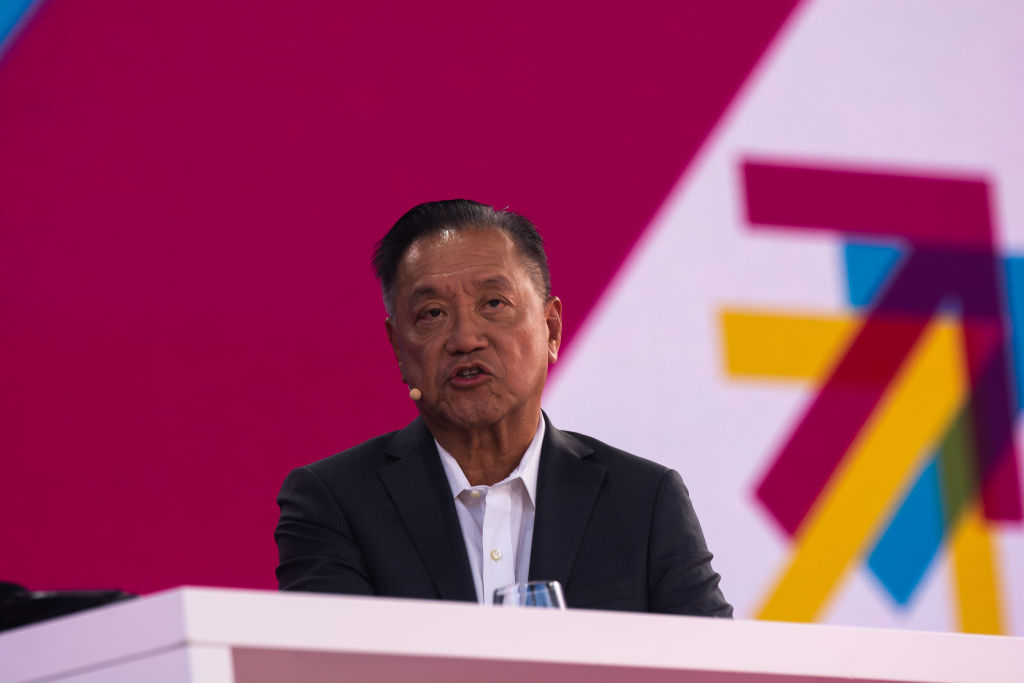
Speaking at the FII Priority Asia forum on Monday, SoftBank founder Masayoshi Son underlined that sentiment, telling the world how much that move was one he had to make, but not one he wanted to make:

“I wish to have unlimited money. I respect Jensen, I respect Nvidia so much; I don’t want to sell a single share. I just had more need for money to invest into OpenAI, invest into our opportunities, so I was crying to sell Nvidia shares. If I had more money, of course, I wanted to keep Nvidia shares, all the time, any time.”

The plunge in SoftBank shares as of late — the company’s ADR is down 39% since peaking at the end of October — is due in part to its exposure to OpenAI, something that also might inspire tears.

SoftBank owes OpenAI $22.5 billion by year-end to finance its increased stake in the ChatGPT maker. Its AI initiatives include its substantial investment in OpenAI, as well as data center sites that are part of Project Stargate.

Son also took the time to clap back at critics who deem the massive tide of money pouring into AI to be a bubble, calling them “not smart enough” and outlining his vision for return on investment.

In 10 years, he believes AI will be much, much smarter than humans, and that “at least 10%” of global GDP will be substituted by superintelligence and physical AI robots. If it takes $10 trillion in investment to get to that point, he says the cumulative capital expenditure would be recouped in just six months.
More Markets

See all Markets
markets

American Eagle posts stronger-than-expected Q4 earnings and revenue

If American Eagle has seen farther, it is by standing on the shoulders of Sydney Sweeney.

The jeans seller posted adjusted earnings of $0.84 per share, ahead of the $0.71 expected by analysts polled by FactSet. It booked $1.76 billion in fourth-quarter revenue, versus the $1.74 billion consensus.

Shares initially climbed more than 5% after-hours before paring gains to about 2%.

“Compelling new product collections, supported by fresh marketing campaigns, led to higher demand trends in the quarter,” said CEO Jay Schottenstein.

American Eagle said it’s expecting same-store sales to grow by high single digits in the first quarter.

Marketing controversy has proved to be a powerful mover of denim for AE. In its third-quarter earnings call in December, AE said its partnership with Sydney Sweeney — together with a Travis Kelce partnership — had garnered more than 44 billion impressions. The retailer hit meme stock status last July when it initially launched its “Sydney Sweeney has great jeans” campaign.

As of Wednesday’s close, American Eagle shares had climbed 120% since the Sweeney ad first landed.

markets

Investors are itching to buy the dip in memory stocks

The intense drubbing in South Korean stocks, with the benchmark Korean index (KOSPI) falling nearly 20% in its first two trading days of the week following a Monday holiday, represented a serious threat to the hottest AI trade: memory stocks.

South Korea’s market is dominated by two high-bandwidth memory giants: SK Hynix and Samsung.

After Tuesday’s tumble, US investors seemingly said enough is enough: it’s a buy-the-dip opportunity.

US memory stocks like Micron, Sandisk, Western Digital, and Seagate Technology Holdings are posting massive gains on the day. The advance comes amid positive commentary at a Morgan Stanley conference on demand for memory chips.

Even more interestingly, the iShares MSCI South Korea ETF is up big today despite the KOSPI falling 12% overnight, its largest drop on record. The ETF’s outperformance of the South Korean equity gauge is the largest since 2008, as the global financial crisis raged.

The daily performance of these two can differ materially since they trade at different times and don’t track precisely the same things. US investors are making the bet that a potential break in this momentum trade and the potential for an unwind of retail leverage in South Korean markets be damned, big drops in memory stocks are meant to be bought.

Latest Stories

Sherwood Media, LLC produces fresh and unique perspectives on topical financial news and is a fully owned subsidiary of Robinhood Markets, Inc., and any views expressed here do not necessarily reflect the views of any other Robinhood affiliate, including Robinhood Markets, Inc., Robinhood Financial LLC, Robinhood Securities, LLC, Robinhood Crypto, LLC, or Robinhood Money, LLC.