

Markets
markets

Stocks really ain’t cheap

We’ve said it before, and we’ll say it again. The stock market’s post-election romp is increasingly untethered to investing fundamentals, as the gambling impulse — always present in the Jekyll-and-Hyde nature of trading markets — is clearly in control.

The WSJ spotlights the skimpy cushion expected earnings for the S&P 500 now provide, versus the guaranteed yields of US government bonds, as evidence that this rally is getting a bit unreasonable.

This so-called equity-risk premium shows that those buying the stock market are getting compensated virtually nothing for the risk they’re taking on at the moment, at least in terms of expected earnings.

A couple caveats here: first off, the post-election rise in stocks and bond yields at least partially reflects more optimism on the growth outlook. Sell-side analysts are never as nimble in adjusting their earnings estimates for companies as the stock and bond markets are in adjusting prices. So, expected profits are likely to see a boost as Wall Street plays catch-up.

Also, anchoring to the past 20 years — and especially the period following the global financial crisis — as a good gauge of what the ERP “should” be is difficult. That’s a period in which bond yields were very low relative to nominal economic growth; that is, stocks were a pretty good deal.

Of course, stock prices can — and, especially recently, have — run far ahead of those expected earnings. On an individual level stock level, this is pretty clear. Some of the year’s big winners like Palantir, Nvidia or CrowdStrike look insanely overvalued according metrics like price-to-sales ratios.

And that’s why the market is on track for its best two-year run since the dot-com boom of the 1990s, ERP be damned.

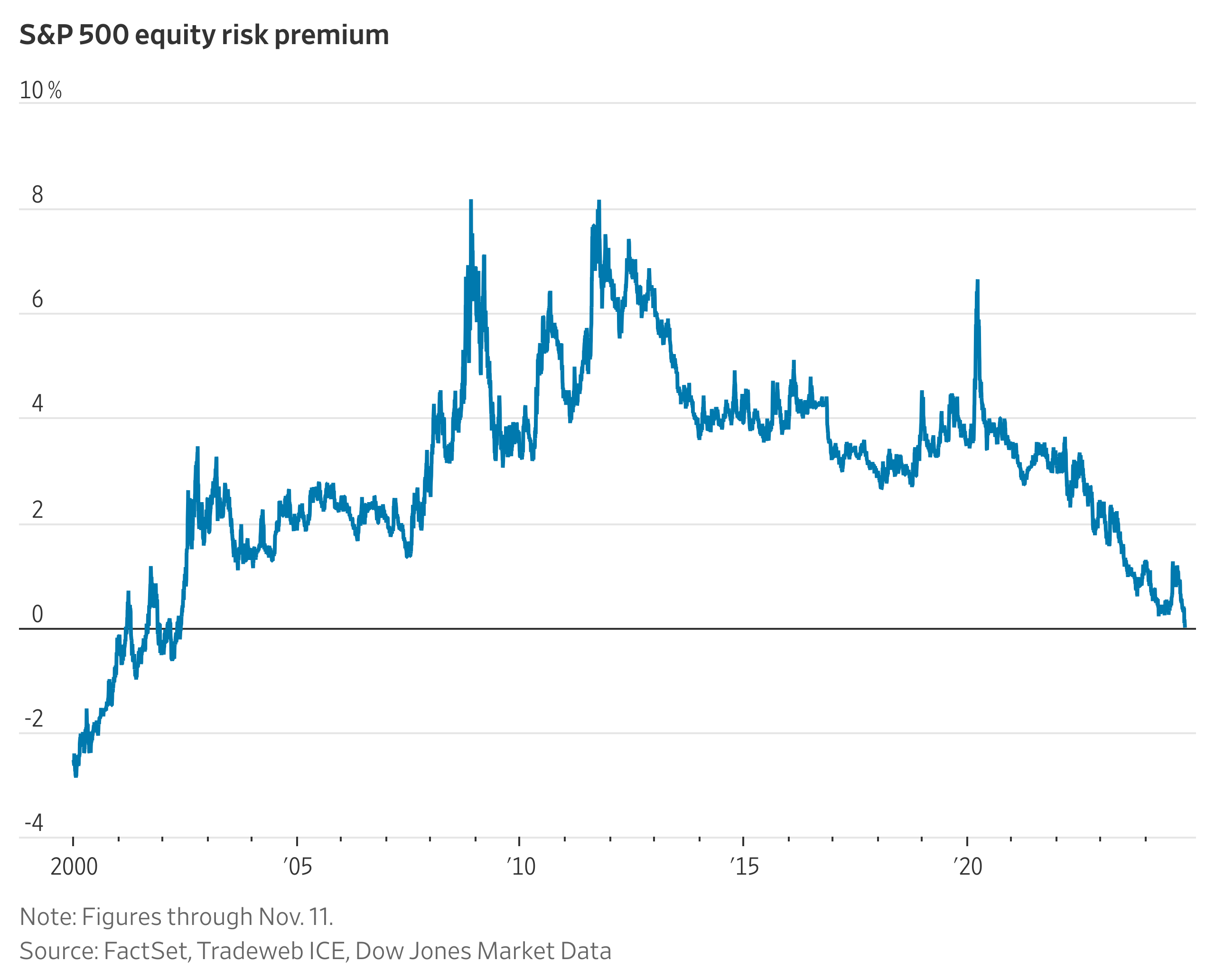
This so-called equity-risk premium shows that those buying the stock market are getting compensated virtually nothing for the risk they’re taking on at the moment, at least in terms of expected earnings.

A couple caveats here: first off, the post-election rise in stocks and bond yields at least partially reflects more optimism on the growth outlook. Sell-side analysts are never as nimble in adjusting their earnings estimates for companies as the stock and bond markets are in adjusting prices. So, expected profits are likely to see a boost as Wall Street plays catch-up.

Also, anchoring to the past 20 years — and especially the period following the global financial crisis — as a good gauge of what the ERP “should” be is difficult. That’s a period in which bond yields were very low relative to nominal economic growth; that is, stocks were a pretty good deal.

Of course, stock prices can — and, especially recently, have — run far ahead of those expected earnings. On an individual level stock level, this is pretty clear. Some of the year’s big winners like Palantir, Nvidia or CrowdStrike look insanely overvalued according metrics like price-to-sales ratios.

And that’s why the market is on track for its best two-year run since the dot-com boom of the 1990s, ERP be damned.

More Markets

See all Markets
markets

Lightwave Logic drops following Q1 earnings

Lightwave Logic released its Q1 earnings report Wednesday postmarket. The company reported increasing shortfalls as the photonics company continues to scale. Investors reacted by pushing the stock slightly down after-hours.

Here are the numbers: 

  • Revenue of $29,000, 27% growing year-over-year.

  • Net loss of $6.3 million, widening 34% year-over-year.

The material photonics company, which designs and provides polymers to speed the flow of information from chip to chip, hit a four-year high this week and has risen nearly 400% since January. Daily options volumes on the stock hit a record high ahead of this release.

The stock has been boosted by an explosion of AI data center demand and interest in the growing industry of photonic integrated circuits for data center connectivity.

On their afternoon earnings call, Lightwave Logic CEO Yves LeMaitre reiterated that he believes the company is "positioned to help address some of the most important challenges facing AI infrastructure over the coming decade."

markets

USA Rare Earth gains after delivering better-than-expected quarterly results

USA Rare Earth is rising in postmarket trading after releasing better-than-expected Q1 results.

Key numbers:

  • Revenue of $5.67 million (compared to analyst estimates of $4.22 million).

  • An adjusted loss per share of $0.12 (estimate: a $0.14 loss).

Management aims to achieve 3,000 metric tons per annum of run rate for metal-making and alloy capacity by year-end, along with 600 MTPA of run rate for magnet manufacturing capacity.

The results come during a period of unease in the global rare earth market. China previously moved to drastically curb critical mineral access in October, adding five new elements to its export controls and freezing supplies to semiconductor manufacturers. These materials may be on the agenda during discussions between US and Chinese leadership this week.

In response, the US has scrambled to build domestic production buffers. In January 2026, USA Rare Earth secured a landmark $1.6 billion government-backed package from the Department of Commerce, which included a $1.3 billion senior secured loan under the CHIPS and Science Act and $277 million in direct incentives in exchange for a 10% federal equity stake.

The company also announced a definitive agreement to acquire Serra Verde Group, owner of the Pela Ema rare earth mine and processing plant in Goiás, Brazil. The $2.8 billion acquisition is expected to close in the third quarter of 2026, subject to customary closing conditions and regulatory approvals.

markets

Cisco surges on Q3 earnings beat and better-than-expected Q4 outlook

Cisco rose double digits after beating Q3 revenue and earnings estimates and giving optimistic projections due to increasing demand from the AI industry.

Shares were 13% higher in after-hours trading.

The tech company reported: 

  • Q3 revenue of $15.8 billion (compared to analyst estimates of $15.6 billion).

  • Q3 adjusted earnings per share of $1.06 (estimate: $1.04).

  • Q4 revenue guidance between $16.7 billion and $16.9 billion (estimate: $15.8 billion).

  • Q4 adjusted earnings guidance of $1.16 to $1.18 (estimate: $1.07).

Management upped its outlook for expected orders from hyperscalers this fiscal year to $9 billion from $5 billion.

Shares in the company have climbed more than 60% over the past calendar year and traded at record highs this week — surpassing $100 on Wednesday afternoon — fully riding the AI infrastructure wave. All these data centers need Cisco’s networking equipment as well as more from the likes of Arista Networks and HP Enterprise, both of which are being boosted postmarket from these results.

Chuck Robbins, chair and CEO of Cisco, said:

Cisco is well positioned as the critical infrastructure for the AI era, building on our technology leadership and customer trust, while innovating at the speed and scale that our dynamic world demands.

While demand for Cisco’s products has been climbing, the price of memory also remains elevated — which can create tension between booming sales and pressure on profitability.

Looking toward the full year, the company updated its outlook to expect revenue ranging between $62.8 billion and $63.0 billion, ahead of analysts’ estimates of $61.1 billion.

Latest Stories

Sherwood Media, LLC and Chartr Limited produce fresh and unique perspectives on topical financial news and are fully owned subsidiaries of Robinhood Markets, Inc., and any views expressed here do not necessarily reflect the views of any other Robinhood affiliate, including Robinhood Markets, Inc., Robinhood Financial LLC, Robinhood Securities, LLC, Robinhood Crypto, LLC, Robinhood Money, LLC, Robinhood U.K. Ltd, Robinhood Derivatives, LLC, Robinhood Gold, LLC, Robinhood Asset Management, LLC, Robinhood Credit, Inc., Robinhood Ventures DE, LLC and, where applicable, its managed investment vehicles.
