


S&P 500 and Nasdaq 100 futures completed a V-shaped recovery after losses of as much as 1.4% and 2.4% overnight, respectively.
Traders quickly made up their minds on what Tuesday’s midterm election results meant for markets. And then just as quickly unmade up their minds (and might be in the process of changing them yet again).
The key events: early numbers released at 6:30 p.m. ET hinting at an even stronger than expected showing by Democrats prompted futures to give up all of their gains and turn negative.
Losses extended sharply after 8 p.m. as tallies showed Democrat Gina Hinojosa appeared more likely to unseat incumbent Greg Abbott as governor of Texas, the race with the most at stake for US data center construction.
But after 11:30 p.m., it was straight up for futures through the early morning. More on the “whys” and “wherefores” below.
With markets in retreat ahead of the election, retail traders dialed down their dip-buying. Net purchases of single stocks were the lowest since October 2 during Monday’s massive reversal. Morgan Stanley’s analysis of a more expansive dataset deemed it to be only the second session all year in which retail traders were net sellers.
Net purchases, in aggregate, picked up on Tuesday. But many of the stocks that Robinhood retail traders were selling suggested they were taking some of their chips — well, what chips go into (data centers) — off the table.
IREN, Applied Digital, Nebius, Riot, CleanSpark, and Cipher Digital were among the 30 net sold securities yesterday on the platform, while CoreWeave was also (barely) divested.
That’s an about-face. CoreWeave, Nebius, IREN, Applied Digital, and Cipher were all in the 30 most-bought single stocks on Robinhood during the 20 sessions before Tuesday.
What we saw on Tuesday was a buyers’ strike, with overall activity down in those names and buy volumes tumbling by a lot more than sales.
As a subsidiary of Robinhood, Sherwood Media is restricted from writing about any company in which Robinhood is or was a selling group member of the IPO during the regulatory "quiet period" for that company.
GPLose
One of my strongest-held opinions is that the stock market is the economy. Bear markets occur during recessions or generationally high inflation, and the US unemployment rate and the S&P 500 tend to head in opposite directions over six-month periods the overwhelming majority of the time.
It turns out that stocks aren’t just the economy. They’re also the electorate.
On the surface, markets are sick of the aggressive data center buildout. The near-term boost to earnings growth isn’t making up for the cash burn from tech giants, the emerging credit vulnerabilities in the weaker hands, and the sheer scale of capital that equity and debt investors are being asked to pour in to facilitate the boom.
Well, voters delivered the same message, if perhaps for different reasons. “Move fast and break things” works when the thing that’s breaking is a line of code. It doesn’t work when what’s “breaking” is a) household budgets via higher electricity bills and b) your employment (with workers being displaced by AI an aspirational goal of at least some of this spending).
To me, the common thread between markets and voters is a sense of indigestion: an unwillingness to stomach the immense AI-induced change being prophesied to or foisted upon them.
The Texas governor race, which has the most potential to alter that trajectory of data center capacity in the US, saw Democrat Gina Hinojosa deliver a surprising victory.
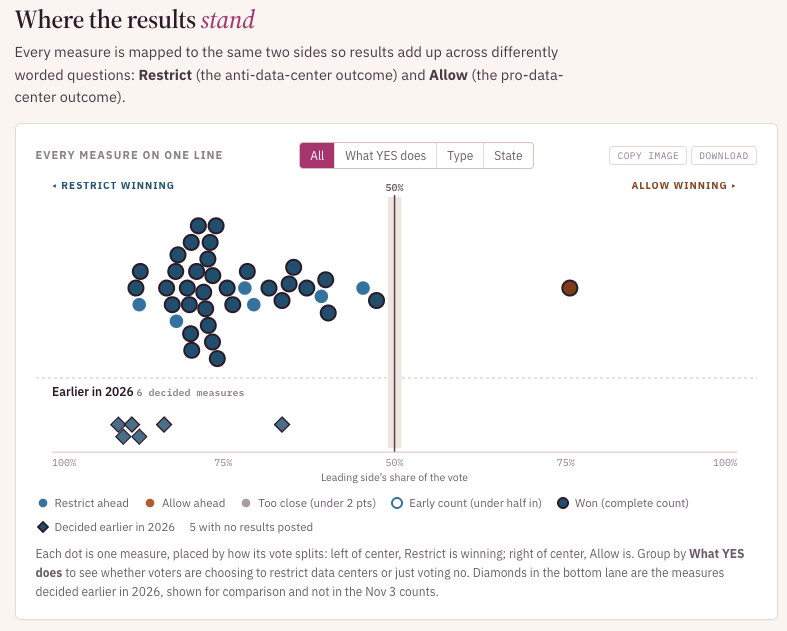
And per “Data Centers on the Ballot,” nearly every local measure that would restrict the development of these token factories is poised to prevail.
The best explanation for the price action — a reversal from sharp losses to roughly flat for Nasdaq futures — is that the “everything is priced in” meme had a child with the argument that “the midterms will be a clearing event.” The VIX Index is down 2.45 points as of 7:45 a.m. ET, which would be its biggest one-day drop since late July when the selling of AI momentum stocks ceased.
It’s an alarming sign when stocks fail to rally on “good” news, like strong quarterly results or guidance. That implies that the “real” bar was higher, or that there was no one left to buy.
By the same token (pun intended), it’s encouraging when stocks fail to stay down despite a supposed fundamental hit. Remember, we’ve been in the midst of some massive deleveraging in stocks as the AI trade came under acute pressure while the stories used to fit the price action failed to have much internal consistency.
So the turnabout in Nasdaq 100 futures could be perceived as a signal that at least a portion of the weakness in tech stocks ahead of the midterms was a function of fears regarding how negative the operating environment would be for AI thereafter.
Sweepier narratives will wax and wane as a lagged function of stock prices.
Perhaps Hinojosa’s harder line on data centers compared to Abbott won’t end up being that hard in practice. Campaigning and governing are different! And to begin with, Hinojosa’s stance wasn’t “blanket ban on data centers in perpetuity” or anything near so black-and-white.

There’s also a way to spin constraints on data center development as a positive for markets at the index level. TBPN’s John Coogan mused that the tech community might be playing 4D chess and would welcome curbs on data center development.
And Skanda Amarnath of Employ America’s tweet hints at the “history rhymes, if not repeats” of it all:
The Texas Railroad Commission was the OG OPEC, setting production limits on crude due to the state’s dominant market position. Well, data is the new oil, and the authorities in Texas now find themselves playing a key role in determining how fast and how many gigawatts of new data centers are constructed.

Yesterday, I caught up with a friend who ran the New York City Marathon on the weekend with her husband. She told me he went out a little too fast and then struggled in the back half of the race.
He probably would have had a better overall time if he had started slower!
Similarly, maybe hyperscalers would be better off with tempered capex ambitions and less cash burn. It’s probably a higher-Sharpe path, especially if all face similar constraints and none can be perceived as “falling behind” rivals.
What are markets struggling with the most? The sheer scale of external financing. What do companies need less of if data center construction becomes more difficult? External financing!
The simultaneous need for capital and uncertainty about the ROI for these projects has made projecting profit growth in two to three years a riskier proposition, both for major capex spenders and their beneficiaries. A longer runway to “prove” (and improve) unit economics would push hyperscalers into treating AI as more of a marathon and less of a sprint. Giving supply time to catch up with demand across key components (like memory) could also improve the efficiency of these investments over time.
But despite the cheery market mood this morning, I would not be so naive to spin even the most glass-half-full interpretations of what these results mean for markets as a clear and simple positive for the AI trade. Even if politicians help save hyperscalers from themselves, that raises thorny questions for other parts of the ecosystem, such as…
If the political climate forces a more measured pace of data center construction, doesn’t that imply slower sales growth for chip companies and other AI infrastructure players?
What happens if a shift to “responsible development” of data centers dents the revenue outlook for companies that have borrowed to fund expansion plans, and were relying on timely construction to satisfy those obligations?
Shouldn’t we be most worried that any downward revision to aggregate capex necessitates a downward revision to systemwide profit projections as well?
Of course it’s still early, and we could be in for our third round of price and narrative whiplash in a 12-hour span. Nasdaq futures are well off their highs!
But here are two easy (if not actionable) predictions more likely to stand the test of time: expect tech CEOs to be talking more about the risk of the US “losing” the AI race to China (in a bid to create a common enemy and duck scrutiny), and also to hear more about data centers in space.
unTrump trade
One individual is suffering the most from the political changing of the guard in the US.
Elon Musk — GOP donor, former Trump administration official, and CEO of two trillion-dollar companies headquartered in the Lone Star State — has seen both SpaceX and Tesla crater overnight and this morning.
One interpretation may be that if you’re part of a Trump trade, you can also be part of an unTrump trade.
The second is that…changes in the political climate in Texas and data center development actually matter fundamentally for these companies! These stocks typically trade on vibes based on hopes about what they may do in the future more than what they’re accomplishing in the here and now, but the ability to realize those dreams might be set to encounter some fresh operational challenges and/or loss of benefits.
Whispers from Wall Street
Tom McClellan of the McClellan Market Report wrote this before the polls closed on Tuesday.
His key message — we have more information, but less knowledge — really resonated with me, and offered a timely reminder of how critical it is for an investor to be able to filter information well:
“In most mid-term election years, Wall Street concludes that it has figured out how the election is going to go, and so stock prices make their bottom well ahead of the actual election. By this point in November, the market is usually headed higher already.
The difference this year is that the plethora of polling firms have turned out to be offering either junk data or outright fraudulent numbers. And the betting markets are the new substitute, but we don’t know how reliable they are going to be. There is even talk of some campaigns using money to influence the betting markets to make their candidate’s chances look better.
The result is greater confusion despite more information, and we are seeing that in the stock market acting hesitant.”
Seen on Socials
Via @bespokeinvest on X: