Markets
Families at the fair on a swing ride
Chairoplane at the Beer Fest in Munich (Getty Images)

Stocks that have gone up keep going up, as momentum rolls higher and value stocks get crushed

What goes up, must go... up? Go-go stocks are having a September to remember — but momentum reversals can be sharp and sudden.

Of all the potential reasons to form an investment idea, none is simpler than the core tenet behind momentum: stocks that have gone up tend to keep going up.

It is, perhaps, the most beautiful of all investing strategies. Beloved by everyday retail traders and some of the most complicated quantitative investing firms on the planet — the type that only employ physics Ph.D.s — momentum was an intuitive idea that became a statistical curiosity when the phenomenon was first posited in academic literature in the 1990s, and it’s been blowing up portfolios, and making others rich, ever since.

And it is having an incredible year so far.

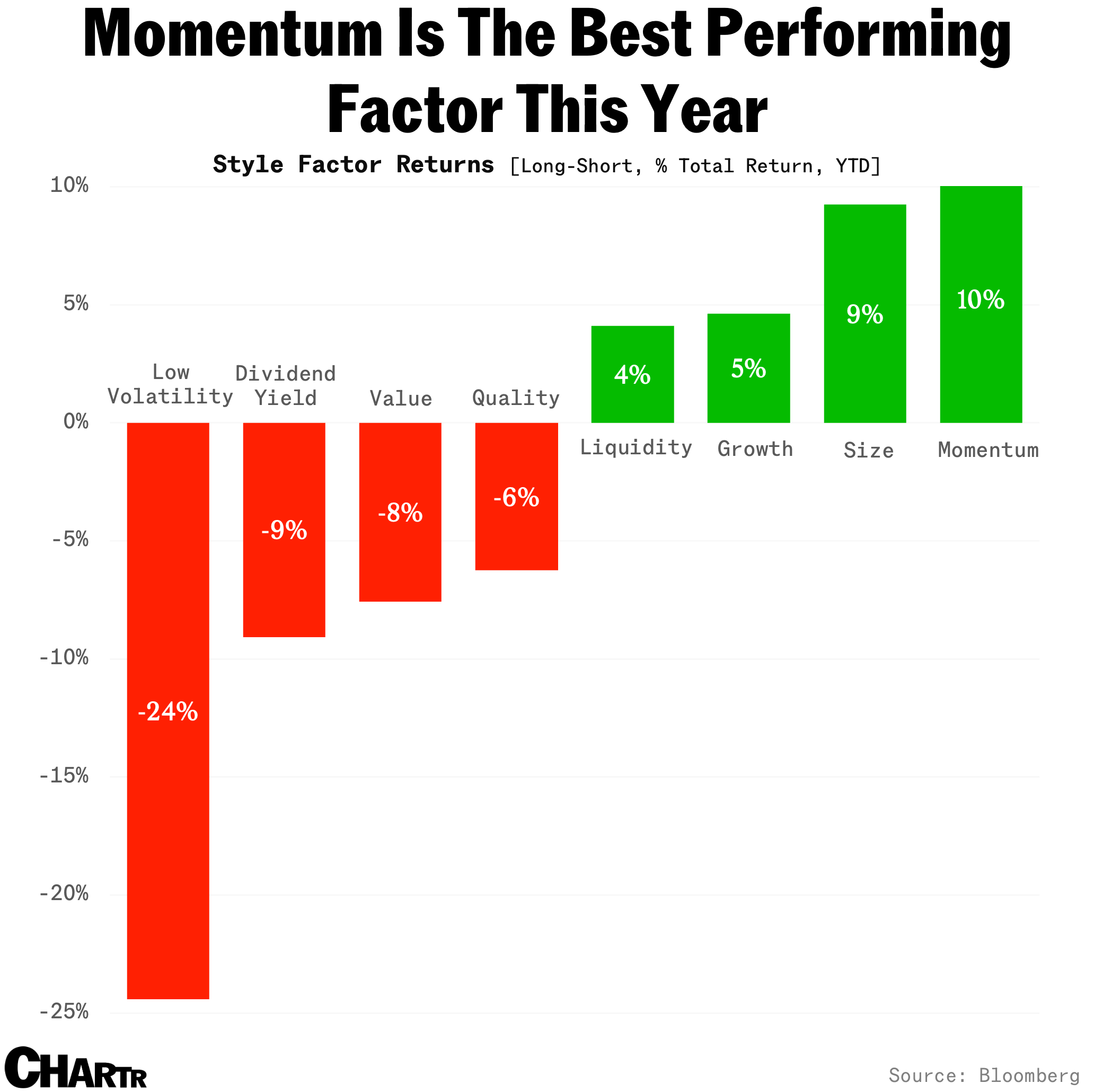
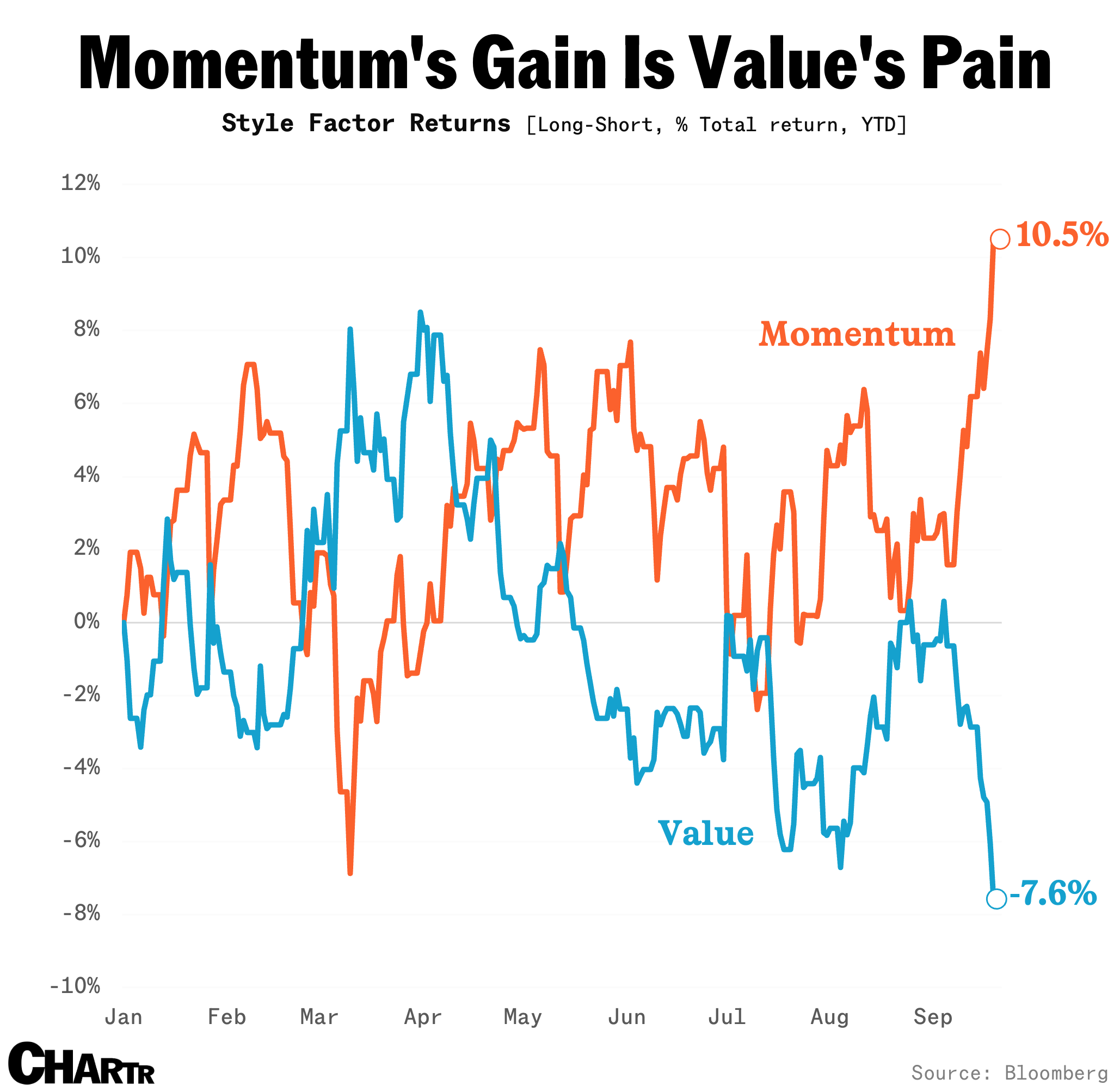
Per data from Bloomberg’s PORT MAC3 model, which tracks a swath of factors and risk premia, a long-short portfolio of US high-momentum stocks — effectively “buying” the stocks that have already gone up a lot*, while simultaneously betting against the ones that have been weaker — has gained 10.5% this year. That’s the most of any of the traditional style factors.
Momentum is crushing value
Sherwood News

Though epitomized by highfliers like Palantir and Robinhood Markets, this isn’t a trend being driven by just a few stocks; the portfolio has over 300 names in the long leg and 300 names in the short leg.

(Robinhood Markets Inc. is the parent company of Sherwood Media, an independently operated media company.)

And many of those stocks have had an incredible few weeks — much to the delight of retail traders, with Sherwood News’ Luke Kawa noting on Friday that their favorite stocks are on a record 10-day winning streak.

In fact, having gained 8% in September so far, momentum is on track for its best month of gains since March 2020.

But if speculative stocks are in, it’s no surprise that boring, stable stocks are out. Indeed, “low volatility” names have been hammered this year. Even the long-favored investing style of icons like Warren Buffett and Benjamin Graham has been under pressure recently, as beaten-down, cheaper stocks have lagged sharply in September as value and momentum remain sharply negatively correlated.
Momentum is crushing value
Sherwood News

At some point, those stocks will get too cheap to ignore, but right now, they’re gathering dust while the momentum carousel continues.

*The momentum definition being used here is 12-month minus one-month returns.

More Markets

See all Markets
markets

‘Golden age of profit margins’ seen in 2026

Wall Street tends to be a pretty optimistic place. But on one measure, market watchers are the most optimistic on record.

FactSet data shows the consensus estimate for S&P 500 net profit margins in calendar year 2026 calls for the gauge to climb to 13.9% in 2026.

But if borne out by events next year “it will mark the highest (annual) net profit margin reported by the index since FactSet began tracking this metric in 2008,” wrote John Butters, senior earnings analyst at the financial data company.

A recent story from Barron’s also commented on the expectations for especially fat profit margins embedded into forecasts for next year.

“We are in the golden age of margins,” RBC’s Capital Markets’ head of US equity strategy, Lori Calvasina, told the magazine.

That’s good news for investors looking forward to next year. But the follow up question, of course, is where the growth in profitability is expected to come from. The answer, as you might have guessed, is tech. Though the precise mechanisms by which those profits land in the coffers of the giant tech firms remains something of a mystery. Barron’s doesn’t get into the details, saying “call it benefits from AI, pricing power, or whatever.”

That doesn’t exactly sound like money in the bank. But even die-hard haters of AI have to acknowledge that betting against the ability of giant tech companies to generate massive profit growth has been a bad trade for the last couple decades.

But if borne out by events next year “it will mark the highest (annual) net profit margin reported by the index since FactSet began tracking this metric in 2008,” wrote John Butters, senior earnings analyst at the financial data company.

A recent story from Barron’s also commented on the expectations for especially fat profit margins embedded into forecasts for next year.

“We are in the golden age of margins,” RBC’s Capital Markets’ head of US equity strategy, Lori Calvasina, told the magazine.

That’s good news for investors looking forward to next year. But the follow up question, of course, is where the growth in profitability is expected to come from. The answer, as you might have guessed, is tech. Though the precise mechanisms by which those profits land in the coffers of the giant tech firms remains something of a mystery. Barron’s doesn’t get into the details, saying “call it benefits from AI, pricing power, or whatever.”

That doesn’t exactly sound like money in the bank. But even die-hard haters of AI have to acknowledge that betting against the ability of giant tech companies to generate massive profit growth has been a bad trade for the last couple decades.

markets

Opendoor rises after CEO Kaz Nejatian touts an explosion in its home-buying footprint

Opendoor Technologies gained in early trading after CEO Kaz Nejatian touted an explosion in the company’s home-buying footprint.

In a message on X, the former Shopify COO posted two maps: one of which depicts a fairly limited area in which the online real estate company would buy or sell homes, and the second of which suggests that has now expanded to include the entire lower 48:

In a follow-up tweet, Nejatian attributed the gains to AI, writing, “First pic took 10 *years* of work without AI. Second pic took 10 *weeks* of work with AI.”

On his first earnings call as CEO, Nejatian said the company had adopted a “default to AI approach.”

One of his first pledges was to launch Opendoor everywhere in the lower 48.

markets

Hertz surges on bullish options activity

As millions begrudgingly make their way to the rental car counter amid the winter holidays, investors are pouring into calls and sending Hertz stock soaring.

As of 10:51 a.m. eastern, Hertz had seen 17,861 calls traded. That’s already significantly ahead of the 20-day average volume of 12,956. Hertz shares are up more than 12%.

Seemingly juicing the rally was a post on X that read “car rental companies could end up being the picks and shovels of autonomy” that was reposted by billionaire Bill Ackman, whose hedge fund is one of Hertz’s largest shareholders.

If Hertz’s price action holds, the move will mark its ninth-best trading day of 2025.

markets

POET Technologies jumps on elevated call activity

Optical communications company POET Technologies is up double digits in early trading on Monday as this potential supporting player in the AI boom gets a bid from the options market.

Just an hour after the opening bell sounded, call volumes are already running well above their five-session average for a full day.

The stock became a retail favorite in early Q4 right before many speculative trades began to retreat, with record call volumes of nearly 600,000 on October 7. The last big bump in options activity came on December 3, the session after Marvell’s acquisition of Celestial AI, a customer of POET, offered some validation for its technology as a data center solution.

Latest Stories

Sherwood Media, LLC produces fresh and unique perspectives on topical financial news and is a fully owned subsidiary of Robinhood Markets, Inc., and any views expressed here do not necessarily reflect the views of any other Robinhood affiliate, including Robinhood Markets, Inc., Robinhood Financial LLC, Robinhood Securities, LLC, Robinhood Crypto, LLC, or Robinhood Money, LLC.