

Markets
Salesman Moving Sales on Chart Up
Getty Images

How tech companies became the source – and death – of US stock market volatility

Tech stocks contain multitudes

Luke Kawa

Wall Street: “2024 is on track to have one of the highest numbers of fragility events among US tech companies since 1992.”

Also Wall Street: The behavior of the five tech megacaps atop the S&P 500 has created a “motionlessness” stock market.

These two seemingly contradictory ideas can both be right! 

Let’s tackle the first: it’s true that, on an individual level, certain tech stocks have had huge daily swings to the upside or downside.

“Salesforce and Dell experienced historic earnings-related moves last week, the latest examples of US Tech stocks exhibiting outsized jumps or price fragility,” write Bank of America analysts led by Benjamin Bowler. “In fact, such fragility shocks for Tech/US megacaps are near 30-year+ extremes today, both in terms of frequency and magnitude.”
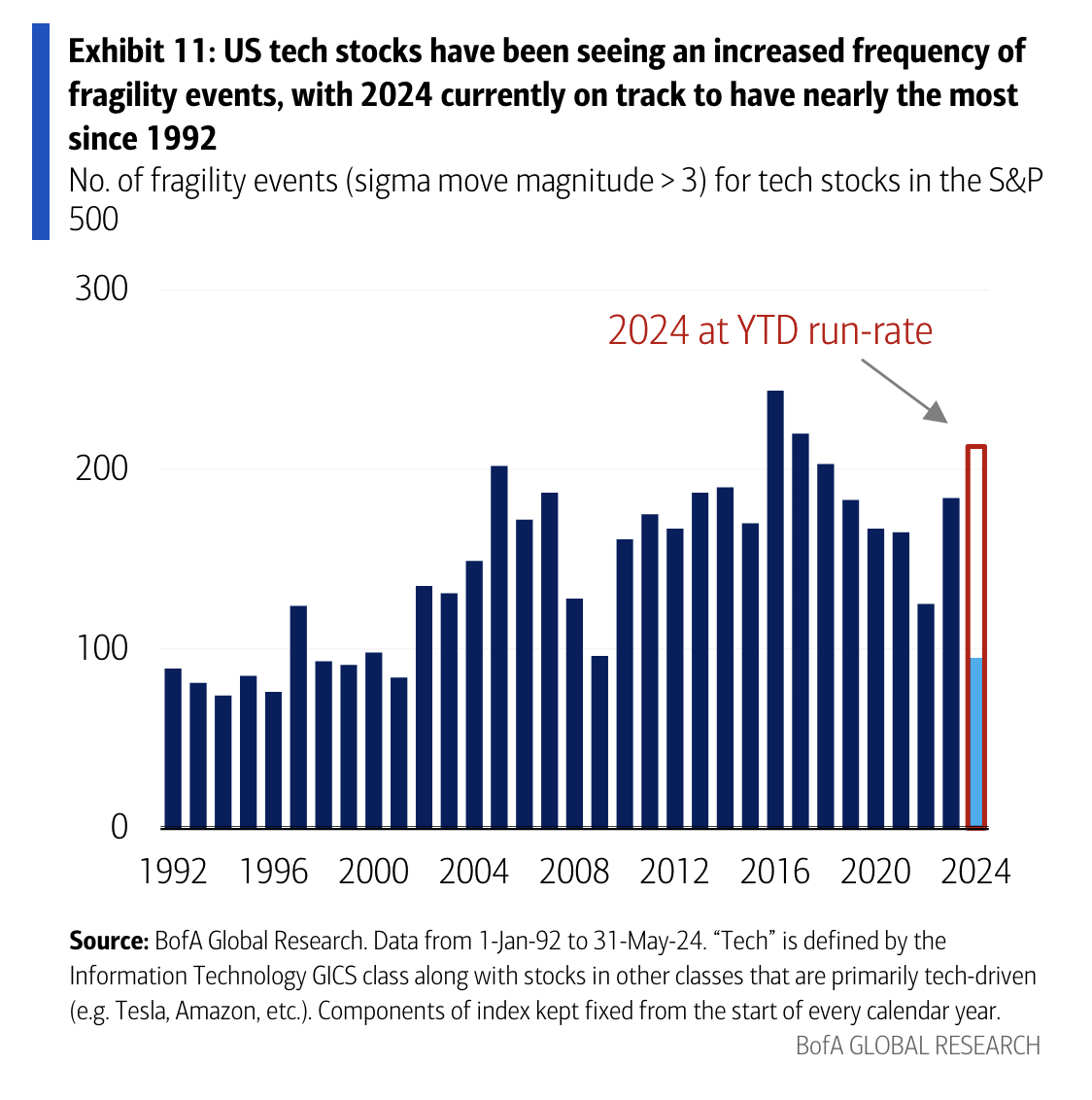
Fragility events in US tech stocks
Increasing frequency of so-called “fragility events” (BofA)

BofA deems it a so-called fragility event if a stock’s daily move is three times larger than its 21-day trailing realized volatility. In my view, this is a rather expansive definition, and periods of low volatility punctuated by hiccups can create these fragility events. Under this metric, a bump on the plains can appear more momentous than another incline on a mountain.

The analysts note that the extreme price moves this year have even been witnessed among the megacaps like Nvidia, Alphabet, and Meta. 

On the other hand, different major groups within the US stock market have been marching to the beat of their own drummers recently, and this dynamic has helped keep the stock market from lurching violently to the downside. 

Dean Curnutt, CEO of Macro Risk Advisors, takes this one step further and flags that even within technology giants, the components aren’t moving in unison.

“Stocks are zigging and zagging in a way that is unique even adjusted for a bull market,” he said on the Alpha Exchange podcast

This is true for the top five constituents: Microsoft, Apple, Nvidia, Alphabet, and Amazon. The average pairwise correlation between members of this group – loosely speaking, their tendency to move in the same direction — is just 43% over the past six months.

To be sure, it’s a little puzzling that correlations among these constituents are so low, given three of the five (Microsoft, Amazon, and Alphabet) are spending tens of billions on AI and another one of the five (Nvidia) is reaping the benefits of those outlays.

“Today’s paltry level of realized correlation among the supercaps comes at a time when the volatility of the stocks is also quite low,” Curnutt added. “The average of the six month realized volatility levels on these five corporate beasts is just 28%, again, one of the lowest readings over the last decade.”

So while BofA has been able to pick out some episodes where tech stocks — and even the heavyweights — are putting in eye-popping moves, by and large, the daily price action in these stocks has been rather mild versus history.

These low levels of realized correlation among major S&P 500 constituents are being extrapolated by market participants.

“In summary, option prices are really low because the motionlessness of indices like the S&P demands that be the case,” concludes Curnutt.

While BofA concedes that, to date, significant individual stock swings haven’t had major ramifications for the market as a whole, they think it’s just a matter of time until these massive moves in individual stocks happen in concert to the downside.

“So far, these fragility shocks have been idiosyncratic (occurring on different days), however, the risk is of a correlated shock among these companies that control so much of US as well as global equity indices,” they write. “Index vol continues to underprice this correlated shock risk, thus offering value as a fragility or broader market hedge.”

More Markets

See all Markets
markets

WSJ reports GameStop is preparing an offer for eBay and has quietly been building a stake in the company

GameStop is preparing an offer for eBay and has been quietly building a stake in the company, according to a report from The Wall Street Journal, a move it calls “part of CEO Ryan Cohen’s audacious plan to turn the trailer into a $100 billion-plus juggernaut.”

From WSJ:

GameStop, which has a market value of around $12 billion, has been quietly building a stake in eBay’s shares ahead of a potential offer, the people said. EBay is several times GameStop’s size, with a market value of around $46 billion. 

GameStop could submit an offer for eBay as soon as later this month, the people said. 

If eBay isn’t receptive, Cohen could decide to take the offer directly to eBay’s shareholders, one of the people added. Details of the potential offer for eBay couldn’t be learned. 

Shares of GameStop rose 7.4% after hours following the report, while eBay soared 12%. 

GameStop, which has a market value of around $12 billion, has been quietly building a stake in eBay’s shares ahead of a potential offer, the people said. EBay is several times GameStop’s size, with a market value of around $46 billion. 

GameStop could submit an offer for eBay as soon as later this month, the people said. 

If eBay isn’t receptive, Cohen could decide to take the offer directly to eBay’s shareholders, one of the people added. Details of the potential offer for eBay couldn’t be learned. 

Shares of GameStop rose 7.4% after hours following the report, while eBay soared 12%. 

US airlines pop on report Spirit preparing to shut down as government rescue deal fails to gain support

US airlines are spiking on Friday following a Wall Street Journal report that low-budget carrier Spirit Airlines is preparing to shut down. According to CBS News, the airline could cease operations as early as Saturday, barring an intervention.

In late April, President Trump said he would “love somebody to buy Spirit.” The administration weighed a $500 million rescue package, though it received significant blowback from members of Congress and ultimately didn’t receive support from Spirit’s creditors.

On Friday, Trump told reporters that the administration has given Spirit a “final proposal.”

Shares of Spirit’s rivals surged on the report, with budget carriers like Frontier Airlines and JetBlue climbing by double digits. The big four — Delta Air Lines, United Airlines, American Airlines, and Southwest Airlines — rose by low single digits. Alaska Air and Allegiant also saw a bump.

markets

Estée Lauder gets a glow-up after earnings beat, guidance hike

Estée Lauder shares are soaring after the beauty giant released Q3 earnings results that topped expectations and raised its full-year outlook, while also expanding its restructuring plan.

The key numbers:

  • Revenue of $3.71 billion (compared to analysts’ estimate of $3.69 billion).

  • Adjusted earnings per share of $0.91 (estimate: $0.65).

Estée Lauder also lifted its full-year earnings outlook to a range of $2.35 to $2.45 per share, up from $2.05 to $2.25 previously.

The bottom line is getting flattered by job cuts, with management increasing that target to as many as 10,000 roles, up from a prior range of 5,800 to 7,000, as part of a broader effort to streamline operations and shift toward faster-growing sales channels.

The rally comes after a tough stretch for the stock, which is down more than 20% year to date, with the results inspiring hope that its turnaround efforts will bear fruit.

CEO Stéphane de La Faverie said fiscal 2026 is “promising to be the pivotal year we intended,” with the company expecting to restore organic sales growth and expand margins for the first time in four years.

Amid these positive signals, Estée Lauder flagged risks from tariffs, geopolitical tensions, and potential disruptions tied to the Middle East.

Latest Stories

Sherwood Media, LLC produces fresh and unique perspectives on topical financial news and is a fully owned subsidiary of Robinhood Markets, Inc., and any views expressed here do not necessarily reflect the views of any other Robinhood affiliate, including Robinhood Markets, Inc., Robinhood Financial LLC, Robinhood Securities, LLC, Robinhood Crypto, LLC, Robinhood Derivatives, LLC, or Robinhood Money, LLC. Futures and event contracts are offered through Robinhood Derivatives, LLC.

