
Tech
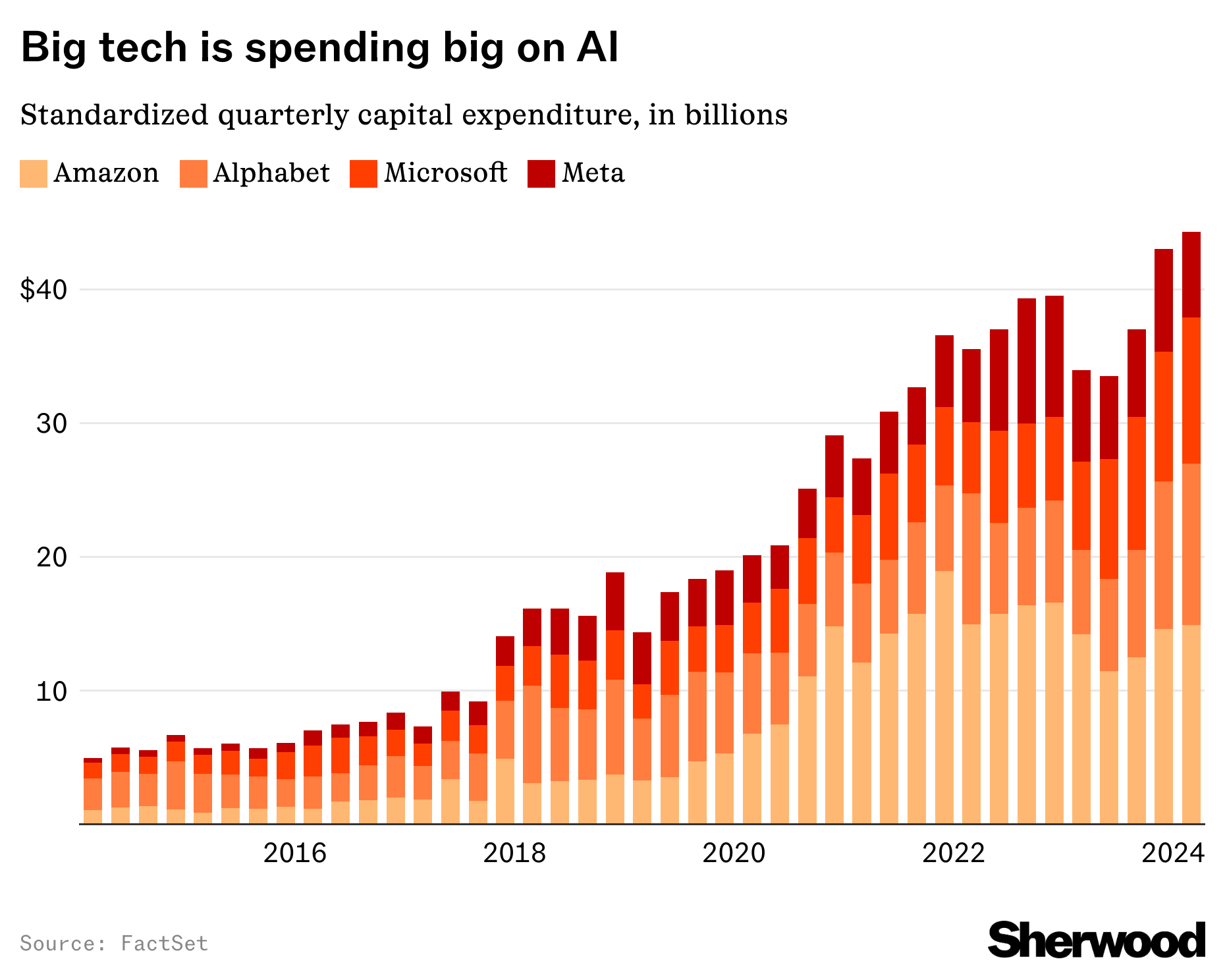
Big tech capex
Capital expenditures at Amazon, Alphabet, Microsoft and Meta grew to more than $44B last quarter.

Tech companies had a record-breaking $44B spending spree thanks to AI

And they plan on spending even more

Big tech is spending big on AI. Last quarter the combined capital expenditure for Amazon, Alphabet, Microsoft, and Meta was a record more than $44 billion, according to standardized data from FactSet.

And listening to the companies’ forward-looking statements on their latest earnings calls, that spending is heading even higher:

Amazon CEO Andy Jassy: “We expect the combination of AWS's reaccelerating growth and high demand for gen AI to meaningfully increase year over year capital expenditures in 2024, which given the way the AWS business model works, is a positive sign of the future growth. The more demand AWS has, the more we have to procure new data centers power and hardware.”

Alphabet CEO Sundar Pichai: “We are committed to making the investments required to keep us at the leading edge in technical infrastructure. You can see that from the increases in our capital expenditures. This will fuel growth in Cloud, help us push the frontiers of AI models, and enable innovation across our services, especially in Search.”

“Microsoft CFO Amy Hood: “We expect capital expenditures to increase materially on a sequential basis driven by cloud and AI infrastructure investments.”

Meta CEO Mark Zuckerberg: “As we're scaling capex and energy expenses for AI, we'll continue focusing on operating the rest of our company efficiently. But realistically, even with shifting many of our existing resources to focus on AI, we'll still grow our investment envelope meaningfully before we make much revenue from some of these new products.”

Generally, the market seems to approve, but that’s also because these companies are raking in gobs of money, even if they’re spending more than usual. The one exception seems to be for Meta, where it’s not quite clear how much of the growing spending will go toward AI (investors like!) or the Metaverse (investors hate!), and how long it will take for these bets to drive revenue.


More Tech

See all Tech
tech

Meta to lay off 8,000 employees, move 7,000 to new initiatives related to AI

On Wednesday, Reuters reported Meta plans to lay off about 8,000 employees in three batches and move another 7,000 employees to “new initiatives related to AI workflows.” The company also plans to “eliminate managerial roles,” though Reuters did not specify how many.

Reuters had previously reported the number and date of the layoffs, but details of the restructuring come from a new internal document from the company’s head of human resources. The cuts come as Meta tries to balance its enormous capex budget of $125 billion to $145 billion this year, as it builds out its AI infrastructure.

As of the company’s last earnings report, its headcount was 77,986.

Reuters had previously reported the number and date of the layoffs, but details of the restructuring come from a new internal document from the company’s head of human resources. The cuts come as Meta tries to balance its enormous capex budget of $125 billion to $145 billion this year, as it builds out its AI infrastructure.

As of the company’s last earnings report, its headcount was 77,986.

tech

Google employees are now competing with Anthropic and Meta for access to Google compute

Google built its reputation as a paradise for ambitious researchers: a place where smart people got massive resources and freedom to experiment.

But in the AI era, the physical infrastructure that powers those breakthroughs is maxed out, and even Google’s own employees are reportedly struggling to get enough computing power.

According to Bloomberg, the bottleneck comes down to hardware. Google’s custom-built AI chips — tensor processing units, or TPUs — are in such high demand that internal researchers say they’re effectively competing for rack space against massive, paying cloud customers like Anthropic and Meta. Frustrated by the bureaucracy of fighting for server time, top engineers are jumping ship to launch their own startups, arguing they can secure more reliable access to infrastructure on the open market than inside the company that actually builds it.

In other words: Google became so successful at selling AI infrastructure that its own researchers now have to justify experimental projects against revenue-generating workloads and a more than $460 billion backlog of paying tenants.

According to Bloomberg, the bottleneck comes down to hardware. Google’s custom-built AI chips — tensor processing units, or TPUs — are in such high demand that internal researchers say they’re effectively competing for rack space against massive, paying cloud customers like Anthropic and Meta. Frustrated by the bureaucracy of fighting for server time, top engineers are jumping ship to launch their own startups, arguing they can secure more reliable access to infrastructure on the open market than inside the company that actually builds it.

In other words: Google became so successful at selling AI infrastructure that its own researchers now have to justify experimental projects against revenue-generating workloads and a more than $460 billion backlog of paying tenants.

$420

Elon Musk once promised to take Tesla private at $420. More recently, he’s been offering xAI employees $420 to hand over their private tax returns as training data for Grok, Bloomberg reports, citing internal chats. In an effort to boost the chatbot’s tax-prep capabilities, the company asked employees — as well as friends and family — to submit completed tax returns in exchange for cash that, two months later, still hasn’t materialized. xAI is owned by the soon-to-be-public SpaceX.

tech

EY retracts report with apparent AI hallucinations

Consulting firm EY has retracted a report on travel loyalty points that an AI watchdog had found was full of hallucinations.

AI-detection firm GPTZero alleged that the report was “riddled with hallucinations,” including citing numerous sources that didn’t appear to exist. Sherwood News exclusively reported on GPTZero’s findings about the report on Thursday. EY didn’t respond to multiple requests for comment.

The firm later told the Financial Times that it had retracted the report, saying it was “reviewing the circumstances that led to this article’s publication.” It said the study wasn’t connected to work for any of its clients. 

“EY Canada takes the accuracy of all the content we publish seriously and we have an organization-wide commitment to the responsible use of AI,” EY said, according to the FT.

A link to the report on EY’s site now displays an error: “Oops! We couldn’t find the page you were looking for.” 

The firm later told the Financial Times that it had retracted the report, saying it was “reviewing the circumstances that led to this article’s publication.” It said the study wasn’t connected to work for any of its clients. 

“EY Canada takes the accuracy of all the content we publish seriously and we have an organization-wide commitment to the responsible use of AI,” EY said, according to the FT.

A link to the report on EY’s site now displays an error: “Oops! We couldn’t find the page you were looking for.” 

tech

Elon Musk expects Tesla Robotaxis to be “widespread” in the US by the end of the year

After an uncharacteristically clear-eyed earnings call where Elon Musk was cautious about the timing of the company’s many ambitious goals, the Tesla CEO is back to making his usual unlikely predictions:

“We already have some vehicles operating with no people inside and no safety monitors in three cities in Texas, and it probably will be widespread in the US by the end of this year,” Musk said by video at the Smart Mobility Summit in Tel Aviv on Monday. It’s a prediction Musk has made before, but that doesn’t mean it’s going to happen.

Tesla’s expansion of its Robotaxi service, which launched nearly a year ago, has been painstakingly slow. The vast majority of the Robotaxis — more than 500 in the Bay Area — have a person behind the wheel using a version of Supervised Full Self-Driving. In Austin, 12 of the 40 Robotaxis have been spotted driving unsupervised in the last week, according to Robotaxi Tracker. There are two more each in Dallas and Houston. Alphabet’s Waymo, by comparison, is already operating more than 3,000 of its driverless vehicles in cities across the country.

“Initially, were taking a very cautious approach to the rollout here,” Musk had said on the last earnings call, estimating the service would be in a dozen states by the end of the year. Today he was more bullish, estimating that in 5 or 10 years, “90% of all distance driven will be driven by the AI in a self-driving car.”

Latest Stories

Sherwood Media, LLC and Chartr Limited produce fresh and unique perspectives on topical financial news and are fully owned subsidiaries of Robinhood Markets, Inc., and any views expressed here do not necessarily reflect the views of any other Robinhood affiliate, including Robinhood Markets, Inc., Robinhood Financial LLC, Robinhood Securities, LLC, Robinhood Crypto, LLC, Robinhood Money, LLC, Robinhood U.K. Ltd, Robinhood Derivatives, LLC, Robinhood Gold, LLC, Robinhood Asset Management, LLC, Robinhood Credit, Inc., Robinhood Ventures DE, LLC and, where applicable, its managed investment vehicles.
