
Markets
Tesla, cybertruck, truck, parked, car dealership, Boston, EV car, snow, car sales, transportation, modern, silver, logo, five objects, winter, night
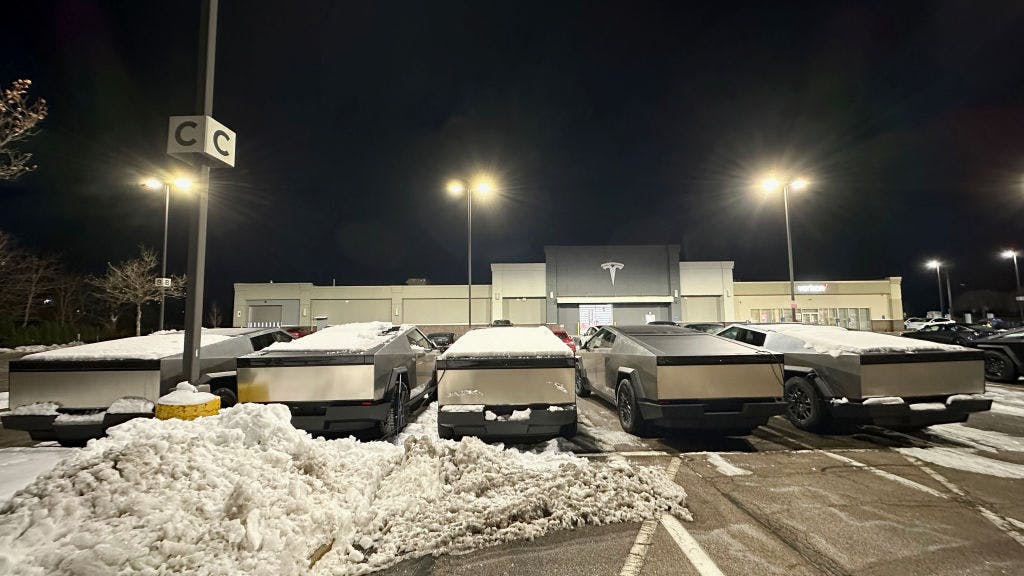
Cybertrucks in Boston (Lindsey Nicholson/Getty Images)

Tesla’s stock looks like a rocket even if its business looks like... Volkswagen?

Sales go down, but the shares go wayyyyy up.

Luke Kawa

Selling more electrified vehicles than you did in 2023 was no guarantee of stock-market success for automakers in 2024. But there was one sure route to a lower share price: seeing annual EV sales shrink. Unless, of course, you’re Tesla.

Figures released on January 2 showed that Elon Musk’s car company missed expectations for its fourth-quarter and full-year deliveries, leading to a severe sell-off in the stock that was quickly erased the following session. A contraction in EV sales was uncommon, looking at this nonexhaustive list of big players in the space:

Based on its operational results, Tesla looks a lot more like Volkswagen, an established legacy automaker that was an early entrant into EVs and is nonetheless having its lunch eaten in the face of Chinese competition.

And yet Tesla’s 2024 stock-price performance outdid every member of this group outside Geely Automobile Holdings.

Of course, just seeing top-line EV volumes grow is no panacea for an automaker. American car companies like General Motors and Ford are still heavily reliant on ICE vehicle sales. And major Chinese automakers tend to have lower profit margins than their American peers — or, in the case of Nio, XPeng’s, and GAC, they’re still outright losing money.

But this massive divergence between the core business and its stock-market performance reinforces how much of Tesla’s market value is tied to high-margin business lines it might be a leader in at some point in the future as well as its head honcho’s relationship with the incoming US president, rather than the state of its EV sales.

More Markets

See all Markets
markets

Ford raises its full-year guidance, receives $1.3 billion tariff refund

Ford reported its first-quarter results after markets closed on Wednesday. The automaker’s shares climbed roughly 7% in after-hours trading on the news.

For Q1, Ford reported:

  • Adjusted earnings of $0.66 per share, compared to the $0.18 per share expected by Wall Street analysts polled by FactSet. The figure includes Ford’s tariff reimbursement.

  • $43.25 in total revenue, vs. the $42.66 billion consensus. Automotive revenue came in at $39.8 billion, compared to estimates of $38.9 billion.

  • A $1.3 billion tariff refund.

Ford boosted its full-year guidance for adjusted earnings before interest and taxes to between $8.5 billion and $10.5 billion, up from between $8 billion to $10 billion.

Late last year, Ford announced it would take $19.5 billion in charges — one of the largest write-downs ever — relating mostly to its EV business. $7 billion of those charges will be spread across this year and next, the company said.

Earlier this month, Ford recorded an 8.8% drop in Q1 sales from the same period last year, a similar result to Detroit rival GM, which posted a 9.7% sales drop.

markets

Microsoft beats on revenue and earnings in Q3

Microsoft reported strong Q3 earnings after the bell Wednesday, posting ​​sales of $82.9 billion for the quarter, beating FactSet analyst estimates of $81.4 billion. Earnings per share were $4.27 handily beating estimates of $4.05. 

Azure (and other cloud revenue) increased 40% on year.

Microsoft reported a $627 billion backlog of commercial bookings (known as RPO), growing 99%.

In the earnings release, Microsoft CEO Satya Nadella said:

“Our AI business surpassed an annual revenue run rate of $37 billion, up 123% year-over-year.”

Microsoft shares whipsawed in after-hours trading.

This is a developing story.

Latest Stories

Sherwood Media, LLC produces fresh and unique perspectives on topical financial news and is a fully owned subsidiary of Robinhood Markets, Inc., and any views expressed here do not necessarily reflect the views of any other Robinhood affiliate, including Robinhood Markets, Inc., Robinhood Financial LLC, Robinhood Securities, LLC, Robinhood Crypto, LLC, Robinhood Derivatives, LLC, or Robinhood Money, LLC. Futures and event contracts are offered through Robinhood Derivatives, LLC.

