Markets
Bear Roar
(Marcos del Mazo/Getty Images)
BEAR NECESSITIES

The insanity over the Starbucks “Bearista” cups tells you everything you need to know about the US economy and markets

Upper-income consumers and megacap tech companies are both a) doing well and b) supply constrained.

Luke Kawa

The lack of bear cups is almost too much to bear.

A $30 ursine coffee cup offered by Starbucks seems to be too popular. Customers are literally fighting to get their hands on one, and the company has already apologized for not having enough supplies to go around.

We can probably safely infer that anyone willing to spend $30 on an admittedly very adorable bear cup probably isn’t pinching pennies to make ends meet. A bear cup is a bear necessity, but not a bare necessity. I have a deep envy of anyone for whom access to a bear cup is what inspired you to make your William Wallace-esque last stand.

Starbucks customers are generally more affluent than average. That means they’re part of a cohort that Bank of America has recently flagged as enjoying better pay growth than lower-income Americans, and, accordingly, showing more robust growth in spending.

Turning to financial markets...

Nvidia’s doing well! CEO Jensen Huang recently boasted of more than $500 billion in orders for its flagship chips through 2026.

Microsoft’s doing well, too! Its Azure cloud business is on fire and has a massive backlog.

But the thinking is that they could be doing even better if not for pesky supply constraints, which in this case do relate to something that is a bare necessity: power.

The most charitable interpretation of Jensen Huang’s remarks this week on how tight the AI race is between the US and China is that the CEO is trying to hold the government’s feet to the fire on the urgency of boosting energy supplies to meet the power demands of the AI boom.

For his part, Microsoft CEO Satya Nadella recently said his biggest problem right now is “not a supply issue of chips; it’s actually the fact that I don’t have warm shelves to plug into.”

The top of the heap, among households and businesses, have little to complain about but supply issues. Those supply issues are still hurting lower-income Americans, too — coffee prices are near all-time highs, and electricity prices have surged — but not in ways that seem to be bad enough to tip the aggregate “economy” in a negative way.

Lower-income earners are supply-of-income constrained, and even major US companies that fall outside the so-called Magnificent 7 cohort appear to be less well-off this year on the earnings front than analysts expected at the beginning of April, as this chart from Apollo Chief Economist Torsten Slok shows:
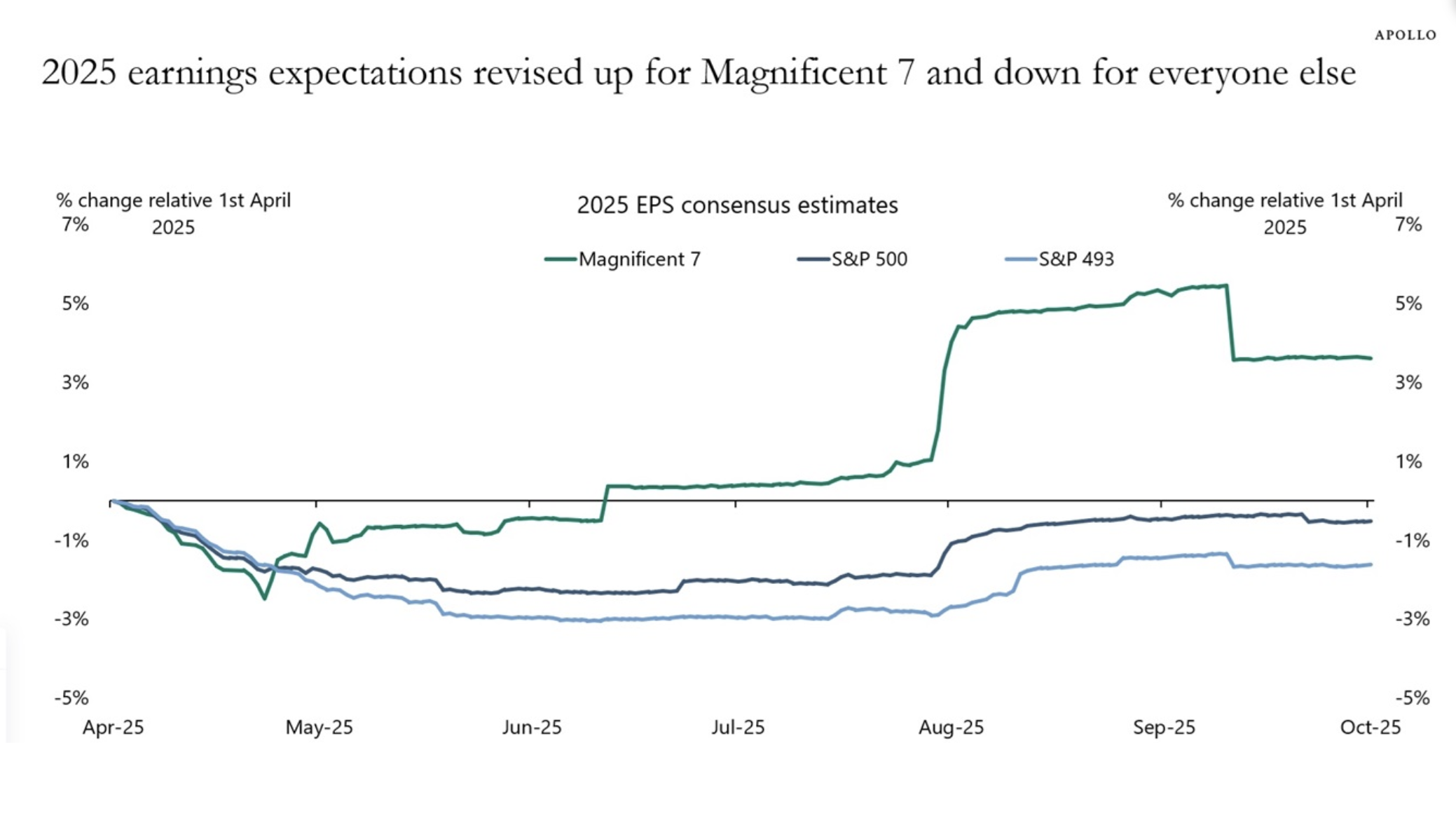
2025 EPS estimates Apollo

More Markets

See all Markets
markets

AI Infrastructure company Vertiv soars after Q4 earnings beat, 2026 outlook crushes expectations

AI infrastructure company Vertiv Holdings is spiking after posting Q4 earnings that beat estimates and sunny guidance.

For Q4, the major provider of power and cooling solutions for data centers reported:

  • Adjusted earnings per share of $1.36 vs. $1.29 consensus expectation from analysts surveyed by Factset.

  • Sales of $2.88 billion, in line with estimates.

For Q1, management said adjusted earnings would come in between $0.95 and $1.01; even the lower end of that range is higher than the $0.93 consensus estimate. Q1 guidance for net sales of $2.5 billion to $2.7 billion also outstripped Wall Street’s call for $2.54 billion.

For the full year, the lower end of Vertiv’s range of guidance for net sales ($13.25 billion to $13.75 billion) and adjusted earnings per share ($5.97 to $6.07) were both above the highest estimates from analysts polled by Bloomberg.

Vertiv has to be one of the more successful examples of SPAC-era financial engineering.

The company came out of the combination of GS Acquisition Holdings Corp., a so-called blank check company, and Vertiv Holdings — then owned by private equity company Platinum Equity — as part of a roughly $1.9 billion deal, including debt, first announced in late 2019.

The stock pretty much went nowhere for years after it listed as Vertiv on Feb. 10, 2020. But as the AI datacenter boom began to roll, the shares exploded. Since the end of 2022, they’re up more than 1,300% and Vertiv has created roughly $70 billion in market value.

Ford Rouge Complex In Michigan

Ford beats revenue estimates in Q4, with weaker-than-expected earnings

The Detroit automaker released its fourth-quarter and full-year results after the bell on Tuesday.

markets

Robinhood Q4 revenue misses estimates, but earnings beat

Robinhood Markets posted fourth-quarter revenue that fell short of analysts’ estimates, but earnings topped Wall Street’s forecasts.

(Robinhood Markets Inc. is the parent company of Sherwood Media, an independently operated media company subject to certain legal and regulatory restrictions. I own Robinhood stock as part of my compensation.)

The stock, crypto, and options trading platform reported:

  • Q4 earnings per share of $0.66 vs. analysts’ consensus estimate of $0.63, according to FactSet.

  • Sales of $1.28 billion vs. expectations of $1.35 billion.

  • Transaction-based revenue of $776 million vs. expectations of $797.6 million. 

Shares of the company were down 5.4% shortly after the report.

Robinhood shares notched gains of 193% and 204% in 2024 and 2025, respectively, though they’ve recently given up some of those gains amid volatility in the crypto markets.

Latest Stories

Sherwood Media, LLC produces fresh and unique perspectives on topical financial news and is a fully owned subsidiary of Robinhood Markets, Inc., and any views expressed here do not necessarily reflect the views of any other Robinhood affiliate, including Robinhood Markets, Inc., Robinhood Financial LLC, Robinhood Securities, LLC, Robinhood Crypto, LLC, or Robinhood Money, LLC.