Markets
Novo Nordisk share price chart
Sherwood News

What’s eating Novo Nordisk?

The Ozempic maker’s market cap has more than halved since this time last year.

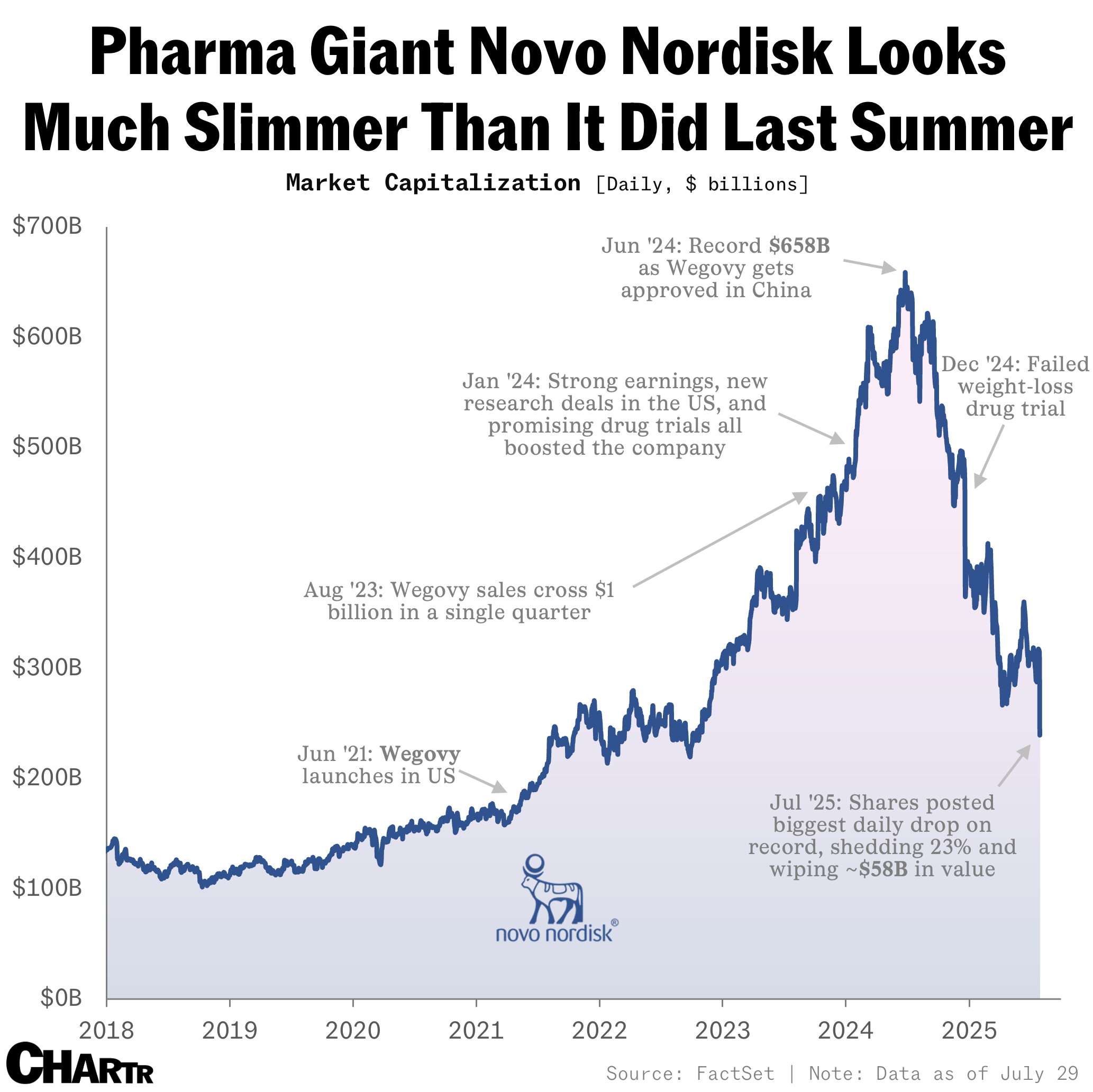
Last July, Novo Nordisk, the drugmaker that brought us Ozempic and Wegovy, was sitting pretty as Europe’s most valuable company — and, with a margin of more than $200 billion between it and storied luxury house LVMH, it wasn’t even really close. A lot can change in a year.

Weighed down

Since peaking just shy of $660 billion last summer, Novo has been shedding market cap almost nonstop. Yesterday, shares ended up posting their steepest single-day drop in the Danish behemoth’s history, sliding 23% after the company slashed its sales and profit outlook for the year ahead. Now, Novo’s new CEO, a veteran insider who was announced with the slimmed-down outlook yesterday, will have his work cut out to stop the bleeding.
Novo Nordisk share price chart
Sherwood News

If 2024 was the year that GLP-1s “took over,” Ozempic (launched in the US in 2017) was very much leading the charge, having amassed enough cultural weight to serve as the poster child for the new wave of obesity treatments.

Since then, however, offerings from Eli Lilly, as well as stiff competition from compounders like Hims & Hers and Noom, have started to muscle in on Novo’s leading Ozempic and Wegovy drugs. Notably, Lilly’s Mounjaro and Zepbound have proven to be more effective for weight loss with fewer side effects, according to reporting from the Financial Times.

Nouveau problems

Much is made of first-mover advantage in business, but Novo might just be the latest in a long list of cautionary tales — MySpace, BlackBerry, Yahoo Search, Zoom, Peloton — that proves being early isn’t always enough. With new GLP-1 effort CagriSema disappointing across trials in December and March, it’s not just Novo that’s feeling the pain; the company’s slumping sales are hurting Denmark’s national export figures, too.

Go Deeper: How the Novo Nordisk-Hims & Hers partnership epically flopped in just two months | Is Ozempic old news?


More Markets

See all Markets
markets

The neoclouds are shooting back up into the stratosphere

Investors’ faith in tech CEOs’ pursuit of digital God has seemingly been restored for now, sparking an intense rally in the speculative AI players that had been in full-on meltdown mode over concerns that the boom had passed its best-before date.

The data center companies colloquially known as the “neoclouds” — CoreWeave, Nebius, IREN, and Cipher Mining — are up more than double digits over the past two sessions, as of 10:40 a.m. ET.

The past 48 hours have brought a steady drumbeat of positive news for the AI theme.

CoreWeave received a vote of confidence from Wall Street as Citi resumed coverage with a buy rating and price target of $135. Oracle, the epicenter of AI credit concerns, has seen a reversal in its fortunes as it nears an acquisition of TikTok’s US operations. And OpenAI’s fundraising efforts appear be going so well that its reported valuation has gone up in back-to-back days.

Before that, Micron’s earnings reaffirmed the intense demand for AI compute, which continues to outstrip supply — a positive sign for the neoclouds. The macro backdrop is also turning perhaps a bit more in favor of lower interest rates, as CPI inflation came in well below expectations.

Snoop Dogg Performs At OVO Hydro Glasgow

Marijuana rescheduling could mean more investment in US weed stocks. There aren’t many ways in.

“Yes, institutional capital will go into the underlying names. The question is: How fast?" one weed company chairman said.

markets

Lyft sinks as Wedbush downgrades the stock and warns about robotaxi disruption risk

Shares of Lyft are down about 4% on Friday morning after the ride-hailer was downgraded by Wedbush to “underperform” from “neutral.” Lyft’s rival Uber also ticked down in early trading.

According to a note published Friday by Wedbush analyst Scott Devitt, the market is underestimating the negative impact that autonomous vehicles and robotaxi services will have on companies like Lyft and Uber. Devitt writes that Lyft is more at risk of these downsides than Uber due to its “exposure to the US ridesharing market and undiversified offering mix.” Along with the downgrade, Wedbush lowered its price target for Lyft to $16 from $20.

While the complex robotaxi market is still in early phases, the coming year could be a big one — and that could be rough for the ride-hailers. Per Wedbush, Alphabet’s $100 billion robotaxi biz Waymo is set to launch operations in 20 cities, and Tesla appears to be making strides.

Devitt writes: “As Waymo moves past its 'training wheels' phase of development, we expect more distribution via Waymo One and less via [third-party] integration. 2026 could prove to be a painful year for ridesharing, if true.”

markets

Nike plunges on weak guidance as China sales slide and tariffs bite

Nike fell around 10% in pre-market trading Friday after the sportswear brand issued lower-than-expected Q3 guidance, despite beating Wall Street estimates on both earnings and revenue for the latest quarter just finished (Q2).

Sales rose 1% year on year to $12.4 billion for the quarter ended November 30, beating the $12.2 billion estimate compiled by LSEG, while adjusted earnings per share of $0.53 also topped the $0.38 estimate — aided by a 9% sales increase in North America, which helped offset a 17% decline in China.

However, for the quarter starting December 1, Nike expects revenues to be "down low single digits" with only "modest growth" in North America, while weakness in China and the company’s Converse brand is expected to persist, CFO Matthew Friend said on the earnings call. The company’s gross margin is also expected to fall by around 175-225 basis points, due to higher costs tied to new tariffs, he added.

After a years-long pivot towards a more direct relationship with customers, Nike’s D2C strategy is stumbling, with a 14% drop in sales for “NIKE Brand Digital.” Its Converse brand was another sore spot, posting a 30% sales drop in Q2, following a 27% decline in Q1.

China also remains a key pressure point, with sales in the region dropping 17% year-on-year, as CEO Elliott Hill — now a little over a year into his turnaround plan — said its recovery is "not happening at the level or the pace we need to drive wider change." Still, he added that the company is now "in the middle innings" of its comeback.

With this morning's slump, Nike shares are down down roughly 23% year-to-date.

markets

Oracle soars after TikTok signs agreement to sell its US operations to consortium that includes the cloud computing giant

Oracle is up 5.5% in premarket trading on Friday following yesterday’s news that TikTok owner ByteDance signed contracts with three major investors who are leading a joint venture to take over the short-form video app’s US operations, per a widely-cited company memo from TikTok CEO Shou Zi Chew.

The trio of parties in that consortium are the cloud computing company, private equity firm Silver Lake, and MGX, a tech investment company backed by Abu Dhabi.

Per reports, the structure of the deal is roughly aligned with what was outlined in September, which valued TikTok’s US operations at about $14 billion. Relative to some less-popular peers, that seems like a pretty low price tag, so picking up doomscrolling on a discount (or if you prefer, short-term video browsing on a budget) looks to be a worthy catalyst for the bump in the beaten-down hyperscaler’s shares. And that’s even before mentioning the potential for Oracle’s cloud business to enhance its preexisting relationship with TikTok.

Latest Stories

Sherwood Media, LLC produces fresh and unique perspectives on topical financial news and is a fully owned subsidiary of Robinhood Markets, Inc., and any views expressed here do not necessarily reflect the views of any other Robinhood affiliate, including Robinhood Markets, Inc., Robinhood Financial LLC, Robinhood Securities, LLC, Robinhood Crypto, LLC, or Robinhood Money, LLC.