

Markets
markets

The world’s largest sovereign wealth fund reported a whopping $40 billion loss last quarter

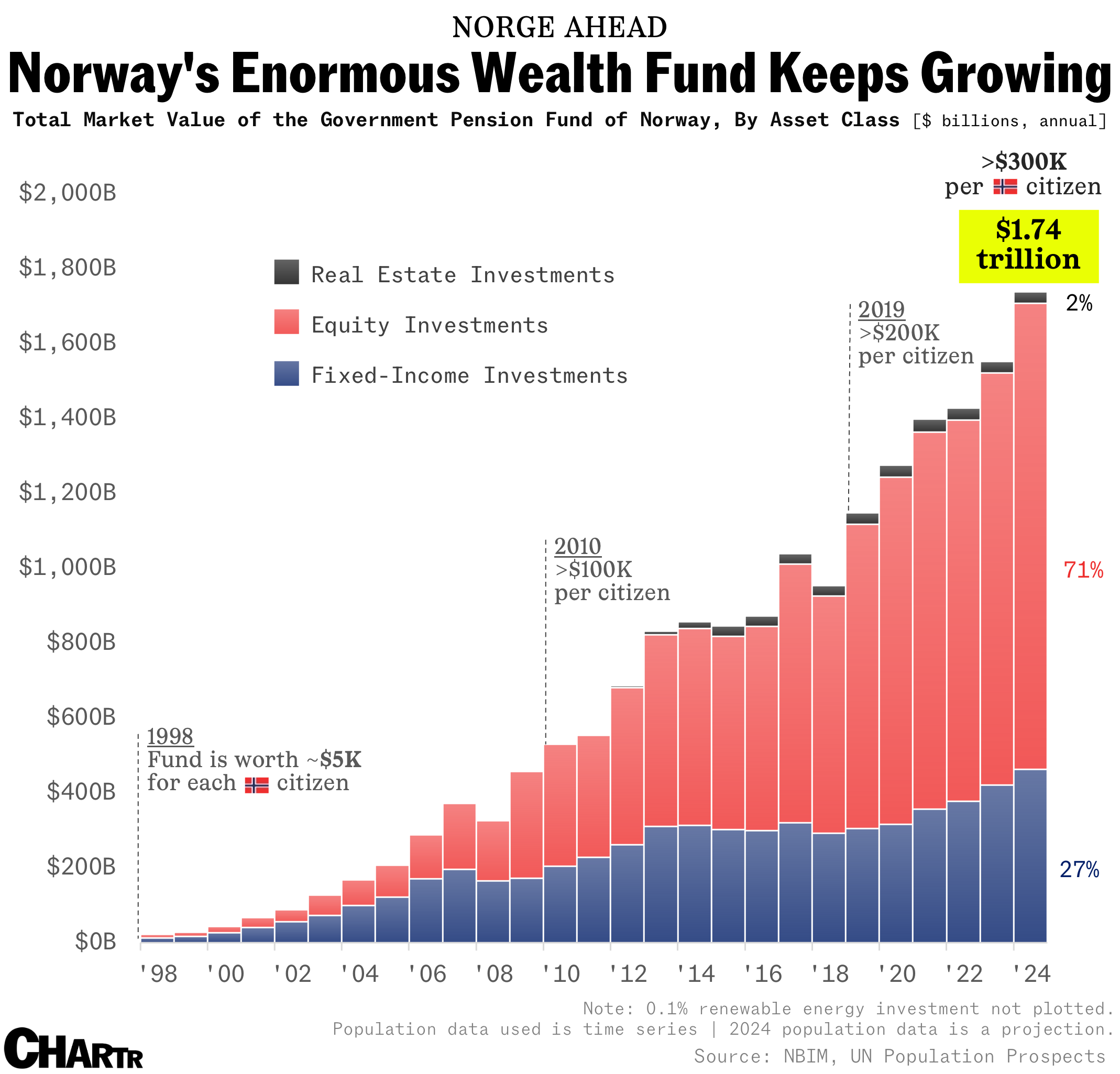
Norway’s $1.7 trillion sovereign wealth fund shed ~$40 billion, or 0.6% of its overall value, during the tumultuous first quarter of 2025, mostly owing to drops across its vast tech stock portfolio.

The quarter has been impacted by significant market fluctuation,Nicolai Tangen, CEO of Norges Bank Investment Management, the operator of the fund, shared in a statement. Our equity investments had a negative return, largely driven by the tech sector.

Because much of Norway’s wealth pot is tied to benchmark indexes, the world’s largest single investor is deep into companies like Apple, Microsoft, and Nvidia, holding about $150 billion worth of those companies combined at the end of last year. While that sort of heavy investment has kept it in good stead for years, the first quarter’s tech rout caused the value of its stock portfolio, which makes up 70% of its total assets, to sink 1.6% across Q1.
Norway fund
Sherwood News

The fund’s market losses offset gains elsewhere, with fixed-income investments (mostly government-issued bonds) up 1.6% for the quarter, while investments in unlisted real estate returned 2.4% in the same period.


The quarter has been impacted by significant market fluctuation,Nicolai Tangen, CEO of Norges Bank Investment Management, the operator of the fund, shared in a statement. Our equity investments had a negative return, largely driven by the tech sector.

Because much of Norway’s wealth pot is tied to benchmark indexes, the world’s largest single investor is deep into companies like Apple, Microsoft, and Nvidia, holding about $150 billion worth of those companies combined at the end of last year. While that sort of heavy investment has kept it in good stead for years, the first quarter’s tech rout caused the value of its stock portfolio, which makes up 70% of its total assets, to sink 1.6% across Q1.

Norway fund
Sherwood News

The fund’s market losses offset gains elsewhere, with fixed-income investments (mostly government-issued bonds) up 1.6% for the quarter, while investments in unlisted real estate returned 2.4% in the same period.

More Markets

See all Markets
markets

GM soars after Q1 earnings impress, with automaker boosting full-year guidance

Detroit automaker GM reported its first-quarter earnings before markets opened on Tuesday. Its shares climbed more than 5% in premarket trading.

For Q1, General Motors reported:

  • Adjusted earnings of $3.70 per share, compared to Wall Street estimates of $2.60 per share by analysts polled by FactSet.

  • Revenue of $43.62 billion, compared to the $43.51 billion estimates.

Looking ahead, GM raised its full-year earnings guidance to between $11.50 and $13.50. It previously forecast between $11 and $13. In its earnings deck, the automaker said the change was due in part to “lower gross tariff costs from the $0.5B IEEPA tariff adjustment.”

Earlier this month, GM reported that its Q1 sales were down 9.7% from last year, though it called year-over-year comparisons “significantly skewed” due to last year’s tariff-induced panic buying.

GM has been steadily retreating from its once-lofty EV ambitions in recent months, recording $7.6 billion in EV-related writedowns last year (the figure was far lower than Ford’s $19.5 billion).

markets

OpenAI-linked stocks suffer after WSJ reports that the company has missed key revenue and user targets

It was once a blessing to be associated with the world's hottest startup.

Supplying chips, general data center hardware, or even just announcing a tangential partnership with the ChatGPT-maker used to be enough to send a stock spiking. But those days are gone, with OpenAI once again weighing on a raft of its suppliers and partners after the Wall Street Journal reported that the company had missed a number of internal revenue and user targets, as its competition with Anthropic and others heats up.

As of 6:45 a.m. ET, CoreWeave is off 5.4%, Oracle is down 5.5%, Advanced Micro Devices and Broadcom are off roughly 4% . With billions of dollars — and in some cases tens of billions of dollars — worth of contracts with each of those companies, any sign that OpenAI is struggling to reach the escape velocity that its remarkable "spend big to win big" strategy is based on is understandably seen as a negative. Even stocks less explicitly tied to OpenAI are under pressure — the company's sheer size is enough to weigh on pretty much the entire AI ecosystem.

Per the WSJ, Sarah Friar, the company's CFO has "told other company leaders that she is worried the company might not be able to pay for future computing contracts if revenue doesn’t grow fast enough."

The goals missed reportedly include:

  • A target to hit 1 billion weekly active users by the end of 2025.

  • Its annual revenue target for ChatGPT last year.

  • Multiple monthly revenue targets this year, as Anthropic has surged ahead in the enterprise markets.

Although some investors might be spooked, for what it's worth, those missed targets haven't exactly dampened the investor enthusiasm too much; the company recently announced that it had raised $122 billion, valuing it an eye-watering $850+ billion.

It's already been a busy week for OpenAI. Yesterday, the company announced a revised agreement with Microsoft, while Sam Altman sent out a memo, in which he said that "A lot of the things that we do that look weird — buying huge amounts of compute while our revenue is relatively small..."

This morning, the markets are deciding that kind of weird is marginally more bad than it was yesterday, in light of the missed targets.

As of 6:45 a.m. ET, CoreWeave is off 5.4%, Oracle is down 5.5%, Advanced Micro Devices and Broadcom are off roughly 4% . With billions of dollars — and in some cases tens of billions of dollars — worth of contracts with each of those companies, any sign that OpenAI is struggling to reach the escape velocity that its remarkable "spend big to win big" strategy is based on is understandably seen as a negative. Even stocks less explicitly tied to OpenAI are under pressure — the company's sheer size is enough to weigh on pretty much the entire AI ecosystem.

Per the WSJ, Sarah Friar, the company's CFO has "told other company leaders that she is worried the company might not be able to pay for future computing contracts if revenue doesn’t grow fast enough."

The goals missed reportedly include:

  • A target to hit 1 billion weekly active users by the end of 2025.

  • Its annual revenue target for ChatGPT last year.

  • Multiple monthly revenue targets this year, as Anthropic has surged ahead in the enterprise markets.

Although some investors might be spooked, for what it's worth, those missed targets haven't exactly dampened the investor enthusiasm too much; the company recently announced that it had raised $122 billion, valuing it an eye-watering $850+ billion.

It's already been a busy week for OpenAI. Yesterday, the company announced a revised agreement with Microsoft, while Sam Altman sent out a memo, in which he said that "A lot of the things that we do that look weird — buying huge amounts of compute while our revenue is relatively small..."

This morning, the markets are deciding that kind of weird is marginally more bad than it was yesterday, in light of the missed targets.

markets

Memory stocks shine in messy day for markets

Micron and Sandisk shook off an otherwise “meh” tech sector performance Monday after the two memory bellwethers received an analyst initiation.

It was a “buy” on both counts from Melius Research, adding to the growing consensus view that there’s no end in sight for data center-related storage demand as the AI capital-spending boom continues.

The newly minted Sandisk watchers at Melius slapped a target price of $1,350 on the stock — a 36% premium to Friday’s close. Their target for memory chip maker Micron was $700, a 40% premium to Friday’s close.

The reason? (At this point do we even have to ask?)

Obviously it’s optimism that the parabolic surge in pricing power for memory products amid the AI boom can last.

Analyst Ben Reitzes argues that memory sellers may effectively offer “subscriptions” — aping the software business model that they’re helping to displace — in a way that protects their margins over time.

Other AI memory plays had something of a mediocre day: hard disk drive maker Seagate Technology Holdings was up, while its arch rival, Western Digital, was down. But the optimistic tone of the note was enough to send Micron and Sandisk to new record highs on an intraday basis. (Sandisk has to close above Friday’s $2,965.66 and Micron has to close above Friday’s $541.59 for the records to stick.)

Obviously, new records are an old hat for both companies. Micron and Sandisk have been on a romp for much of the past 12 months, in which they’re up a cool 550% and 3,100%, respectively.

The newly minted Sandisk watchers at Melius slapped a target price of $1,350 on the stock — a 36% premium to Friday’s close. Their target for memory chip maker Micron was $700, a 40% premium to Friday’s close.

The reason? (At this point do we even have to ask?)

Obviously it’s optimism that the parabolic surge in pricing power for memory products amid the AI boom can last.

Analyst Ben Reitzes argues that memory sellers may effectively offer “subscriptions” — aping the software business model that they’re helping to displace — in a way that protects their margins over time.

Other AI memory plays had something of a mediocre day: hard disk drive maker Seagate Technology Holdings was up, while its arch rival, Western Digital, was down. But the optimistic tone of the note was enough to send Micron and Sandisk to new record highs on an intraday basis. (Sandisk has to close above Friday’s $2,965.66 and Micron has to close above Friday’s $541.59 for the records to stick.)

Obviously, new records are an old hat for both companies. Micron and Sandisk have been on a romp for much of the past 12 months, in which they’re up a cool 550% and 3,100%, respectively.

markets

AI data center and networking stocks take a breather after parabolic run

AI infrastructure and data center stocks are swooning on Monday after an exceptionally hot run, with the likes of Applied Optoelectronics, Lumentum, Astera Labs, Coherent, Marvell Technology, Nebius, IREN, and Applied Digital all off at least 3% as of 1:08 p.m. ET.

Most of these names didn’t fall in tandem on news of the amended agreement between Microsoft and OpenAI, but rather began to sharply extend losses shortly ahead of the open (by which time the Copilot creator was already well off its lows).

So it’s tough to cite that as a catalyst for the group. If you wanted to try to pigeonhole that as a cause of the decline: Microsoft and OpenAI’s simplified relationship points to a world where AI spend is increasingly rationalized by the underlying economics, with cash-burning behemoths forced to stand on their own two feet. That may ultimately restrain what appears to be the present eye-popping demand for AI infrastructure.

On the other hand, there have been myriad signs in recent weeks of just how intense supply crunches are across networking, CPUs, and AI accelerator chips as well as elevated end user appetite, so it’s difficult to suggest this is something fundamental as opposed to the space taking a breather ahead of hyperscalers’ earnings reports on Wednesday.

The capex budgets for Meta, Amazon, Microsoft, and Google effectively serve as sales guidance for the rest of the AI ecosystem.

For some parts of the AI trade, Monday’s tape may be a reminder that parabolic moves don’t end by going sideways. For other core contributors to the 2025-26 advance, the skyward marches are still intact: Sandisk and Micron are zooming higher.

Latest Stories

Sherwood Media, LLC produces fresh and unique perspectives on topical financial news and is a fully owned subsidiary of Robinhood Markets, Inc., and any views expressed here do not necessarily reflect the views of any other Robinhood affiliate, including Robinhood Markets, Inc., Robinhood Financial LLC, Robinhood Securities, LLC, Robinhood Crypto, LLC, Robinhood Derivatives, LLC, or Robinhood Money, LLC. Futures and event contracts are offered through Robinhood Derivatives, LLC.
