
Tech
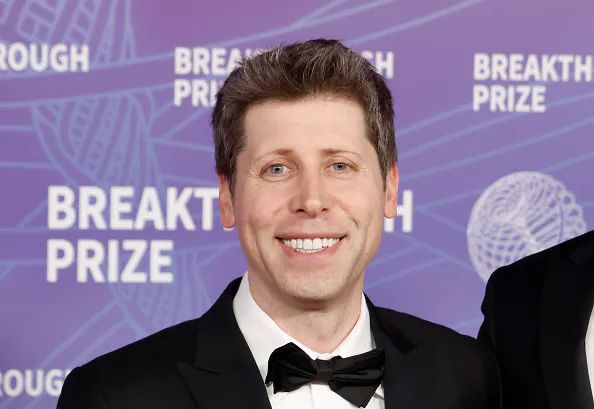
12th Breakthrough Prize Ceremony - Arrivals
(Taylor Hill/FilmMagic)

Altman: We do “weird” things like building massive data centers so there will be “universal prosperity”

OpenAI’s CEO spelled out the company’s principles for AGI in a blog post.

Fresh off a revised agreement with Microsoft that makes significant changes to the terms of the contentious $13 billion partnership between the two companies, OpenAI CEO Sam Altman offered an update on the principles that guide the company as it inches toward artificial general intelligence.

The memo lays out a familiar assortment of rosy predictions couched with dire warnings: AGI will lead to things “we’ve only let ourselves dream about in sci-fi,” but it also could lead to “catastrophic harm” and “potential corrosive societal effects.”

One interpretation of the memo could be that OpenAI is defending its choice to monetize its products with advertising. The argument is that competitors like Anthropic offer skimpy free offerings, and hide the empowering, life-changing AI tools behind paid accounts. OpenAI has emphasized its goal of democratizing AI — making AI as accessible to as many people as possible — which can only really happen if the product is supported by ads.

Altman seemed to acknowledge the public’s growing unease with the AI industry’s insatiable thirst for building larger and larger data centers around the world. This massive outlay of capital is all about “universal prosperity”:

“A lot of the things that we do that look weird — buying huge amounts of compute while our revenue is relatively small, vertically integrating to lower costs and make our technology easier to use, pushing to build datacenters all around the world, and much more — are driven by our fundamental belief in a future of universal prosperity.”

Altman said the company will have to be resilient in how it responds to new risks created by this fast-evolving technology, which will require partnering with competitors and governments to responsibly develop new tools, like how the company opted to let partners assess its advanced cybersecurity tool before wider release.

The memo also aims to give OpenAI the right to revisit these principles as the technology evolves:

“We are heading into a very impactful phase as the technology continues to improve. It’s very fair to critique us on every decision; we deserve an enormous amount of scrutiny given the weight of what we are doing. We will not get everything right, but we will learn quickly and course-correct.”


More Tech

See all Tech
tech

Microsoft loses exclusive access to OpenAI’s models and tools while ending revenue-sharing deal with ChatGPT maker

Microsoft shares dropped as it announced a revised agreement with OpenAI.

The amended agreement ends revenue-sharing payments from Microsoft to OpenAI, and also ends Microsoft’s exclusive access to OpenAI’s intellectual property (i.e. models and products).

OpenAI’s revenue sharing with Microsoft will end in 2030, is subject to a total cap, and is no longer dependent on its achieving artificial general intelligence.

Amazon, a likely beneficiary of this lack of exclusivity, initially popped on the news but erased those gains.

This is a developing story.

tech

China just blew up one of Meta’s key AI bets

China has ordered Meta to unwind its $2 billion acquisition of Manus, a Chinese startup (since relocated to Singapore) that makes AI agents and was central to Meta’s push to turn its massive AI investments into a real business. The move is part of the Chinese government’s effort to stop US firms from gaining access to Chinese talent and intellectual property, as Washington continues to restrict sales of advanced AI chips to Chinese companies.

Unlike its tech peers, which can sell AI through cloud services, Meta mainly uses AI to improve its existing ad business rather than as a stand-alone revenue driver. The decision strips away one of Meta’s clearest paths to monetizing AI — leaving it spending like a hyperscaler, without a hyperscaler business model.

Unlike its tech peers, which can sell AI through cloud services, Meta mainly uses AI to improve its existing ad business rather than as a stand-alone revenue driver. The decision strips away one of Meta’s clearest paths to monetizing AI — leaving it spending like a hyperscaler, without a hyperscaler business model.

tech
Jon Keegan

DeepSeek releases new V4 series models highlighting efficiency and long context

Chinese AI lab DeepSeek has released a major new version of its eponymous open-source AI models that are nipping at the heels of leading frontier models in some areas.

The most significant DeepSeek-V4 Pro and DeepSeek-V4 Flash both have a 1 million-token context — the amount of information the model can actively work with in a single session — which is a crucial feature for complex, long-running coding tasks.

DeepSeek rebuilt how the models process information under the hood, making them substantially more efficient — and that efficiency is what makes the large context window actually usable.

Also, the new models’ coding skills have closed the gap with the major frontier models from Anthropic, OpenAI, and Google.

The authors of the model acknowledge some of V4’s shortcomings, such as its lower scores on reasoning benchmarks, saying that V4 “trails state-of-the-art frontier models by approximately 3 to 6 months.”

As open-weight models, V4 can be run on any user’s own hardware, making the V4 models among the top-performing open-source models out there. V4’s large context and token efficiency are especially significant among open-source models.

But like with earlier DeepSeek models, don’t ask it about Tiananmen Square.

DeepSeek rebuilt how the models process information under the hood, making them substantially more efficient — and that efficiency is what makes the large context window actually usable.

Also, the new models’ coding skills have closed the gap with the major frontier models from Anthropic, OpenAI, and Google.

The authors of the model acknowledge some of V4’s shortcomings, such as its lower scores on reasoning benchmarks, saying that V4 “trails state-of-the-art frontier models by approximately 3 to 6 months.”

As open-weight models, V4 can be run on any user’s own hardware, making the V4 models among the top-performing open-source models out there. V4’s large context and token efficiency are especially significant among open-source models.

But like with earlier DeepSeek models, don’t ask it about Tiananmen Square.

$28.5T
Rani Molla

SpaceX thinks its total addressable market (TAM) is a whopping $28.5 trillion for its businesses, according to an S-1 filing for its upcoming IPO reviewed by Reuters. And most of that market isn’t rockets. The company says roughly 90% could come from AI — largely selling artificial intelligence tools to businesses.

“We believe that our enterprise strategy, which is focused on serving the digital needs of the world’s largest industries with Al solutions, positions us competitively to pursue this rapidly ⁠growing opportunity,” ​SpaceX said in the filing. “We believe we have identified the largest actionable total addressable market in human ​history.”

TAM, of course, assumes capturing every possible customer. But even a small slice of a $28.5 trillion market would be enormous.

Latest Stories

Sherwood Media, LLC produces fresh and unique perspectives on topical financial news and is a fully owned subsidiary of Robinhood Markets, Inc., and any views expressed here do not necessarily reflect the views of any other Robinhood affiliate, including Robinhood Markets, Inc., Robinhood Financial LLC, Robinhood Securities, LLC, Robinhood Crypto, LLC, Robinhood Derivatives, LLC, or Robinhood Money, LLC. Futures and event contracts are offered through Robinhood Derivatives, LLC.
