
Markets
Black sheep standing amongst flock of white sheep (Digital Composite)
Getty Images

There’s only one Wall Street analyst with a sell rating on Nvidia — what’s his thesis?

The poster child of the AI boom is nearing a $4 trillion market cap, and most Wall Street analysts still think there’s room for more upside. Except one.

As we’ve seen before, Wall Street analysts tend to move as a herd. Indeed, for all the constant bleating about contrarian thinking, many of the analysts at major banks and research houses tend to end up with the same conclusion about the megacap tech stocks they’re tasked with covering: that you should buy their stock.

Nvidia’s coverage is no exception. According to FactSet, there’s just one analyst, Jay Goldberg of Seaport Global Securities, who is going against the grain, with an active “sell” (or equivalent) rating on the name.
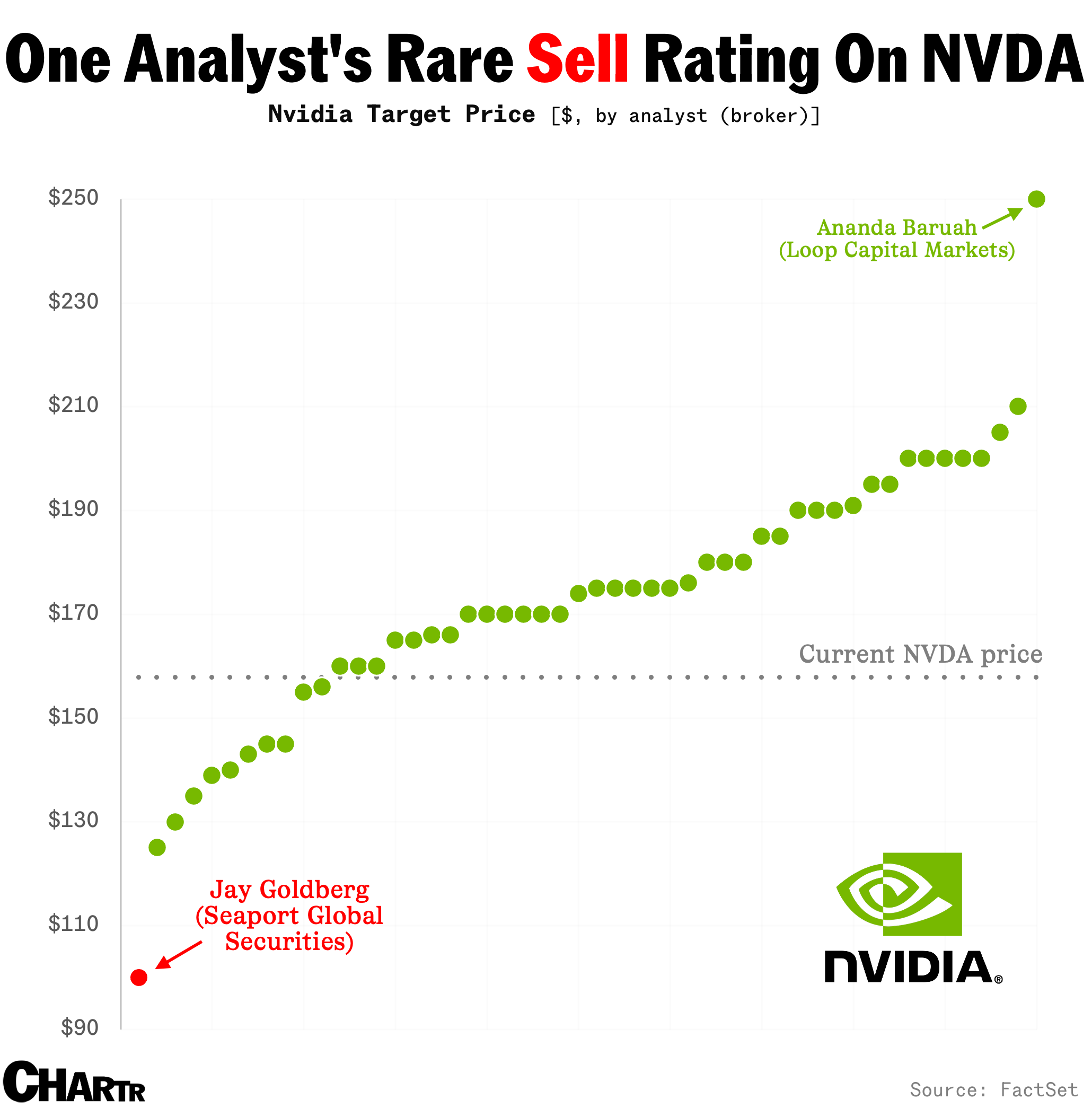
Only one analyst has a "sell" rating on Nvidia
Sherwood News

Goldberg’s $100 target price on the stock market behemoth — implying 37% downside to yesterday’s close price — is predicated on a few key pillars. In a document shared with Sherwood News, Goldberg outlined the headlines of his bearish thesis:

“Nvidia is one of the leading beneficiaries of the current AI spending boom, but its prospects are well understood and largely priced into the stock.”

According to Goldberg, there are growing questions about the actual usefulness of AI, with many of Nvidia’s customers still looking for returns from their “significant investments” in AI so far. That’s likely to mean a slowing of AI budgets in 2026.

Goldberg also wrote:

“Our research indicates significant complexity required for deployments of Nvidia systems in comparison to traditional data centers — cooling, configuration and orchestration challenges throughout the supply chain.”

On top of potential supply chain issues, he also sees a chance that Nvidia’s near monopoly position in the industry could face competition in the medium term, as the company’s top customers, like Meta, Microsoft, and Amazon build on efforts to make their own chips:

“Strong momentum behind hyperscalers’ internal Nvidia alternatives — Nvidia’s largest customers are all looking to design their own chips.”

In the nearer term, cyclical issues, including production limitations for its much sought-after Blackwell line, could raise further concerns.

Of course, there are some major “risks” to the bearish case, too. Perhaps the most important of those noted by Goldberg is that some “unforeseen advances” in AI could suddenly lead to another surge in demand. That’s a possibility that Loop Capital analysts, who have the highest price target on the street ($250), clearly think is more likely than not.

With Nvidia’s stock up more than 40% since he gave his “sell” rating in April, Goldberg hasn’t convinced enough investors to come round to his way of thinking... yet.

Related reading: 73 Wall Street analysts cover Amazon, there are 72 on Meta, and 66 write about Nvidia — how many do we need?


More Markets

See all Markets
markets

AST SpaceMobile rises after favorable commentary from BofA

Mobile-services-from-space play — and retail investor favorite — AST SpaceMobile rose after receiving a target price upgrade from Bank of America analysts.

In a note published Thursday, BofA telecom services analysts lifted their price target for the stock to $100 from $85, while noting that the low-Earth orbit satellite industry — which supercharged stocks like Rocket Lab, Planet Labs, and AST in 2025 — is set to gain more attention this year:

“We expect the momentum to intensify in 2026 as providers like ASTS and Starlink jockey to offer full cellular service and capture subscribers. Debates will likely grow regarding Starlink’s plans to offer full cellular service and regulatory decisions on Ligado and EchoStar spectrum transactions are events to watch. Carrier partnerships could evolve and pricing and plan decisions should be clearer by year end as ASTS approaches full constellation operability.”

Still, they maintained their “neutral” rating on the stock, saying they “await progress on ASTS 1) fully producing and subsequently launching its BlueBird satellite constellation, 2) successfully operating the constellation, and 3) capturing subscribers and turning them into revenue paying subscribers before becoming more constructive on the story.”

The market has been less reticent: the money-losing company’s shares are up approximately 300% over the last year.

Bulls pour into Joby and Archer options as Trump’s push for record defense budget boosts eVTOL names

Options traders appear bullish on electric aircraft makers like Archer Aviation and Joby Aviation on Thursday, with large volumes boosting the stocks following President Trump’s call for a record $1.5 trillion US military budget for 2027.

Both companies, as well as newly public rival Beta Technologies, have sizable defense contracts. In July, Archer CEO Adam Goldstein told Sherwood News that he believes the company’s defense side will outpace its civil air taxi service for at least a decade.

Traders seem to believe him. As of 10:53 a.m. ET, about 31,000 Archer call options had exchanged hands, around 9,000 short of its 20-day average for a full day. Joby saw roughly 20,000 call options traded by the same time, eclipsing its 20-day average. For the most actively traded calls for Joby and Archer (C$17s expiring February 20 and C$9s expiring on Friday, respectively), volumes on the ask side are outstripping the bid or mid, indicating motivated buyers.

Latest Stories

Sherwood Media, LLC produces fresh and unique perspectives on topical financial news and is a fully owned subsidiary of Robinhood Markets, Inc., and any views expressed here do not necessarily reflect the views of any other Robinhood affiliate, including Robinhood Markets, Inc., Robinhood Financial LLC, Robinhood Securities, LLC, Robinhood Crypto, LLC, or Robinhood Money, LLC.