
Markets
Black sheep standing amongst flock of white sheep (Digital Composite)
Getty Images

There’s only one Wall Street analyst with a sell rating on Nvidia — what’s his thesis?

The poster child of the AI boom is nearing a $4 trillion market cap, and most Wall Street analysts still think there’s room for more upside. Except one.

As we’ve seen before, Wall Street analysts tend to move as a herd. Indeed, for all the constant bleating about contrarian thinking, many of the analysts at major banks and research houses tend to end up with the same conclusion about the megacap tech stocks they’re tasked with covering: that you should buy their stock.

Nvidia’s coverage is no exception. According to FactSet, there’s just one analyst, Jay Goldberg of Seaport Global Securities, who is going against the grain, with an active “sell” (or equivalent) rating on the name.
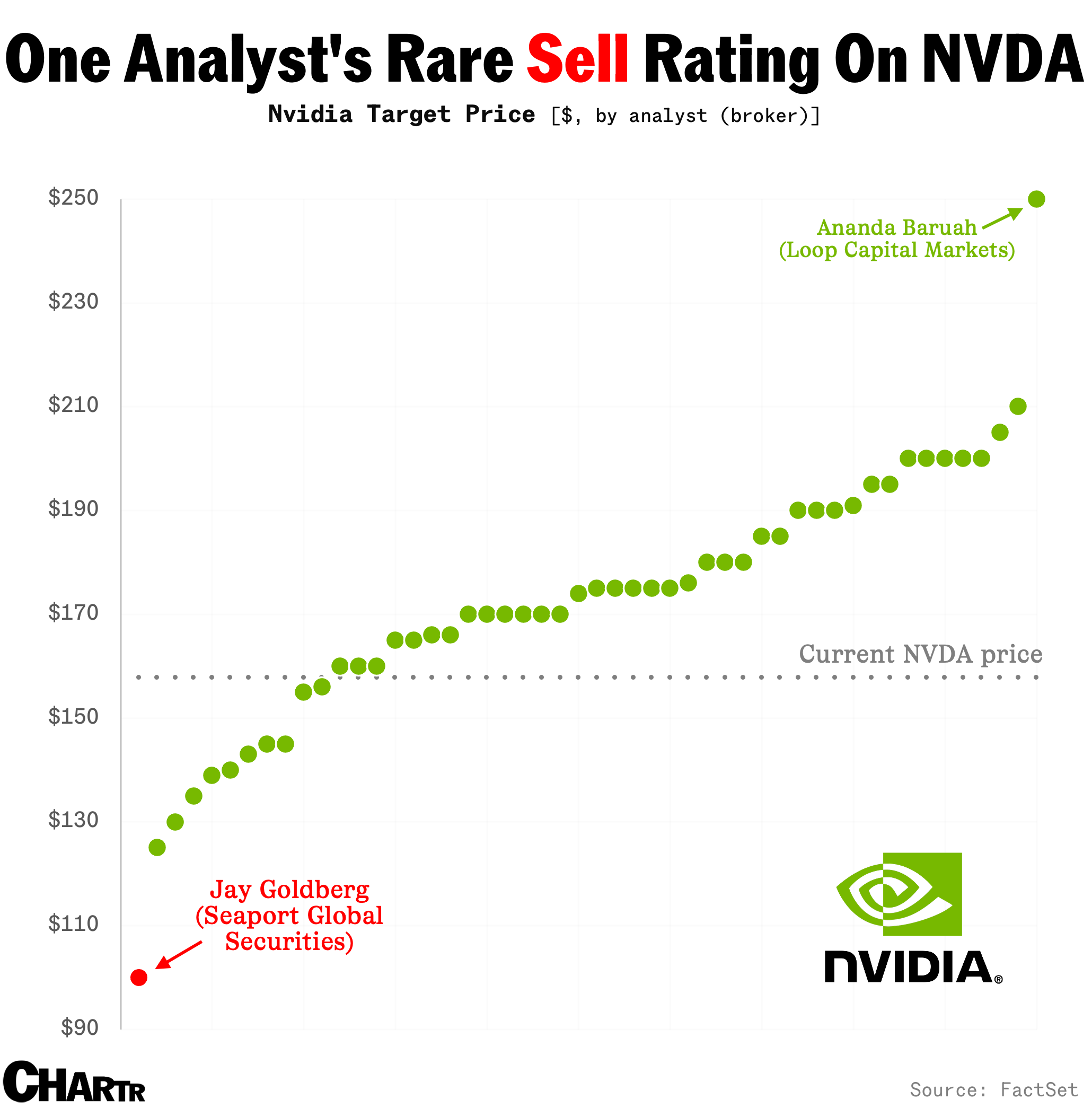
Only one analyst has a "sell" rating on Nvidia
Sherwood News

Goldberg’s $100 target price on the stock market behemoth — implying 37% downside to yesterday’s close price — is predicated on a few key pillars. In a document shared with Sherwood News, Goldberg outlined the headlines of his bearish thesis:

“Nvidia is one of the leading beneficiaries of the current AI spending boom, but its prospects are well understood and largely priced into the stock.”

According to Goldberg, there are growing questions about the actual usefulness of AI, with many of Nvidia’s customers still looking for returns from their “significant investments” in AI so far. That’s likely to mean a slowing of AI budgets in 2026.

Goldberg also wrote:

“Our research indicates significant complexity required for deployments of Nvidia systems in comparison to traditional data centers — cooling, configuration and orchestration challenges throughout the supply chain.”

On top of potential supply chain issues, he also sees a chance that Nvidia’s near monopoly position in the industry could face competition in the medium term, as the company’s top customers, like Meta, Microsoft, and Amazon build on efforts to make their own chips:

“Strong momentum behind hyperscalers’ internal Nvidia alternatives — Nvidia’s largest customers are all looking to design their own chips.”

In the nearer term, cyclical issues, including production limitations for its much sought-after Blackwell line, could raise further concerns.

Of course, there are some major “risks” to the bearish case, too. Perhaps the most important of those noted by Goldberg is that some “unforeseen advances” in AI could suddenly lead to another surge in demand. That’s a possibility that Loop Capital analysts, who have the highest price target on the street ($250), clearly think is more likely than not.

With Nvidia’s stock up more than 40% since he gave his “sell” rating in April, Goldberg hasn’t convinced enough investors to come round to his way of thinking... yet.

Related reading: 73 Wall Street analysts cover Amazon, there are 72 on Meta, and 66 write about Nvidia — how many do we need?

More Markets

See all Markets
markets

Marvell soars after Nvidia CEO says it will be the “next trillion-dollar company”

Marvell Technology surged after Nvidia CEO Jensen Huang called the chipmaker, which it has a stake, in ⁠the next “trillion-dollar company.”

Huang made the comments at Computex ​week in Taipei on ‌Tuesday. It’s not the first vote of confidence for Marvell from the world’s most valuable company: Nvidia announced a strategic partnership with Marvell in March, saying that it has invested $2 billion in the company.

Marvell’s market capitalization as of Monday’s close was around $192 billion, meaning that Huang’s prediction would hinge on a more than 420% rally. Huang said computing is becoming increasingly disaggregated and distributed, creating a need for advanced connectivity, which is what Marvell specializes in.

“That's the reason why Marvell is so essential,” Huang said, standing on stage next to Marvell CEO Matt Murphy. “That's why you’re going to be the next trillion-dollar company.”

The stock rose 23% in premarket trading on Tuesday and is up more than 145% since the start of the year.

markets

HP Enterprise skyrockets on strong Q2 earnings and full-year guidance boost

HP Enterprise shares soared Monday afternoon following the enterprise software companys Q2 earnings report, which detailed a blockbuster quarter.

The stock was up more than 30% — not a typo — after-hours.

Here are the numbers for Q2:

  • Revenue of $10.7 billion (compared to the analyst estimate of $9.78 billion, per FactSet).

  • Adjusted earnings per share of $0.79 (estimate: $0.53).

The company raised its guidance for the full fiscal year, saying it sees revenue growth of 29% to 33%, compared with its previous guidance for 17% to 22%. It also guided for adjusted EPS of $3.35 to $3.45 for the full year, up from the $2.30 to $2.50 it had estimated in its Q1 earnings release.

For its early fiscal 2027 guidance, HPE said it expects revenue to grow 8% to 12%, compared with analysts expectations for 5.5% growth. It also said it expects adjusted EPS growth of 12% to 16%, compared to analysts forecasts of a 13.5% rise.

Unlike HP, which makes consumer products like PCs and printers, HP Enterprise is primed to support the AI boom — specializing in cloud servers, data storage systems, and AI infrastructure. HPE has gained 90% since January.

Last week, competitor Dell saw a similarly rosy earnings report, which boosted its stock nearly 40%.

On Monday at Computex, HPE announced a new project with Nvidia: a new server powered by the semiconductor company. Agentic AI has arrived, and it needs a new CPU, said Nvidia CEO Jensen Huang. According to the companies, the plan is to support and optimize the New York Stock Exchanges day-to-day infrastructure with industry leading agentic AI CPU performance, memory bandwidth and low latency.

markets

Credo Technology tanks, despite beating on earnings and revenue for Q4

Credo Technology Group shares cratered in after-hours trading after releasing Q4 earnings after the bell, despite crushing analyst expectations for earnings and revenue.

The stock dropped 15% in after-hours trading.

For Q4, the company — which makes high-speed connectivity solutions for data centers — posted:

  • Revenues of $437 million (estimate: $431.8 million).

  • Adjusted earnings per share of $1.16 (estimate: $1.02).

And for the first quarter, the company estimated revenue ranging from $465 million to $475 million, compared with analysts’ estimates for $461 million.

Shares of the company are up 63% year to date, and hit their all-time high of $247 today.

Shares soared earlier in the month after Credo announced its acquisition of DustPhotonics, which makes silicon photonic integrated circuits for high-speed networking in data centers. The acquisition means that Credo will be able to play both ends of the data center connectivity business, by adding advanced photonics to its bread and butter of active electrical cables.

Credo stock was down over 14% in after-hours trading.

markets

AMC, Cinemark climb on record May movie theater attendance

Shares of movie theater chains AMC and Cinemark are surging on Monday, following impressive May attendance tallies for both companies.

AMC logged 25.5 million moviegoers last month, the company’s best May since 2019. Cinemark said it achieved its highest May US box office tally ever.

Both companies cited the success of popular horror titles “Backrooms” and “Obsession,” which were each born out of the minds of popular TikTok creators. The Michael Jackson biopic “Michael” and Disney’s “The Mandalorian and Grogu” also performed well.

“Audiences are showing up for a wide range of content, with particular strength in younger moviegoers, resulting in impressive performances across blockbusters and varied small- to mid-tier titles,” said Cinemark CEO Sean Gamble.

Latest Stories

Sherwood Media, LLC and Chartr Limited produce fresh and unique perspectives on topical financial news and are fully owned subsidiaries of Robinhood Markets, Inc., and any views expressed here do not necessarily reflect the views of any other Robinhood affiliate, including Robinhood Markets, Inc., Robinhood Financial LLC, Robinhood Securities, LLC, Robinhood Crypto, LLC, Robinhood Money, LLC, Robinhood U.K. Ltd, Robinhood Derivatives, LLC, Robinhood Gold, LLC, Robinhood Asset Management, LLC, Robinhood Credit, Inc., Robinhood Ventures DE, LLC and, where applicable, its managed investment vehicles.

