
Markets
US-APEC-SUMMIT Tim Cook
Apple CEO Tim Cook (Andrew Caballero-Reynolds/Getty Images)

It may be time for Big Tech’s wake-up calls

Call volumes in the “Magnificent 7” have slipped to lows not seen in over a year.

Luke Kawa

Megacap tech companies are showing some signs of stirring as their quarterly reporting period begins.

On the eve of Tesla and Alphabet’s earnings, a Bloomberg index that tracks the so-called Magnificent Seven (Microsoft, Apple, Nvidia, Alphabet, Amazon, Meta, and Tesla) rose 2.3% on Monday in its best day of the month. The prior 8% pullback in this cohort is – in the grand scheme of its +40% year-to-date gain – a flesh wound. 

But what’s concerning for investors looking for a repeat of the group’s performance in the back half of the year is how much demand for bullish options has plummeted.

On Monday, the total call volumes traded across the group totaled 4.1 million, the lowest in over a year. That’s down from a cumulative 14.1 million on June 7 – the session before Nvidia’s stock split went into effect. 

The decline in call buying is more acute in Nvidia – off more than 80% over this period. But five members of the Magnificent Seven have seen call volumes decline by at least 20% over this stretch – Amazon and Alphabet are the exceptions, where demand for bullish options has risen. This period has been marked by something of a “hot potato” dynamic in the options market, with speculative activity shifting from Nvidia after its split to Apple, to Tesla, and then to small caps.

Why does this matter? Because call buying can magnify demand for a stock. Assume a world in which a trader buys a call option, and a dealer is on the other side of the trade. The dealer is on the hook if that stock goes up enough so that the option is money-good. Dealers don’t like taking directional risk – they like making money on the fine edges of every trade. So, dealers will offset that directional exposure by buying the underlying stock. Problem solved – and more effective buying demand for that company’s shares. The positive momentum created during times of heavy call buying can, at times, resemble something of a perpetual motion machine (it isn’t, though). 

Earnings are certainly a potential catalyst for (most of) the Magnificent Seven to be able to remind investors why they warrant such an honorific.

Per John Butters, senior earnings analyst at FactSet, four of the seven constituents– Nividia, Amazon, Meta, and Alphabet – are expected to be among the top five drivers of annual earnings growth for the S&P 500 this reporting period. Profit growth by these four companies is expected to outstrip the rest of the index by 50 percentage points, according to Butters, and that premium performance doesn’t shrink to less than 15 percentage points until the fourth quarter.
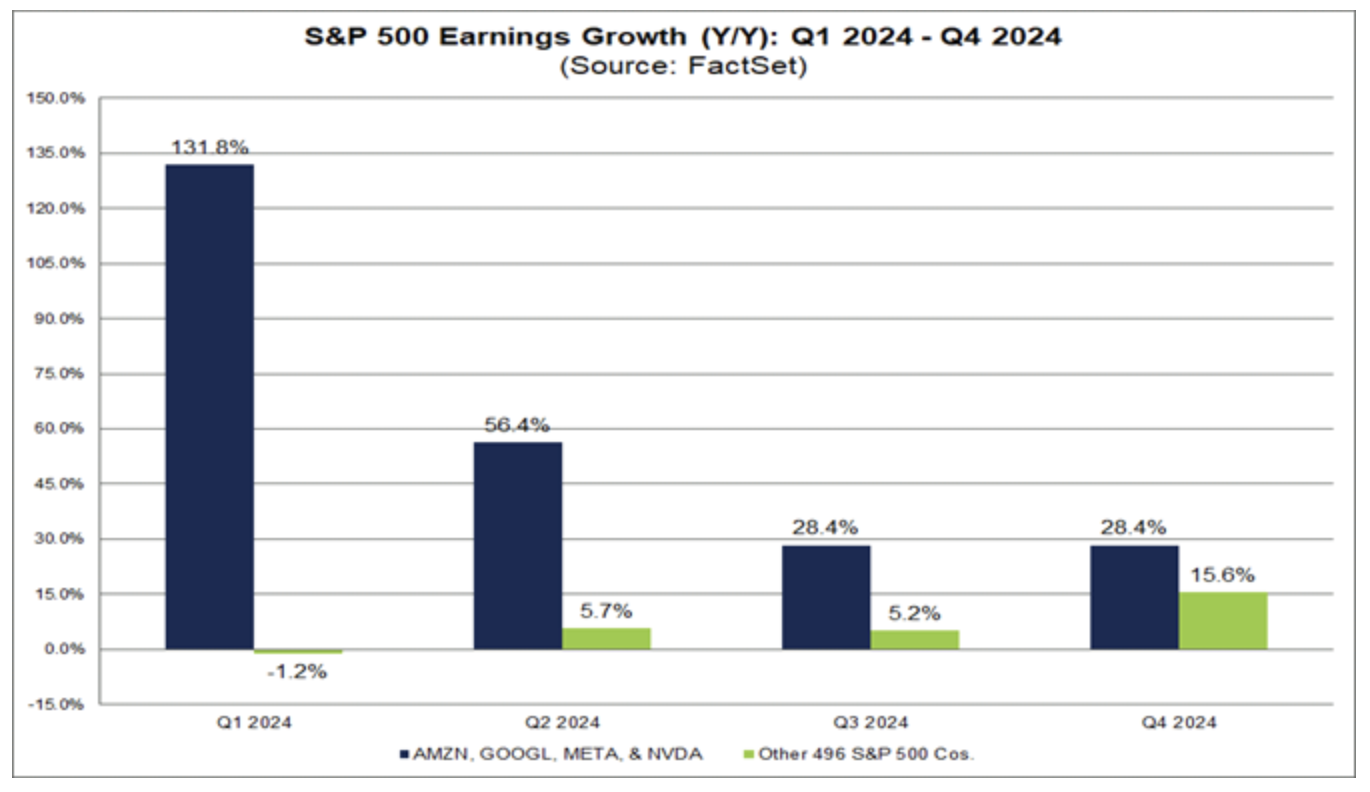
Earnings growth Mag 4
Earnings growth in Amazon, Alphabet, Meta, and Nvidia poised to stay far ahead of the pack. (Source: Factset)

Microsoft, Meta, Apple, and Amazon will release their quarterly figures next week, while Nvidia’s report is still more than a month away.

Perhaps call demand will pick up in the next few sessions as investors pre-position for financial results that tend to exceed expectations. Or, on the other hand, given the amazing run of form for these stocks so far this year, there’s a higher bar to clear for traders to aggressively re-engage in these names.

In the long term, stocks are going to be driven by earnings growth. But shorter-term episodes of outperformance in stocks or sectors are often going to include a substantial amount of multiple expansion. And that’s a process that is usually firmly rooted in flows, and more and more, those flows tend to be emanating from the options market.

More Markets

See all Markets
markets

Figma rises on Citi’s Buy rating and $36 price target

Figma shares are rising moderately in pre-market trading after Citigroup initiated coverage with a Buy rating, saying demand tied to AI could help fuel the design software company’s next phase of growth, according to the note provided by Bloomberg.

Citi set a $36 price target on the stock and said Figma is well-positioned to offset AI disruption concerns through its own AI-driven consumption growth.

"Our proprietary customer and go-to-market (GTM) checks with hyperscalers and large financial services (FS) firms suggest strong seat upgrades & credit pack utilization, which offer positive reads on AI-monetization strategy," analyst Tyler Radke commented.

The company has been moving to roll out AI-native features in recent months, including developer-focused tools and in-house Figma agent aimed at making Figma a more central operating layer between product teams, engineers and AI systems.

Citi also pointed to upcoming product launches and potential monetization tied to Figma’s Model Context Protocol server which is an emerging framework that could allow AI systems to interact more directly with design environments.

Figma’s most recent earnings posted stronger-than-expected revenue growth while management raised its full-year guidance, saying that AI-related products were seeing encouraging adoption.

Still, the company that went public in 2025 has faced intense pressure with stock tumbling more than 50% this year-to-date over fears that automated AI code-generation tools and design alternatives from competitors like Anthropic might squeeze the need for seat-based design software.

markets

Lionsgate closes higher on Netflix acquisition rumor, streaming giant denies report

Shares for the film production company Lionsgate soared on Tuesday following rumors of a potential buyout.

According to a person familiar with the possible merger and acquisitions deal, streaming giant Netflix is one of the companies that may be interested in buying Lionsgate Studios, per reporting by Semafor. A Netflix spokesperson denied the rumor to Deadline.

Neither Lionsgate nor Netflix confirmed the news, but nevertheless the stock climbed, closing up 14%. The stock fell 4.6% in premarket trading after Netflix denied the rumor.

Netflix closed lower on news that Fox will acquire Roku in an approximately $22 billion deal after it was also rumored that the streaming company was interested in that acquisition. “Netflix did not make a bid for Roku,” a spokesperson told Semafor. This comes after Netflix withdrew its buyout bid for Warner Bros. Discovery earlier this year.

Lionsgate’s shares are up 77% since January. Lionsgate owns massive franchises like “John Wick” and “The Hunger Games.” The film company has a market cap of approximately $4.7 billion, making it roughly 5x smaller than Roku and 13x smaller than Warner Bros.

Latest Stories

Sherwood Media, LLC and Chartr Limited produce fresh and unique perspectives on topical financial news and are fully owned subsidiaries of Robinhood Markets, Inc., and any views expressed here do not necessarily reflect the views of any other Robinhood affiliate, including Robinhood Markets, Inc., Robinhood Financial LLC, Robinhood Securities, LLC, Robinhood Crypto, LLC, Robinhood Money, LLC, Robinhood U.K. Ltd, Robinhood Derivatives, LLC, Robinhood Gold, LLC, Robinhood Asset Management, LLC, Robinhood Credit, Inc., Robinhood Ventures DE, LLC and, where applicable, its managed investment vehicles.

