

Markets
markets

Trump didn’t wait until “Liberation Day” to announce autos tariffs — stocks sink

President Trump announced plans to impose a 25% tariff on cars and auto parts from overseas on Wednesday.

The move will affect completed cars and trucks that are shipped to the US, as well as imported parts that are assembled into cars at US auto manufacturers, and is expected to go into effect April 3 — a day after “Liberation Day” duties are expected to hit a variety of goods from Canada, Mexico, and other trading partners.

Though details about the plan remain unclear, US auto stocks have already been dented by the news. Ford was down 4% in premarket trading (though it’s since pared those losses), Stellantis was down 2%, while General Motors was hit hardest, dropping as much as 7%. At the same time, American electric vehicle manufacturers Rivian and Tesla were modestly in the green.

International auto stocks also slumped, with Toyota, Volkswagen, and BMW in the red.
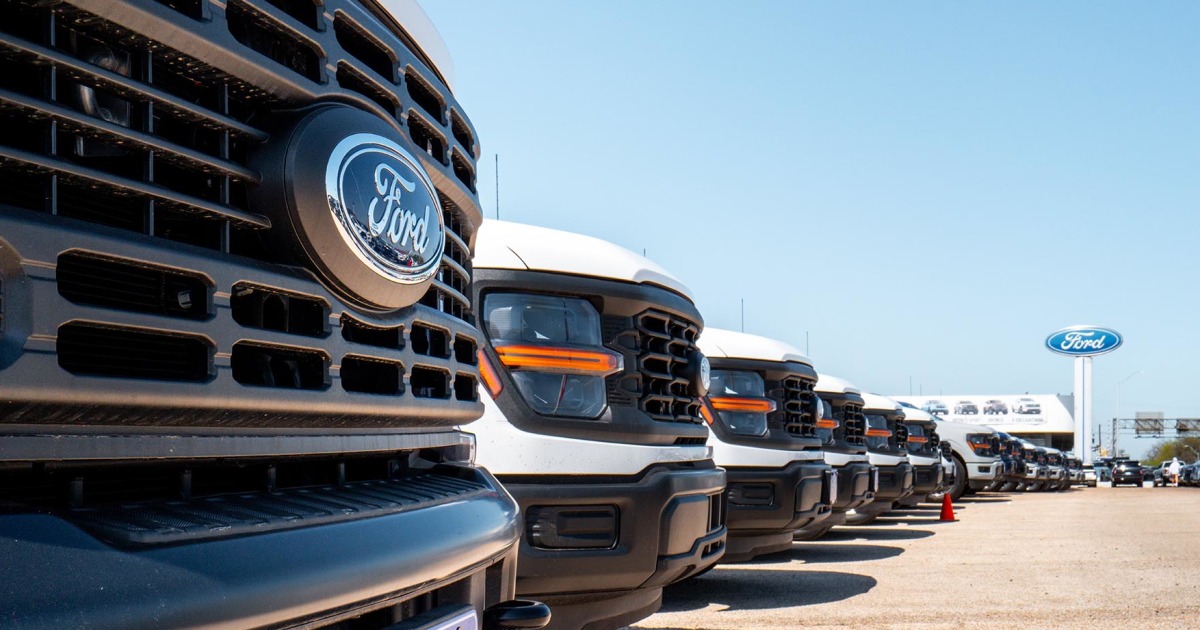
Though details about the plan remain unclear, US auto stocks have already been dented by the news. Ford was down 4% in premarket trading (though it’s since pared those losses), Stellantis was down 2%, while General Motors was hit hardest, dropping as much as 7%. At the same time, American electric vehicle manufacturers Rivian and Tesla were modestly in the green.

International auto stocks also slumped, with Toyota, Volkswagen, and BMW in the red.

More Markets

See all Markets
markets

What to look for in Oracle’s Q3 earnings

On Tuesday, Oracle will announce its third-quarter earnings, and all eyes are on the company’s massive AI data center buildout. Last month, the company told investors that it plans to raise $45 billion to $50 billion to fund its ambitious capex plans.

With so much new spending, the company is reportedly looking to make steep job cuts —  thousands of positions across the company — and may be freezing hiring in its cloud division.

Shares of Oracle are down by more than 20% since the start of the year. The stock is down about 56% from its 52-week high of $345.72.

The company’s big bet on AI is causing some concerns among investors, and the company has recently seen a wave of lowered price targets by analysts:

  • Jeffries: to $320 from $400

  • Scotiabank: to $215 from $220

  • Deutsche Bank: to $300 from $375

  • Baird: to $200 from $300

On Friday, shares dropped sharply on reports that OpenAI had pulled out of a planned expansion of the Stargate data center, in Abilene, Texas. But OpenAI has since clarified that the decision back out of plans for the expansion was just the result shifting capacity to other data center sites under construction.

The company will announce its earnings after market close on Tuesday.

FactSet’s survey of analysts shows they expect an EPS of $1.70 and revenue of $16.9 billion for Oracle’s third quarter. Cloud revenue is expected to be $8.76 billion, and all eyes will be on Oracle’s capex, which is expected to be $14 billion.

Joby, Archer, and Beta climb following their inclusion in the Trump administration’s air taxi pilot program

Shares of air-taxi makers Joby Aviation, Archer Aviation, and Beta Technologies are climbing in Monday afternoon trading following the Department of Transportation’s announcement of their inclusion in the eVTOL Integration Pilot Program (eIPP).

Archer and Joby, which announced their plans to participate in the program back in September, each climbed more than 4% on Monday, while Beta surged more than 12%. Boeing’s air taxi subsidiary Wisk was also named in the DOT’s announcement.

The DOT and FAA selected eight projects spanning 26 states to speed up the development of “advanced air mobility.” Operations will begin this summer. According to an Archer press release, the program could mark “a major step toward bringing electric air taxis to market in the United States.”

“These partnerships will help us better understand how to safely and efficiently integrate these aircraft into the National Airspace System,” said FAA Deputy Administrator Chris Rocheleau. “The program will provide valuable operational experience that will inform the standards needed to enable safe Advanced Air Mobility operations.”

markets

As the S&P 500 announces new members, index investors could get exposure to SpaceX

Here’s something kind of strange.

If all goes as planned, investors in the most basic kind of investment available — your plain vanilla, low-cost, S&P 500 index fund such as SPDR S&P 500 ETF — will soon get a form of pre-IPO exposure to Elon Musk’s SpaceX, one of most sought after stakes in the private markets.

That’s because one of the new companies that will be added to the S&P 500 — via additions announced on Friday — is EchoStar , the indebted satellite services company that owns Dish Network.

EchoStar — which along with Vertiv Holdings, Lumentum, and Coherent will go into the index on March 23 — is also set to become a not-insignificant owner of class A common stock in SpaceX.

SpaceX is said to be targeting an over $1 trillion valuation for an IPO this June. EchoStar has struck deals for shares that would give it a roughly 2.8% stake in SpaceX, analysts say.

SpaceX sold that stake to pay EchoStar for part of the roughly $20 billion cost of prized spectrum assets. The company first struck a spectrum deal with SpaceX in September, which it expanded in November. Investors have since seemed to be view to the company as a way to gain backdoor exposure to Musk’s hot privately held space company.

That excitement continues, but it should be noted, that even though EchoStar struck a deal for SpaceX shares, company officials say that stock is not yet in its coffers and it won’t be until its SpaceX deals close.

Speaking to analysts after the company’s earnings call on March 2, EchoStar CEO Hamid Akhavan said:

“Until the closing, we don't have actually the – that SpaceX's equity. So that is not something that we can make any plans on till we actually get the equity. We have a right to it, but we don't have the – we actually don't have that equity yet. So we'll see how that plays out.”

No closing date was offered when the initial deal with SpaceX was announced in September, with EchoStar releases saying only the “closing of the proposed transaction will occur after all required regulatory approvals are received and other closing conditions are satisfied.”

markets

Oil-sensitive stocks and companies relying on middle-class spending are getting crushed

Sometimes there’s a singular story driving the markets. With US benchmark crude oil prices topping $100 a barrel, Monday is one of those days.

Oil-sensitive stocks are getting clobbered, with airlines foremost among them. JetBlue, United Airlines, and Alaska Air are all tumbling.

But the pain is more widespread than that, with industries where oil prices are a major input, such as chemical manufacturers (Eastman Chemical), industrial machinery makers (Illinois Tool Works), and building products (Owens-Corning), also getting shellacked.

More ominous — economically speaking — is the performance of companies catering to America’s middle class, including Macy’s, Kohl’s, Best Buy, and Texas Roadhouse. The drop suggests that investors and traders expect the rising cost of fuel to eat away at disposable income, potentially setting the stage for an economic slowdown.

Some of the worst off on Monday are companies that are both fuel-sensitive and heavily reliant on middle-class consumers — a double whammy.

Cases in point: Carnival is getting creamed, and Clorox, a company that depends on slightly better-off Americans shelling out for its brand-name products, is also getting pummeled.

But the pain is more widespread than that, with industries where oil prices are a major input, such as chemical manufacturers (Eastman Chemical), industrial machinery makers (Illinois Tool Works), and building products (Owens-Corning), also getting shellacked.

More ominous — economically speaking — is the performance of companies catering to America’s middle class, including Macy’s, Kohl’s, Best Buy, and Texas Roadhouse. The drop suggests that investors and traders expect the rising cost of fuel to eat away at disposable income, potentially setting the stage for an economic slowdown.

Some of the worst off on Monday are companies that are both fuel-sensitive and heavily reliant on middle-class consumers — a double whammy.

Cases in point: Carnival is getting creamed, and Clorox, a company that depends on slightly better-off Americans shelling out for its brand-name products, is also getting pummeled.

Latest Stories

Sherwood Media, LLC produces fresh and unique perspectives on topical financial news and is a fully owned subsidiary of Robinhood Markets, Inc., and any views expressed here do not necessarily reflect the views of any other Robinhood affiliate, including Robinhood Markets, Inc., Robinhood Financial LLC, Robinhood Securities, LLC, Robinhood Crypto, LLC, or Robinhood Money, LLC.