
Markets
Dollar and Sterling close-up
Getty Images
Keep calm and pay more

UK inflation came in hot, jumping to 3% in January

UK and US inflation are twinning.

David Crowther

The United States and the United Kingdom have a lot in common: language, music, movies, and, as of this week, like-for-like inflation rates.

On Wednesday, the latest UK CPI print revealed that prices were up 3% in the last 12 months, a 10-month high and the exact same rate of price increases that the US reported last week. In contrast with the States, though, there was no eggflation to single out in the British figures. Instead, the Office for National Statistics dumped the blame on airfares, higher food costs, and more expensive private schools, with the BBC reporting that “private school fees grew by about 13%... after the government removed the [VAT] tax exemption.”
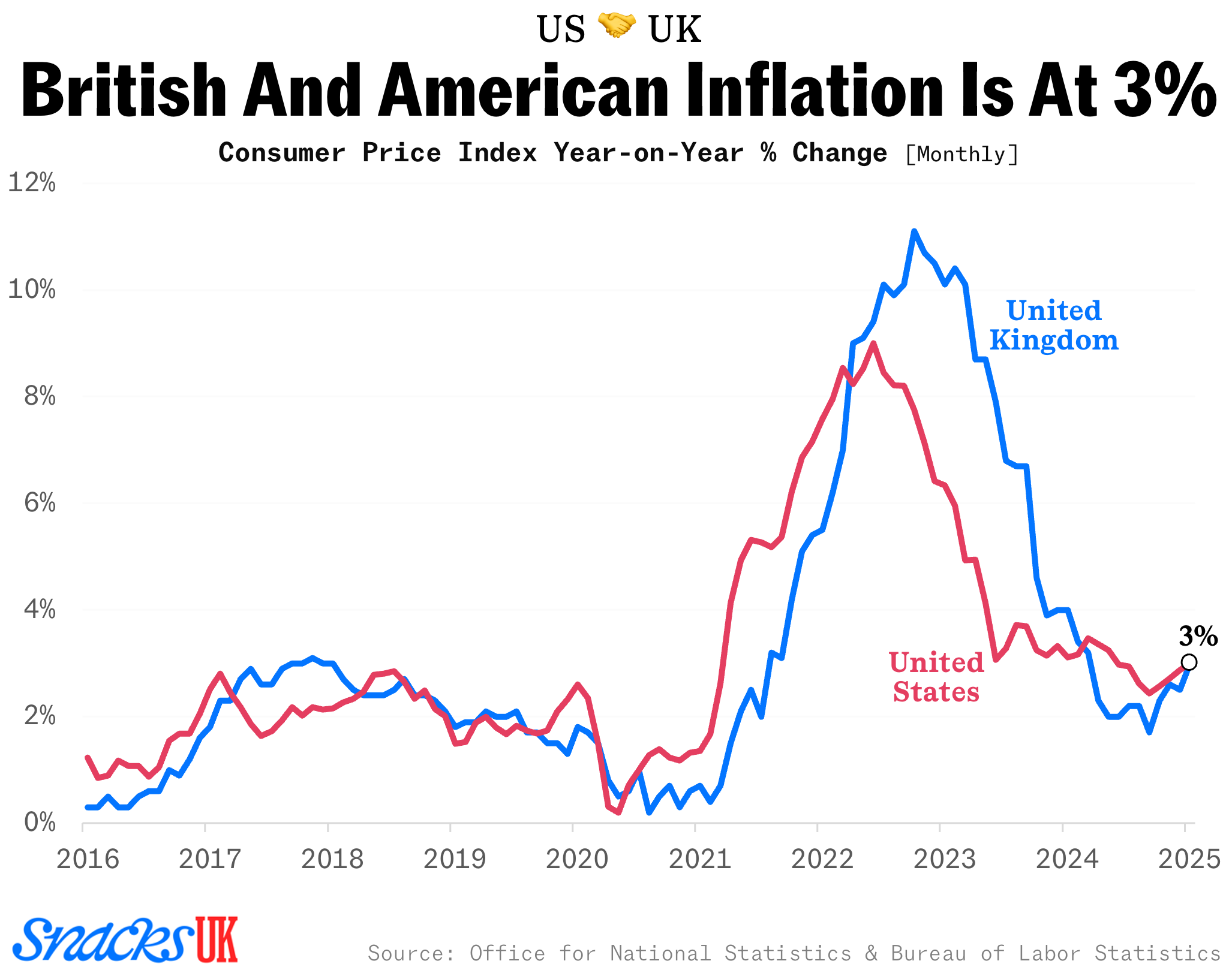
UK vs. US Inflation
Sherwood News

With inflation running ahead of the 2% target, the Bank of England’s tightrope act — keeping a lid on prices while kickstarting an economic engine that notched anemic growth of 0.1% in Q4 — just got a bit wobblier.

Investors on both sides of the pond, however, still expect rates to come down this year in spite of persistent inflation. Per Bloomberg data, Fed funds futures are pricing in 39 basis points of easing in 2025, while the market expects 50 bps of cuts for the Bank of England.

Wait, we’re winning?

The news weighed modestly on UK stocks, with the FTSE 100 down 1% since Tuesday, a small dampener on a solid start to the year for British names. Indeed, after months, years, and decades of being trounced by their American counterparts, UK stocks are actually slightly outperforming their stateside peers: the FTSE 100 is up 6% in 2025, ahead of the S&P 500’s 4% rise (never mind the fact that the flagship US index is up 84% in the last five years, vs. the FTSE’s 17% gain).

More Markets

See all Markets
markets

SpaceX gets a wave of bullish ratings from Wall Street analysts

SpaceX received more than a dozen positive analyst calls on Tuesday — including from major Wall Street banks — as they initiate coverage on Elon Musk’s space and AI company.

SpaceX went public on June 12 at a $2.2 trillion valuation, the largest debut in history. While the company hasn’t yet posted a profit, it seems to have convinced Wall Street that it will get there and grow its valuation on the way.

Of the at least 17 analysts that gave a rating on Tuesday, all but one gave it a “buy” or “outperform” rating. MoffettNathanson was "neutral."

The ratings come as SpaceX joined the Nasdaq 100 index, a benchmark tech-heavy basket of companies that underpins millions of portfolios. The inclusion adds built-in demand for the stock from index funds and ETFs.

Still, SpaceX fell more than 5% on Tuesday amid a broader sell-off, and is currently effectively flat from its opening price of $150 a share.

Latest Stories

Sherwood Media, LLC and Chartr Limited produce fresh and unique perspectives on topical financial news and are fully owned subsidiaries of Robinhood Markets, Inc., and any views expressed here do not necessarily reflect the views of any other Robinhood affiliate, including Robinhood Markets, Inc., Robinhood Financial LLC, Robinhood Securities, LLC, Robinhood Crypto, LLC, Robinhood Money, LLC, Robinhood U.K. Ltd, Robinhood Derivatives, LLC, Robinhood Gold, LLC, Robinhood Asset Management, LLC, Robinhood Credit, Inc., Robinhood Ventures DE, LLC and, where applicable, its managed investment vehicles.

