Markets
Bethlehem PA
Bethlehem, PA (Getty Images)
Living Here

Unsexy cities see some of the country’s fastest home price growth

Billy Joel’s ode to a small Pennsylvania town didn’t predict this 2024 boom.

Matt Phillips

No offense to Allentown, but in terms of beauty, wealth, climate, or cultural caché, it ain’t exactly Miami or San Francisco.

Nevertheless, the Allentown-Bethlehem-Easton urban area in Pennsylvania’s fast-growing Lehigh Valley enjoyed the sharpest annual home price appreciation out of the country’s 100 largest metropolitan areas, according to Q1 data just released by Federal Housing Finance Agency.

Interestingly, several other grittier Northeastern regions that have endured decades-long struggles with deindustrialization — Camden, NJ and Rochester, NY, for instance — are rising to the top of the rankings of home price appreciation in the US, along with other decidedly unsexy locales like New York’s Albany-Schenectady-Troy — my hometown! — and Hartford, Connecticut.

What’s going on? It’s not completely clear. The search for affordable housing is clearly driving some people to expand their housing hunt to exurban areas which might require much longer commutes. With a 90-minute drive to Manhattan, Pennsylvania’s Lehigh Valley meets that criteria. Proximity to the big city has also made the Lehigh Valley a hotspot for warehousing jobs, providing a strong employment base. Immigration, which has been a big driver of population growth in the Lehigh Valley, is also likely playing a role.

Some of the outperformance of the cities I’ve spotlighted also reflects the fact that cities that saw remarkable price spikes during the pandemic-era housing boom such as Austin, Texas couldn’t sustain double-digit growth rates forever. Still, the rise of the unsexy city is an interesting dynamic to keep an eye on.

More Markets

See all Markets
markets

STAAR Surgical soars after company reported preliminary sales that crushed expecations

STAAR Surgical rose more than 20% in premarket trading after it gave preliminary Q1 sales numbers that crushed Wall Street expectations, which it attributed to booming sales in China and the Americas.

The company, which sells eye implants, said in a press release published Wednesday that it expects to report revenue north of $90 million in the current quarter, compared to the $73 million analysts polled by FactSet are currently penciling in.

The company said sales in China "accounted for the majority of the increase in net sales, along with continued double-digit growth in the Americas." It also noted that sales in the Middle East "were negatively affected by significant geopolitical and macroeconomic challenges, resulting in a decline in sales in parts of those regions."

The stock is up nearly 21% as of 6:25 a.m. ET, having fallen more than 11% from the start of the year to yesterday’s close.

markets

Infleqtion targets revenue growth of 23% in 2026, up from 12% in 2025

Quantum computing firm Infleqtion said it’s aiming to book $40 million in sales this year as it released its 2025 results after the close on Wednesday.

That would be an increase of roughly 23% compared to the $32.5 million in revenues the company generated in 2025, and would mark an acceleration from growth of 12% last year.

The seller of quantum sensors and computers went public via a SPAC in February after carrying a pre-money valuation of $1.8 billion (well below other pure-play peers like Rigetti Computing, IonQ, and D-Wave Quantum).

“We did $29 million in revenue in 2024, and then we announced that we did $50 million of booked and awarded business in 2025. I think that sets a good foundation for significant revenue growth going forward,” CEO Matthew Kinsella told us in February. “I’ve always deeply believed that we need to develop that muscle of commercialization.”

markets

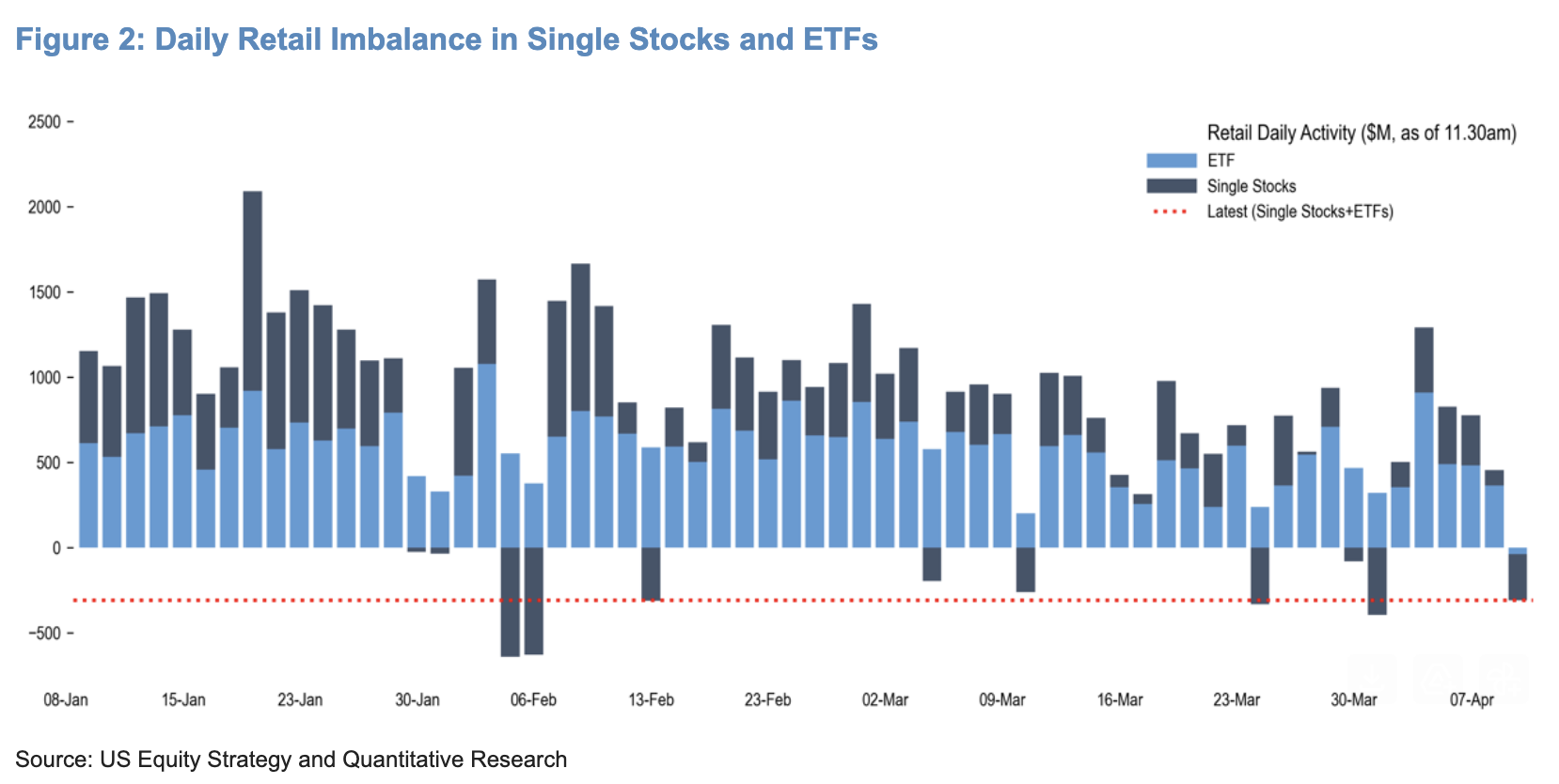
Retail traders are selling everything but the Magnificent 7, per JPMorgan

JPMorgan strategist Arun Jain with the skinny on retail trading activity through 11:30 a.m. ET today:

“Retail investors are selling into today’s strength in both ETFs and Single Stocks. In ETFs, they are trimming their broad-based exposure — a major departure from their typical pattern.”

The SPDR S&P 500 ETF and ProShares UltraPro QQQ suffered particularly large outflows, per Jain.

The exceptions to the selling pressure are the Magnificent 7 stocks, he wrote, with Nvidia, Tesla, Meta, and Microsoft enjoying “small net purchases,” while Micron, TSMC, Exxon, and Chevron were the most dumped names.

Retail trading 4/8

Last week, Jain noted that retail traders had been “skipping the dips, selling into rallies, and positioning more defensively” with markets jittery amid the ongoing Mideast war.

Latest Stories

Sherwood Media, LLC produces fresh and unique perspectives on topical financial news and is a fully owned subsidiary of Robinhood Markets, Inc., and any views expressed here do not necessarily reflect the views of any other Robinhood affiliate, including Robinhood Markets, Inc., Robinhood Financial LLC, Robinhood Securities, LLC, Robinhood Crypto, LLC, Robinhood Derivatives, LLC, or Robinhood Money, LLC. Futures and event contracts are offered through Robinhood Derivatives, LLC.