
Markets
Texas Electric Grid Under Strain As Triple-Digit Temperatures Continue
An aerial view of an Austin Energy-owned electrical substation (Brandon Bell/Getty Images)
Power Texas Ranger

The S&P 500’s best performer this year is surging once again after earnings

Texas-based utility firm Vistra Corp is the big beneficiary of accelerating demand for electricity.

Luke Kawa

Vistra, the top S&P 500 performer in 2024, is on a renewed press higher after reporting better-than-expected quarterly results and boosting its full-year earnings outlook.

The power generator has soared 227% year to date through Wednesday, and is adding another 4.8% as of 10:12 a.m. ET. 

Revenues of $6.3 billion were well above the $5 billion consensus estimate, with earnings per share of $1.28 also exceeding analysts’ expectations.

Demand for electricity accelerated meaningfully in 2024 relative to average growth over the past 10 years, and grid operators in regions where Vistra has a major footprint are forecasting even stronger growth through the end of the decade.
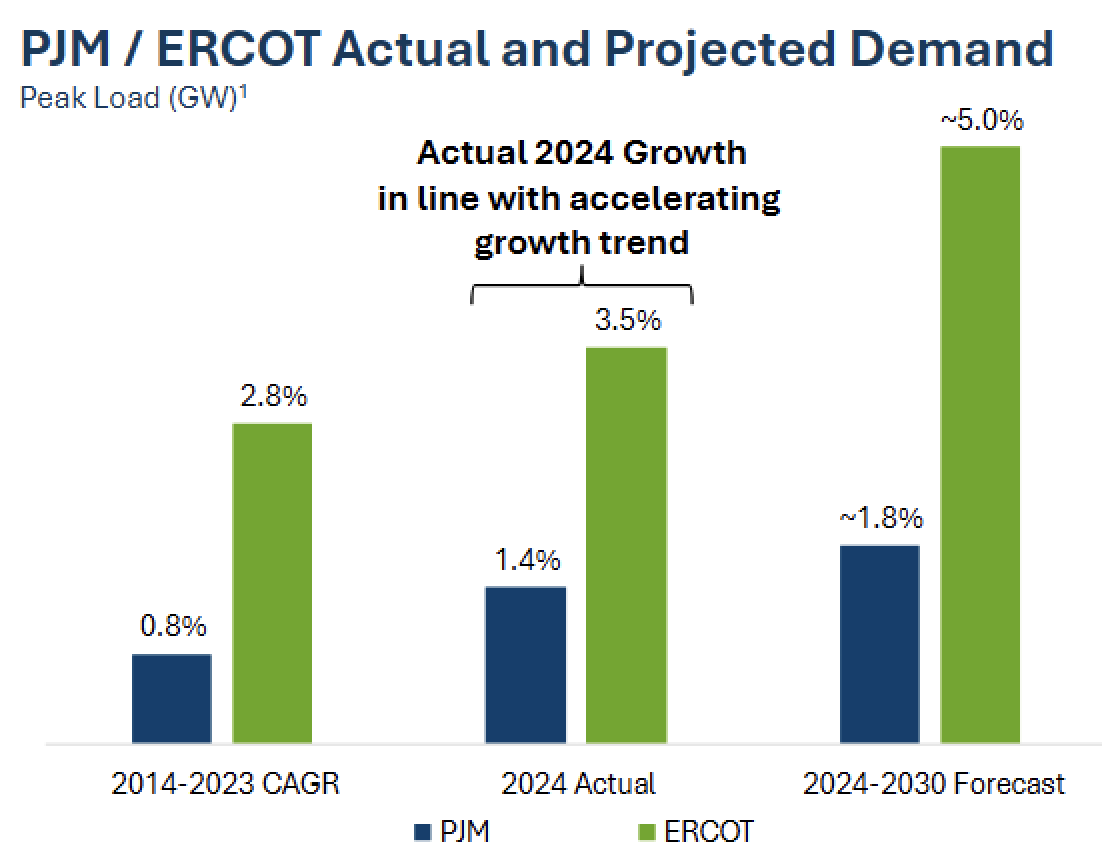
Projected electricity demand growth
Source: Vistra company presentation

Management’s improved guidance for 2024 and initial range for 2025 doesn’t include potential benefits from nuclear-production tax credits, which could add materially to its bottom-line results. The board also authorized another $1 billion in share repurchases to be carried out by the end of 2026.

More Markets

See all Markets
markets

Akamai Technologies jumps on $1.8 billion cloud infrastructure deal

Akamai is up 26% in premarket trading Friday after the company announced a major cloud infrastructure deal tied to AI, helping investors look past modestly better-than-expected Q1 results and a weaker-than-expected Q2 outlook.

In a press release Thursday after the bell, the cloud and cybersecurity company said it had secured a $1.8 billion, seven-year commitment from a “leading frontier model provider” for Akamai’s cloud infrastructure services, a deal CEO Tom Leighton said strengthened the company’s position as a “key infrastructure provider in the AI economy.”

The announcement came alongside Akamai’s Q1 earnings, which were only modestly ahead of Wall Street expectations. Adjusted earnings came in at $1.61 per share, slightly above analysts’ estimate of $1.60 per share compiled by FactSet. Revenue rose 6% year on year to $1.074 billion, broadly in-line with Wall Street's forecasts.

The company said growth was led by its cloud infrastructure services, where revenue jumped 40% year on year. Security revenue grew 11%, while delivery and other cloud applications revenue dropped 7%.

For the current quarter, the company forecast adjusted earnings per share of $1.45 to $1.65, with the midpoint falling short of the $1.68 expected, and revenue of $1.075 billion to $1.1 billion also below the $1.104 billion estimate at the midpoint, according to FactSet.

markets

Nvidia to invest up to $2.1 billion in IREN in partnership that deploys as much as 5 gigawatts of its AI infrastructure

Another day, another massive Nvidia warrants deal in the AI ecosystem.

Shares of data center company IREN spiked 20% in postmarket trading after it reached a pact with the chip designer to deploy up to 5 gigawatts of its AI offerings across data centers.

This means that IREN will effectively be building out data centers designed by Nvidia to optimize for its hardware. And some of that hardware deployed will seemingly then be utilized by Nvidia: IREN also announced a $3.4 billion AI cloud contract with the giant on Thursday.

As part of the arrangement, IREN issued Nvidia warrants that expire in five years that enable the company to buy up to 30 million shares at $70 apiece. If fully exercised, that would amount to a $2.1 billion investment into IREN.

This announcement took the sting out of IREN’s Q3 results, which saw the firm report sales of $144.8 million (compared to analyst estimates of $216.6 million) and adjusted EBITDA of $59.5 million (estimate: $125 million).

On Wednesday, Nvidia announced an investment of $500 million in fiber-optics firm Corning to accelerate its manufacturing capacity.

markets

Applied Optoelectronics sinks after Q1 sales miss, underwhelming Q2 revenue guidance

Applied Optoelectronics tumbled after-hours after the connectivity company reported lower-than-expected Q1 sales and underwhelming revenue guidance.

Here are the numbers:

  • Revenue of $151.1 million (compared to analyst estimates of $157.5 million).

  • An adjusted loss per share of $0.07 (estimate: a $0.05 loss).

  • An adjusted gross margin of 29.1% (estimate: 30.37%).

The company helps servers in large-scale data centers relay information, partnering with companies like Microsoft and Amazon. Last month, the stock surged after news broke that a key hyperscale customer, following an initial order, had significantly increased its demand for AAOIs offerings.

For second quarter of 2026, the company expects:

  • Revenue in the range of $180 million to $198 million (estimate: $196.83 million).

  • Adjusted gross margin in the range of 29% to 30% (estimate: 31.42%).

In the press release, AAOI Chief Financial and Strategy Officer Dr. Stefan Murry said:

Our focus remains on ramping our capacity thoughtfully to meet the unprecedented demand and are confident in our ability to execute on our ambitious growth plans, while ensuring reliability, quality, and a dedication to excellence.”

Demand for photonics does not seem to be in question, but judging by Lumentum’s post-earnings call on Tuesday and Applied Optoelectronics’ commentary, the challenge lies in securing supply.

AAOI was up nearly 300% since the beginning of the year before this print.

markets

Airbnb beats on Q1 revenue, increases guidance for current quarter

Shares of Airbnb whipsawed in after-hours trading Thursday after the company beat Wall Street estimates on revenue and raised guidance for the year, but missed on earnings per share, citing macroeconomic and geopolitical uncertainty.

Airbnb reported: 

  • Q1 revenue of $2.7 billion (compared to analyst estimates of $2.6 billion).

  • Adjusted EBITDA of $519 million (estimate: $483.2 million).

  • Adjusted diluted EPS of $0.26 (estimate: $0.29).

  • Q2 revenue sales guidance of $3.54 billion to $3.60 billion, representing year-over-year growth of 14% to 16% (estimate: $3.4 billion).

Investors were watching for initial impacts of the Iran war, gas prices, jet fuel costs, and cost-of-living increases on the companys finances and projections.

Despite the difficult terrain, the company said that its confident going forward. For 2026, Airbnb raised its guidance, stating that it expects year-over-year revenue growth to accelerate to low to mid-teens and an adjusted EBITDA margin of at least 35%.

The upward revision to our revenue outlook reflects meaningful progress across our growth initiatives and improvements to monetization through a simplified fee structure and our insurance programs, which are expected to lift our full-year take rate. We remain optimistic about our continued momentum, even as we face tougher comparisons in the back half of this year against the rollout of Reserve Now, Pay Later in 2025 and current headwinds from the Middle East conflict.

Perhaps Wall Street is less certain about customers’ willingness to splurge on vacations given the state of things. According to the company, in Q1, roughly 20% of global booking value came from Reserve Now, Pay Later bookings.

markets

DraftKings rises after reporting better-than-expected Q1 numbers

Sports betting company DraftKings rose in aftermarket trading Thursday after it reported better-than-expected Q1 sales and earnings. Here’s a rough outline of the results:

  • Q1 revenue of $1.65 billion vs. Wall Street’s $1.63 billion expectation, according to FactSet.

  • Q1 earnings per share of $0.03 vs. the consensus estimate of $0.01.

  • Q1 adjusted EBITDA of $167.9 million vs. the $152.6 million expectation.

  • Maintained previous full-year adjusted EBITDA guidance of $700 million to $900 million, compared with estimates of $791.4 million.

  • Maintained previous full-year sales guidance of between $6.5 billion and $6.9 billion (midpoint $6.70 billion), compared with analysts’ estimates of $6.82 billion, according to FactSet.

Shares of traditional online sports gambling platforms like DraftKings have struggled as prediction markets have emerged as a center of industry excitement.

The shift to such markets has been tricky for both DraftKings and rival FanDuel, the US leader in online sports betting, which have to manage preexisting relationships with state gaming commissions that stand to be disrupted by prediction markets, which are regulated on the federal level by the CFTC.

DraftKings is down roughly 25% in 2026, while FanDuel parent Flutter Entertainment, which reported earnings yesterday, is down more than 50%.

Latest Stories

Sherwood Media, LLC produces fresh and unique perspectives on topical financial news and is a fully owned subsidiary of Robinhood Markets, Inc., and any views expressed here do not necessarily reflect the views of any other Robinhood affiliate, including Robinhood Markets, Inc., Robinhood Financial LLC, Robinhood Securities, LLC, Robinhood Crypto, LLC, Robinhood Derivatives, LLC, or Robinhood Money, LLC. Futures and event contracts are offered through Robinhood Derivatives, LLC.

