
Markets
Goldman raises S&P 500 target, expects Fed cuts to boost market multiple
(CSA Archive/Getty Images)

Wall Street says chase the rally, with Goldman and BofA upping S&P 500 price targets

Goldman Sachs expects high valuations to persist thanks to Fed easing, while Bank of America trumpets the resilience of corporate earnings.

Goldman Sachs Chief US Equity Strategist David Kostin and his team lifted their price targets for the S&P 500 (SPDR S&P 500 ETF) to 6,900 from 6,500 in a new research note, suggesting a roughly 11% increase for the blue chips over the next 12 months. They wrote:

“Earlier and deeper Fed easing and lower Treasury yields than we previously expected, the continued fundamental strength of the largest stocks, and investors’ willingness to look through likely near-term earnings weakness support our revised S&P 500 forward P/E forecast of 22x (from 20.4x).”

The tango between yields on US Treasury bonds — and expected rate cuts from the Federal Reserve — is a complicated (and passionate!) one. (I got into the weeds of it here, for those interested.)

But in the interest of time, think of it like this: all else equal — and yes, all else is never perfectly equal, but let’s pretend — lower bond yields translate into higher market multiples, foremost among them the fabled price-to-earnings ratio. So if earnings stay stable, and bond yields are lower than expected, multiples rise and the market price, in this case the S&P 500, goes up — at least on paper.

And Goldman is penciling in S&P 500 earnings per share essentially on a steady 7% rise over the next 12 months, even amid the large uncertainties related to the Trump administration’s ongoing tariff frenzy.

“Company commentary shows S&P 500 firms plan to use a combination of cost savings, supplier adjustments, and pricing to offset the impact of tariffs,” they wrote.

To put it another way, the panic that accompanied the massive tariffs announced by President Trump in early April — which pushed the S&P 500 to the brink of a bear market — hasn’t been justified, at least so far. Inflation hasn’t gone nuts. That leaves the Fed room to cut, and the economy, which is the key driver of corporate earnings, seems to be more or less hanging in there.

Bank of America market analysts had a similar takeaway in a note published Tuesday. They upgraded their previously bearish price target for the S&P 500, raising it to 6,600 over the next 12 months from 5,600, implying a gain of about 6%, citing the resilience of corporate earnings.

“Corporate transparency has remained intact. Most co’s have continued to guide on profits, and estimate dispersion (a measure of EPS uncertainty) is near post COVID lows,” they wrote.

For the record, that doesn’t mean the market was wrong to panic after the president announced plans to raise America’s trade barriers to levels not seen in a century.

If those tariffs went through as initially announced, they likely would have done a ton of damage. But, of course, they didn’t go through, as the famously improvisational president backed away from the initial announcement within days and muddied the water with weeks of delays, adjustments, carve-outs, tweaks, Truth Social blasts, and nontransparent dealmaking that has significantly muted and obscured the impact of Trump’s trade policy of choice.

Or as my colleague Luke Kawa might have put it, the market failed to take into account the role that the Trump Hot Air Cycle continues to play in Trump 2.0.
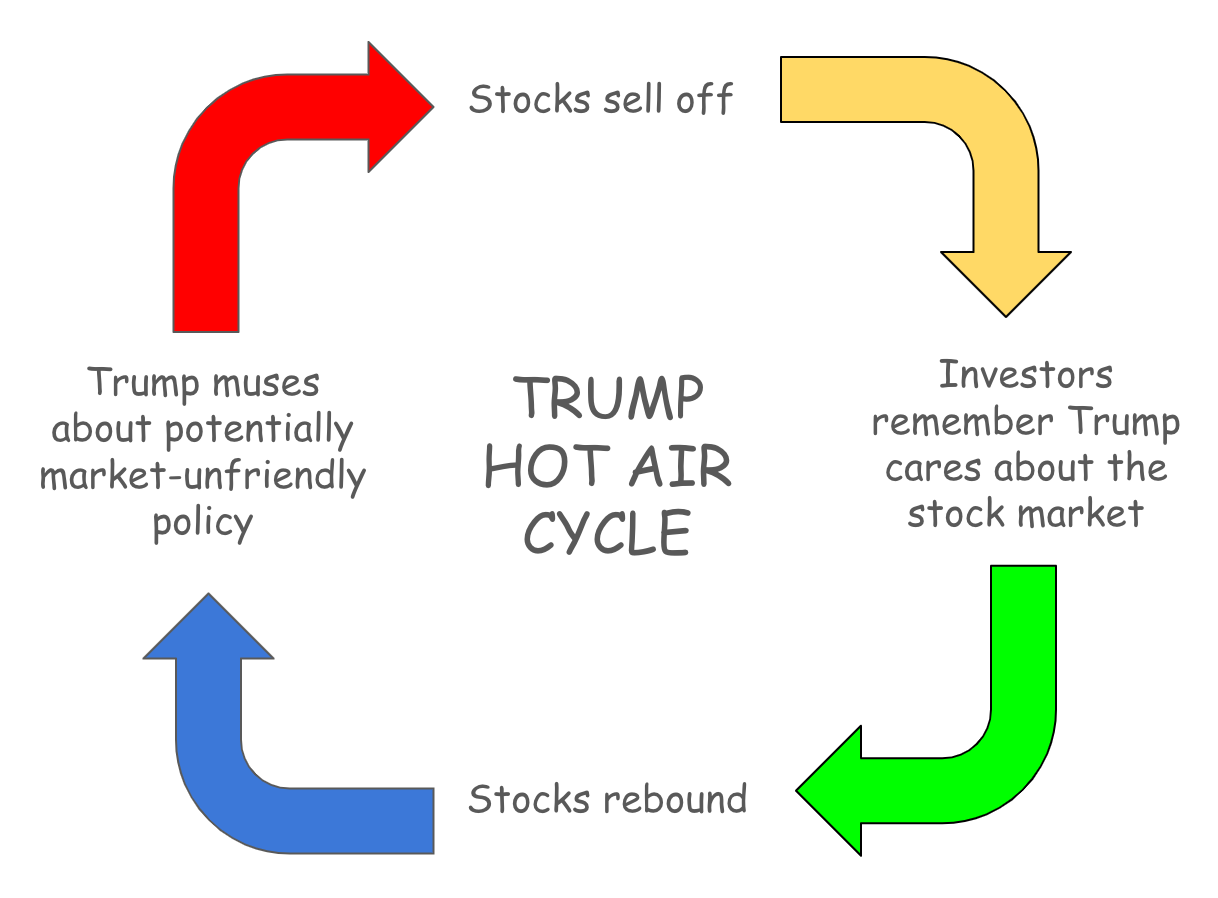
Trump Hot Air Cycle
Source: Sherwood News

More Markets

See all Markets
The Future of the AI boom is coming into view

GE Vernova and Vertiv are giving us a glimpse into the future of the AI boom

GEV’s backlogs are bursting at the seams. One analyst told us he thinks that by the end of this year, GEV could be completely sold out of production capacity for heavy-duty turbines until 2029 or 2030.

markets

Low-cost airlines plunge on report Trump administration is close to $500 million rescue deal for Spirit

Low-budget US airlines are sinking on Wednesday morning following a Wall Street Journal report that the Trump administration is close to making a rescue deal for Spirit Airlines, which is said to be nearing liquidation amid high fuel costs.

Shares of Frontier, Allegiant, JetBlue, and Southwest Airlines all dropped notably.

Per the WSJ, the US government could soon loan Spirit up to $500 million in return for warrants to take a sizable stake in the airline, which has filed for bankruptcy twice since late 2024. Those warrants could give the US government the ability to purchase as much as 90% ownership of Spirit, Bloomberg reports. The carrier has made efforts to emerge from its latest bankruptcy, filed in August, but fuel costs amid the war in Iran have upset the math.

On Tuesday, President Trump told CNBC he would “love somebody to buy Spirit.”

Per the WSJ, the US government could soon loan Spirit up to $500 million in return for warrants to take a sizable stake in the airline, which has filed for bankruptcy twice since late 2024. Those warrants could give the US government the ability to purchase as much as 90% ownership of Spirit, Bloomberg reports. The carrier has made efforts to emerge from its latest bankruptcy, filed in August, but fuel costs amid the war in Iran have upset the math.

On Tuesday, President Trump told CNBC he would “love somebody to buy Spirit.”

markets

Boeing reports better-than-expected Q1 earnings, revenue

Plane maker Boeing reported its first-quarter earnings before the market opened on Wednesday. Its shares climbed more than 3% in premarket trading.

For Q1, Boeing reported:

  • An adjusted loss of $0.20 per share, compared to the loss of $0.68 per share expected by Wall Street analysts polled by FactSet.

  • Revenue of $22.22 billion, compared to estimates of $21.85 billion.

Boeing reported -$1.45 billion in free cash flow in Q1, compared to the -$2.34 billion expected by Wall Street. Prior to Wednesday, Boeing had reported two consecutive quarters of positive FCF following six straight quarters of negative results. The company is still guiding for full-year FCF of between $1 billion and $3 billion.

Earlier this month, Boeing announced it had delivered 143 commercial jets in Q1, up 10% from the same period last year and ahead of rival Airbus, which delivered 114. This was Boeing’s first time outdelivering Airbus since 2018.

markets

GE Vernova, top AI energy play, rises after Q1 report

GE Vernova, a maker of power plant equipment that’s seen orders tied to data centers surge, rose early Wednesday after posting strong Q1 results and lifting full-year sales guidance. The GE spin-off reported:

  • Adjusted EBITDA of $896 million vs. the $772 million estimate from analysts polled by FactSet.

  • Total revenue of $9.34 billion vs. the $9.25 billion consensus expectation from analysts polled by FactSet.

  • Full-year 2026 sales guidance that was lifted to between $44.5 billion and $45.5 billion from prior guidance of between $44 billion and $45 billion, vs. the consensus estimate of $44.64 billion.

“In the quarter, our electrification segment booked $2.4 billion in equipment orders to support data centers, more than all of last year,” said CEO Scott Strazik.

GE Vernova is up some 600% over the last two years through Tuesday’s close, but the majority of those gains were booked by August 2025. After being largely range-bound for months, the stock busted out following the company’s last earnings report, lifting the shares up nearly 50% in 2026.

Latest Stories

Sherwood Media, LLC produces fresh and unique perspectives on topical financial news and is a fully owned subsidiary of Robinhood Markets, Inc., and any views expressed here do not necessarily reflect the views of any other Robinhood affiliate, including Robinhood Markets, Inc., Robinhood Financial LLC, Robinhood Securities, LLC, Robinhood Crypto, LLC, Robinhood Derivatives, LLC, or Robinhood Money, LLC. Futures and event contracts are offered through Robinhood Derivatives, LLC.

