

Markets
markets
Luke Kawa

Wall Street’s new strategy: Hope that these tariffs aren’t real

The scale of the trade barriers announced by President Donald Trump on Wednesday means that any bull calls you see out of Wall Street today will have one tenet at their core: take Trump’s reciprocal tariffs seriously, but not literally.

Here’s Wedbush tech analyst Dan Ives:

“Over the coming 24 hours the world will quickly realize these tariff rates will never stay as they are shown otherwise it would be a self-inflicted Economic Armageddon that Trump would send the US and world through over the coming year. We have to assume this is the start of a negotiation and these rates will not hold... stocks will sell-off massively but ultimately our view is these numbers would throw the US into a clear recession and cause stagflation almost immediately... IF they hold (and they will not for long, in our view).

For today with clients... we are taking the approach after speaking with business leaders/supply chain experts from around the world last night that these tariffs (and the fascinating calculations which need to be explained by someone from the White House today) are the start of negotiations with countries and even individual companies to even the playing field. If you start with that assumption then the massive sell-off today (and potentially over the coming days) is a major buying opportunity to own the best tech winners on sale for a policy that will be temporary and not permanent.”

Ives adds that “our focus to own this morning” is Wedbush’s tech winners basket, which includes Nvidia, Microsoft, Amazon, Apple, Tesla, Palantir, Alphabet, Palo Alto Networks, CyberArk, and Check Point Software.

We’ve been pretty vocal about the idea that the proximate cause of the stock market’s retreat from all-time highs has been more a momentum unwind than a pricing in of the economic downside risks that loom following the imposition of tariffs. That’s in part because investors with some memory of Trump 1.0 policy sequencing, as well as the stock market serving as a “report card” for that administration, had cause to shrug off fiery trade rhetoric as cases of the president’s bark being worse than his bite.
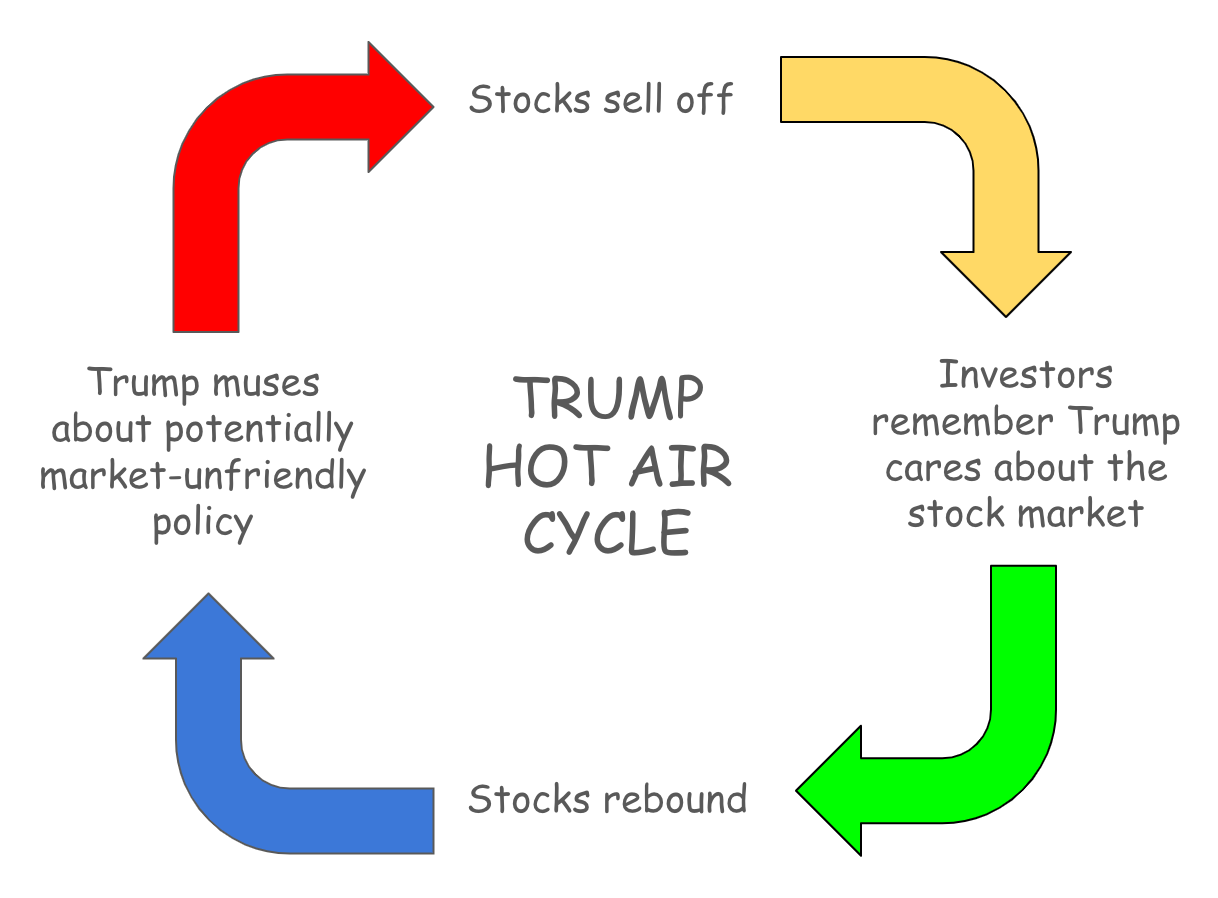
Trump Hot Air Cycle
Source: Sherwood News

When we first wrote about the “Trump Hot Air Cycle,” we noted that this method of thinking conditions investors to react late to negative catalysts — that this is a miniature version of Hyman Minsky’s “stability breeds instability” argument.

“What’s needed to break this cycle? Well, action that everyone was warned about but no one thought was coming, probably,” was the thought. Action that everybody was warned about but no one thought was coming sounds an awful lot like a scheduled “Liberation Day” Rose Garden address. And based on the reaction we’re seeing today in markets — which comes amid a continued reluctance to countenance the outcome of these measures as a new, enduring reality — yes, this has the potential to be a paradigm-shattering event.

More Markets

See all Markets
markets

Ford raises its full-year guidance, receives $1.3 billion tariff refund

Ford reported its first-quarter results after markets closed on Wednesday. The automaker’s shares climbed roughly 7% in after-hours trading on the news.

For Q1, Ford reported:

  • Adjusted earnings of $0.66 per share, compared to the $0.18 per share expected by Wall Street analysts polled by FactSet. The figure includes Ford’s tariff reimbursement.

  • $43.25 in total revenue, vs. the $42.66 billion consensus forecast. Automotive revenue came in at $39.8 billion, compared to estimates of $38.9 billion.

  • A $1.3 billion tariff refund.

Ford boosted its full-year guidance for adjusted earnings before interest and taxes to between $8.5 billion and $10.5 billion, up from between $8 billion and $10 billion.

Late last year, Ford announced it would take $19.5 billion in charges — one of the largest write-downs ever — relating mostly to its EV business. Of those charges, $7 billion will be spread across this year and next, the company said.

Earlier this month, Ford recorded an 8.8% drop in Q1 sales from the same period last year, a similar result to Detroit rival GM, which posted a 9.7% sales drop.

markets

Microsoft beats on revenue and earnings in Q3, but only meets expectations for cloud growth

Microsoft shares dipped after the company reported strong Q3 earnings postmarket Wednesday, posting ​​sales of $82.9 billion for the quarter, beating FactSet analyst estimates of $81.4 billion. Earnings per share were $4.27, handily beating estimates of $4.05. 

In a closely watched number, Microsoft’s Azure cloud business increased 40% year on year, just above the 39.7% estimated. The metric technically beat expectations, but may not be the beat investors were looking for.

Total capital expenditure for the quarter was $31.9 billion, up 49% year on year, above estimates of $27.5 billion and down from Q2’s $37.5 billion.

One thing investors were eager to find out: how is the company doing in its effort to fulfill the billions in backlogged commercial bookings? Last quarter, the company reported a staggering $625 billion in remaining performance obligations, and 45% of that was for just one customer — OpenAI.

For the third quarter, Microsoft reported a backlog of $627 billion, up 99% year on year. The company said the RPO increase was 26% — in line with “historical seasonality” — when excluding OpenAI.

Breaking down the results by the company’s business lines:

  • ☁️ 🤖 Intelligent Cloud (Azure, server products): $34.7 billion in revenue, up 30% year on year.

  • 📝 📊 Productivity and Business Processes (Microsoft 365, LinkedIn, Dynamics): $35 billion in revenue, up 17% year on year.

  • 💻 🎮 More Personal Computing (Windows, Xbox, Bing): $13.2 billion in revenue, down 1% year on year.

Microsoft CFO Amy Hood said in the earnings release:

“We delivered results that exceeded expectations across revenue, operating income, and earnings per share, reflecting strong execution and growing demand for the Microsoft Cloud.”

Latest Stories

Sherwood Media, LLC produces fresh and unique perspectives on topical financial news and is a fully owned subsidiary of Robinhood Markets, Inc., and any views expressed here do not necessarily reflect the views of any other Robinhood affiliate, including Robinhood Markets, Inc., Robinhood Financial LLC, Robinhood Securities, LLC, Robinhood Crypto, LLC, Robinhood Derivatives, LLC, or Robinhood Money, LLC. Futures and event contracts are offered through Robinhood Derivatives, LLC.
