Markets
markets
Luke Kawa

We’re about to enter the historically worst week of the year for US stocks

The September scaries — the tendency for US stocks to perform poorly in the ninth month of the year — have seemingly been vanquished this year. So far.

However, Brent Donnelly, president of Spectra Markets, was very early in highlighting a peculiar calendar quirk that implies some potential downside risk for next week.

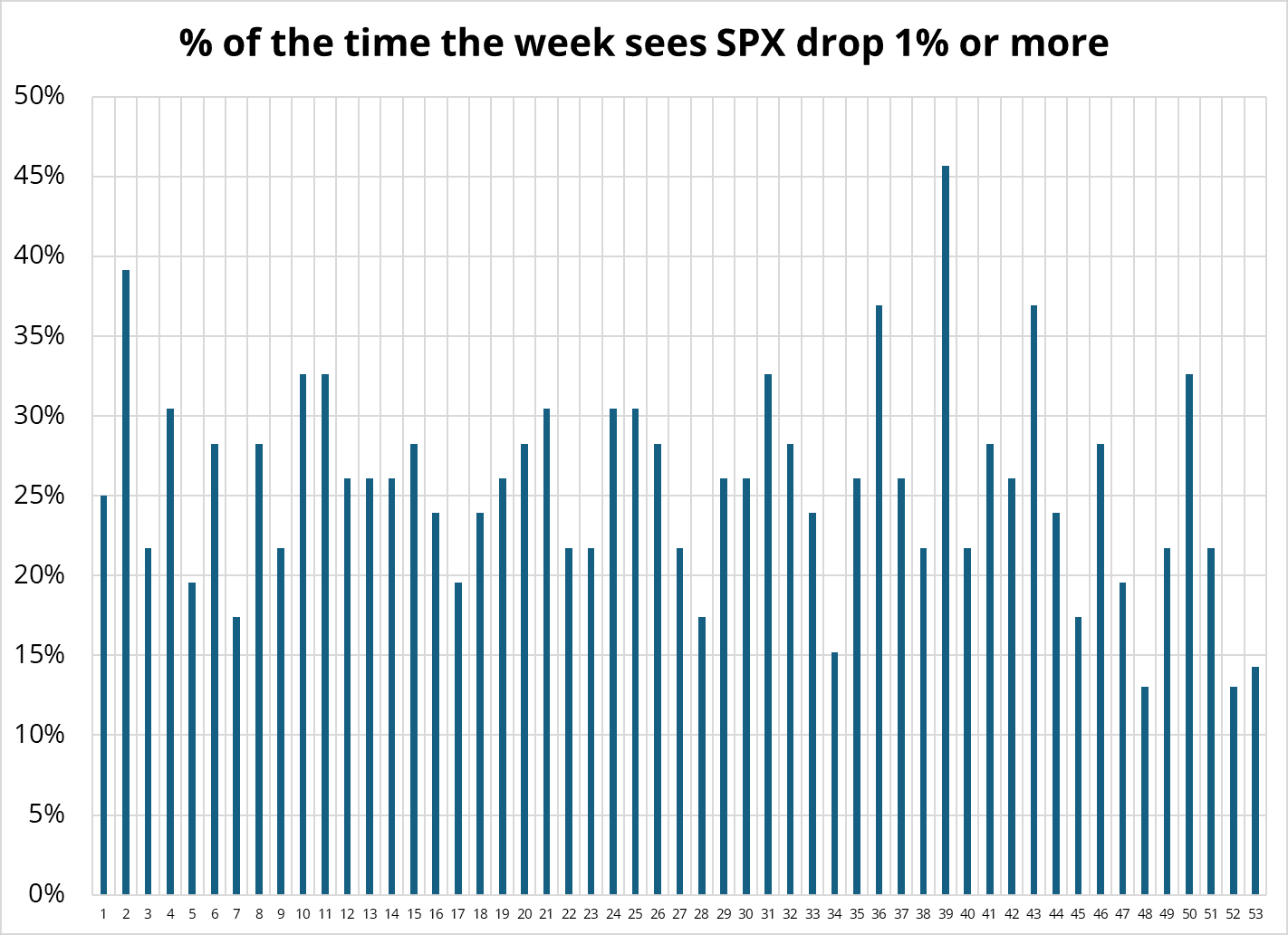
Monday marks the start of the 39th trading week of the year. That’s historically been the worst week for the S&P 500, based on data going back to 1990, and the week that’s seen the highest incidence of 1% drops for the benchmark US stock index.

“Meanwhile, the week after next is the one where stocks are most likely to have a moment,” he wrote on September 11 (last Thursday). “There is something special about the week after September expiry and this has been true for basically ever. Could be a bit of the old fooled by randomness, but anyway.”

Median return of S&P 500 by week
Source: Brent Donnelly, Spectra Markets
% of time S&P 500 sees weekly drop of 1% or more
Source: Brent Donnelly, Spectra Markets

Donnelly also separately flagged, though, that seasonality has not been that useful of a trading tool this year:

“2025 has not been good for the seasonality believers. My view is that seasonality functions mostly because of asymmetry of flows and human behavior around specific times of the year and political and macro shocks are bigger than those flows. So if you have a series of randomly-timed policy shocks month after month, that will blow the flows and the behavioral seasonality out of the water. That’s my explanation for why seasonality has not worked this year. But I could be wrong.”

More Markets

See all Markets
markets

Target rises as Q1 revenue tops estimates, guidance raised

Target shares are up in early trading Wednesday after the retail giant delivered Q1 earnings results that beat Wall Street estimates with 6.7% net sales growth, breaking a yearlong slump.

Key numbers:

  • Revenue of $25.44 billion (estimate: $24.11 billion).

  • Adjusted earnings per share of $1.71 (estimate: $1.43).

  • Same-store sales growth of 5.6% (estimate: 1.85%).

Backed by the strong quarterly performance, Target raised its full-year sales growth forecast to 4.0% compared with 2025, double its previous forecast of 2% growth. The company now projects annual EPS to land at the high end of its $7.50 to $8.50 range, beating the $8.10 consensus estimate from Wall Street.

The retail giant steps into the earnings spotlight under newly appointed CEO Michael Fiddelke, who officially took the helm in February and who’s focused on enhancing operational efficiency amid a prolonged retail sales slump.

Target yesterday announced that it tapped former Walmart exec Jeff England as chief supply chain officer to optimize inventory and delivery, part of a wider $6 billion turnaround. The retailer is also overhauling its beauty, baby, and apparel categories through exclusive Parke and Pokémon partnerships, though margins remain sensitive to inventory markdowns and labor costs.

Shares of the company have surged approximately 30% year to date, outperforming the broader retail sector.

markets

Roblox jumps after announcing $3 billion share buyback plan

Roblox rallied in postmarket trading on Tuesday after unveiling its first-ever share repurchase program.

The somewhat controversial, but certainly popular, gaming company has put forth a plan for $3 billion in future stock buybacks, with the intention to back up to $1 billion over the next 12 months. The stock subsequently jumped 4% after-hours.

On Tuesday, Naveen Chopra, chief financial officer of Roblox, said:

“Investing in continued growth will always be our highest priority, but the strength of our balance sheet and free cash flow generation allows us to support industry leading innovation while simultaneously reducing dilution.”

As of Q1 2026, Roblox had $6.2 billion in total cash, cash equivalents, and investments (for a net $5.2 billion after subtracting its $1.0 billion in debt). The company posted a consolidated net loss of $248 million in Q1.

While management has the cash on hand for a $3 billion buyback, the stock been taking hits recently — falling 28% over the past month (and 45% since the beginning of the year) as the company adjusts its safety standards. In April, the video game company slashed its full-year guidance due to age verification hurdles, which have slowed growth.

markets

Cava rallies after Q1 results impress and management hikes full-year guidance

Cava jumped 8% after the bell on Tuesday after the fast-casual Mediterranean restaurant chain was able to bring in more customers and drive up more revenue than expected in the first quarter, with management signaling that this momentum is poised to continue.

Here are the numbers:

  • Q1 revenue of $434.4 million (compared to analyst estimates of $418.2 million).

  • Q1 adjusted EBITDA of $61.7 million (estimate: $57.3 million).

  • Full-year guidance for same-restaurant sales growth of 4.5% to 6.5%, up from its prior guidance of 3% to 5% and above estimates for 4.95%.

The company also posted traffic growth of 6.8% — blowing away salad competitor Sweetgreen’s traffic decrease of 11.2% in the first quarter.

“We’re creating a bit of a bridge in a K-shaped economy and becoming very accessible for the low-income cohorts,” CFO Tricia Tolivar told Restaurant Dive. “When we look at our restaurant stratified based on median household income, we’re seeing tremendous strength in the lower-income cohorts.”

The performance of these fast-casual establishments (or slop bowl chains) has been a way to keep an eye on our increasingly unequal economy. Interestingly, as especially younger consumers seem to be pulling back, at some of these restaurants, Cava continues to perform well.

markets

AMC rallies after CEO Adam Aron purchases 250,000 shares

AMC popped in postmarket trading after a filing showed CEO, Chairman, and President Adam Aron bought 250,000 shares on Tuesday.

With this $344,350 purchase, Aron now owns more than 2.4 million shares of the theater chain he runs. He’s one of the 20 largest holders, per data compiled by Bloomberg.

Latest Stories

Sherwood Media, LLC and Chartr Limited produce fresh and unique perspectives on topical financial news and are fully owned subsidiaries of Robinhood Markets, Inc., and any views expressed here do not necessarily reflect the views of any other Robinhood affiliate, including Robinhood Markets, Inc., Robinhood Financial LLC, Robinhood Securities, LLC, Robinhood Crypto, LLC, Robinhood Money, LLC, Robinhood U.K. Ltd, Robinhood Derivatives, LLC, Robinhood Gold, LLC, Robinhood Asset Management, LLC, Robinhood Credit, Inc., Robinhood Ventures DE, LLC and, where applicable, its managed investment vehicles.