

Markets
markets
Luke Kawa

Why Apple usually falls on a new iPhone launch

You can only shock the world so many times, and a thinner phone with a better camera isn’t always going to cut it.

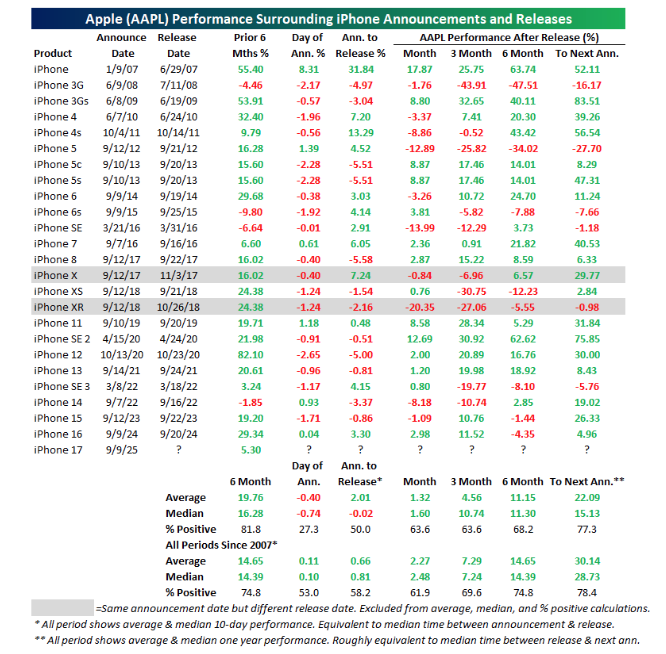
That, in short, is why Apple has tended to go down on days when it’s introduced a new iPhone to the world, as this great chart from Bespoke Investment Group shows:
Bespoke iPhone announcement Apple performance
Source: Bespoke Investment Group

On average, the tech giant falls 0.4% on the release date and is negative more than 70% of the time, perhaps a useful tidbit on this, the day of the iPhone 17 launch.

One more thing....

A potentially complicating factor to the aforementioned data is that Apple has often done quite well in the six months leading up to a new iPhone announcement, roughly 5 percentage points better than its typical six-month return, as shown above. That’s not the case this time, with Apple shares up about 5% over the past six months compared to a typical near 20% advance in the prelude to a new iPhone drop.

So it’s not like expectations about how big of a catalyst this can be for the company are sky-high and due for a sharp retrenchment, especially given Apple’s relatively lackluster progress in developing AI capabilities relative to its megacap tech peers. But a seemingly low bar to clear hasn’t necessarily been a boon for the company on the big day, either.

In any event, staring too closely at the minutiae of all this may be missing the forest for the trees.

“While this info may be helpful to traders, we doubt its something that long-term shareholders are too worried about given the huge compounding returns the stock has provided during the iPhone era,” Bespoke wrote.

More Markets

See all Markets
markets

SpaceX gets a wave of bullish ratings from Wall Street analysts

SpaceX received more than a dozen positive analyst calls on Tuesday — including from major Wall Street banks — as they initiate coverage on Elon Musk’s space and AI company.

SpaceX went public on June 12 at a $2.2 trillion valuation, the largest debut in history. While the company hasn’t yet posted a profit, it seems to have convinced Wall Street that it will get there and grow its valuation on the way.

Of the at least 17 analysts that gave a rating on Tuesday, all but one gave it a “buy” or “outperform” rating. MoffettNathanson was "neutral."

The ratings come as SpaceX joined the Nasdaq 100 index, a benchmark tech-heavy basket of companies that underpins millions of portfolios. The inclusion adds built-in demand for the stock from index funds and ETFs.

Still, SpaceX fell more than 5% on Tuesday amid a broader sell-off, and is currently effectively flat from its opening price of $150 a share.

Latest Stories

Sherwood Media, LLC and Chartr Limited produce fresh and unique perspectives on topical financial news and are fully owned subsidiaries of Robinhood Markets, Inc., and any views expressed here do not necessarily reflect the views of any other Robinhood affiliate, including Robinhood Markets, Inc., Robinhood Financial LLC, Robinhood Securities, LLC, Robinhood Crypto, LLC, Robinhood Money, LLC, Robinhood U.K. Ltd, Robinhood Derivatives, LLC, Robinhood Gold, LLC, Robinhood Asset Management, LLC, Robinhood Credit, Inc., Robinhood Ventures DE, LLC and, where applicable, its managed investment vehicles.
