
Power
Amazon risk factors
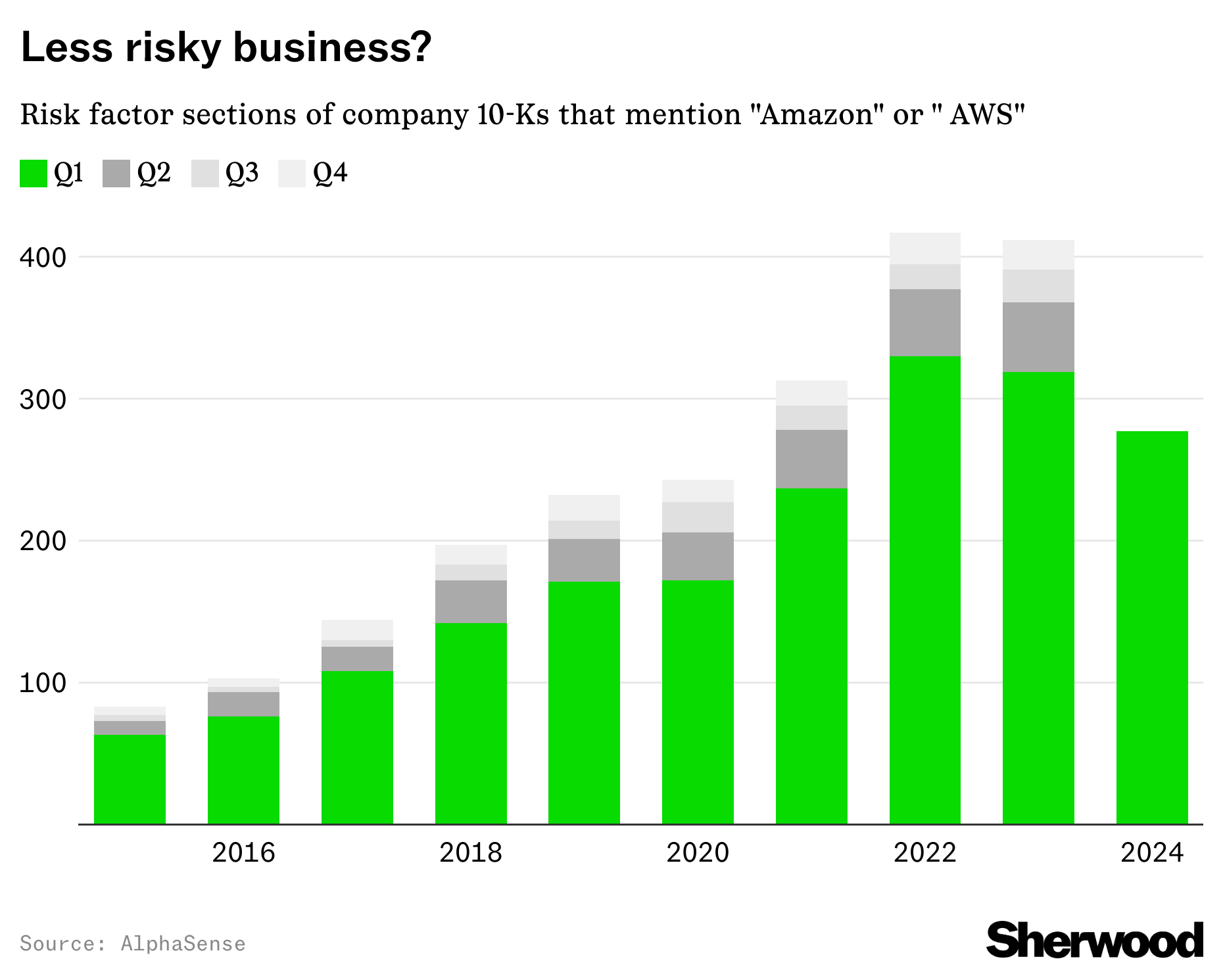
Quarterly mentions of Amazon and AWS as a risk factor on company 10-Ks had been going up for years. They peaked in 2022 and then began declining in 2023 and 2024.

Companies aren’t talking about Amazon as much as they used to

Who’s afraid of the big bad internet behemoth?

Amazon has long been the bogeyman in the boardroom.

For years it seemed all companies could talk about in their annual 10-K filings, which includes a section called Risk Factors where companies lists the most significant threats to their business, was Amazon and its Web Services division. The number of documents citing Amazon or AWS as a risk factor just kept going up.

But recently, that’s changed. In the last two years, such mentions of Amazon have started to come down, according to data from market intelligence platform AlphaSense.

Mentions on earnings transcripts and within filings overall have declined too, according to data from FactSet.

For example, travel site Booking.com, mentioned Amazon as a risk last year but didn’t this year. Last year it wrote, “Some of our current and potential competitors, such as Google, Apple, Alibaba, Tencent, Amazon, Uber, and Meta, have significantly more customers or users, consumer data, and financial and other resources than we do,” while this year it just said those competitors “include the largest global technology companies.”

It’s unlikely that Amazon, which ranks among the most valuable companies in the world by market cap, has become less of a risk. So why the relative silence?

There could be a few reasons. There are fewer public companies these days and Big Tech companies like Amazon have been buying up would-be public companies, but that’s a long-running trend that Amazon had bucked. It could also be that companies have become more cagey when it comes to mentioning their tech stacks. It’s also possible that Amazon is just not news anymore. Companies have already adopted the cloud and Amazon might be so omnipresent it no longer warrants mention (though if it’s still a risk companies should probably say so in their 10-Ks). Notably, obvious competitors like Walmart and Google never mention Amazon as a risk.

Still, it bears mention that a huge number of companies still mention Amazon among their risk factors, either due to competition from or relationships with the online retail and internet behemoth, including UPS, Roku, Netflix, Pinterest, Mattel, Sonos, American Express, and Uber.

Interestingly, Amazon — which itself has threatened to disrupt Walmart, retail in general, package delivery, bookstores, grocery stores, healthcare, you name it — has lately been finding itself in more of a defensive position than it’s used to, as it focusses on fending off other e-commerce upstarts like Temu and Shein.

“Competition continues to intensify, including with the development of new business models and the entry of new and well-funded competitors,” its latest 10-K reads, as it has for years, without mentioning any companies by name.

And maybe there is more competition that other companies are worried about. Of course, Amazon also has a vested interested in appearing to have competition, since these days antitrust regulators are what it’s most afraid of.

Amazon, whose stock risen lately thanks to the company’s AI efforts, reports earnings after market close today. Let us know if you have other theories as to why Amazon is seeming like less of a risk.

More Power

See all Power
power

WSJ: DOJ approved the Paramount-Warner Bros. deal even as investigators were leaning toward suing to stop it

The Justice Department’s approval of Paramount’s $111 billion acquisition of rival Warner Bros. Discovery Friday came as a surprise to the agency’s antitrust investigators, according to Wall Street Journal reporting.

Per the WSJ, a team of lawyers who’d scrutinized the merger were leaning toward recommending a lawsuit to block the deal, but hadn’t gotten to make their final recommendation, before they were told that it had been approved on Friday.

Antitrust investigators typically make a final recommendation to the agency in the review process — and that recommendation is often followed by the agency — but that step was reportedly skipped in this instance. Last month, Semafor reported that senior DOJ antitrust officials appeared likely to approve the Paramount-WBD combo.

The deal could still face antitrust challenges from a collection of states led by California, and EU regulators.

Per the WSJ, a team of lawyers who’d scrutinized the merger were leaning toward recommending a lawsuit to block the deal, but hadn’t gotten to make their final recommendation, before they were told that it had been approved on Friday.

Antitrust investigators typically make a final recommendation to the agency in the review process — and that recommendation is often followed by the agency — but that step was reportedly skipped in this instance. Last month, Semafor reported that senior DOJ antitrust officials appeared likely to approve the Paramount-WBD combo.

The deal could still face antitrust challenges from a collection of states led by California, and EU regulators.

power
Jake Lahut

Strait of Hormuz is closed to all oil tankers and commercial ships, Iran military says

In retaliation to US strikes, the Islamic Republic of Iran announced that the Strait of Hormuz is fully closed as of early Thursday morning in Tehran. The attacks from the US were separate from a series of retaliatory drone and missile launches overnight Tuesday into Wednesday.

President Donald Trump told Fox News in a phone interview on Wednesday night that “the bombing will stop soon,” but if Iran doesn’t sign the agreement put forward by special envoys Steve Witkoff and Jared Kushner, “we’ll bomb the shit out of them tomorrow night.”

When asked whether the ceasefire still stands, Trump described it as “the most violated ceasefire in the history of the world,” per Fox News.

According to Al Jazeerah, Iran’s Mehr news agency reported that Iran’s joint military command specified that any oil tankers or other commercial vessels will be attacked if they attempt to cross the strait.

This is the second day in a row hostilities have resumed to a level not seen since the early April ceasefire was announced.

US CENTCOM announced the series of strikes beginning at 5:15 p.m. ET on Wednesday, which Secretary of Defense Pete Hegseth previewed in on-camera remarks, promising to “strike ’em hard tonight” before later saying he would not broadcast whether the military would take any action.

Shortly after the announcement on the closure of the Strait of Hormuz to all commercial vessel traffic, Iranian state media reported that two ships attempting to cross were attacked.

This story is developing.

President Donald Trump told Fox News in a phone interview on Wednesday night that “the bombing will stop soon,” but if Iran doesn’t sign the agreement put forward by special envoys Steve Witkoff and Jared Kushner, “we’ll bomb the shit out of them tomorrow night.”

When asked whether the ceasefire still stands, Trump described it as “the most violated ceasefire in the history of the world,” per Fox News.

According to Al Jazeerah, Iran’s Mehr news agency reported that Iran’s joint military command specified that any oil tankers or other commercial vessels will be attacked if they attempt to cross the strait.

This is the second day in a row hostilities have resumed to a level not seen since the early April ceasefire was announced.

US CENTCOM announced the series of strikes beginning at 5:15 p.m. ET on Wednesday, which Secretary of Defense Pete Hegseth previewed in on-camera remarks, promising to “strike ’em hard tonight” before later saying he would not broadcast whether the military would take any action.

Shortly after the announcement on the closure of the Strait of Hormuz to all commercial vessel traffic, Iranian state media reported that two ships attempting to cross were attacked.

This story is developing.

power
Jake Lahut

United States and Iran trade retaliatory strikes, escalating war and rattling ceasefire

The war in Iran is heating back up. Overnight, both sides have been trading hostilities in a series of retaliations to other retaliations.

It marks the most robust escalation in combat since the April 8 ceasefire announcement.

Oil prices were little changed, with Brent crude futures down 0.48% as of 5:30 a.m. ET. At the same time, S&P 500 futures were down nearly 0.7% and the tech-heavy Nasdaq Composite had slipped 1.18%, as the escalations compounded a broader AI sell-off.

Travel stocks, like United Airlines and Royal Caribbean, which got a boost on Tuesday as oil prices fell, lost some of those gains in premarket trading. Meanwhile, oil giants such as Chevron and Exxon ticked higher and chipmakers such as Arm Holdings and Micron continued to slip.

The escalation ladder began ratcheting back up when Iran shot down an American helicopter with a drone while it was patrolling the Strait of Hormuz, a US official told NBC News. US forces then conducted strikes in Iran’s Qeshm Island, Sirik, Jask, and Bandar Abbas, according to Al Jazeera. In response, Iran attacked a US fleet in Bahrain, Al Jazeera also reported.

“The Iranians are trying to make clear that any attack on them would be responded to, regardless of the size and the scope,” Trita Parsi of the Quincy Institute for Responsible Statecraft in the US told Al Jazeera. “Now, of course, whether they are seeking to escalate the situation or de-escalate remains to be seen, and it will be very much measured by how they calibrated their response by attacking these US bases.”

The scope of the strikes and counterstrikes broadened out as of early Wednesday morning in Iran. Kuwait activated its air defense systems to intercept strikes, its army announced.

Mohamed Vall, a reporter for Al Jazeera reporting from inside Iran, described “a lot of activity in terms of air defence by the Iranians, and they talked about the downing of a helicopter, an American MQ-9 [drone] over Bushehr. So that gives you an idea about the scope of these attacks and counterattacks, or these retaliations across the Strait of Hormuz and the Gulf region tonight.”

Iran’s IRGC also reported targeting a hangar for American F-35 jets in Jordan, Al Jazeera reported.

Oil prices were little changed, with Brent crude futures down 0.48% as of 5:30 a.m. ET. At the same time, S&P 500 futures were down nearly 0.7% and the tech-heavy Nasdaq Composite had slipped 1.18%, as the escalations compounded a broader AI sell-off.

Travel stocks, like United Airlines and Royal Caribbean, which got a boost on Tuesday as oil prices fell, lost some of those gains in premarket trading. Meanwhile, oil giants such as Chevron and Exxon ticked higher and chipmakers such as Arm Holdings and Micron continued to slip.

The escalation ladder began ratcheting back up when Iran shot down an American helicopter with a drone while it was patrolling the Strait of Hormuz, a US official told NBC News. US forces then conducted strikes in Iran’s Qeshm Island, Sirik, Jask, and Bandar Abbas, according to Al Jazeera. In response, Iran attacked a US fleet in Bahrain, Al Jazeera also reported.

“The Iranians are trying to make clear that any attack on them would be responded to, regardless of the size and the scope,” Trita Parsi of the Quincy Institute for Responsible Statecraft in the US told Al Jazeera. “Now, of course, whether they are seeking to escalate the situation or de-escalate remains to be seen, and it will be very much measured by how they calibrated their response by attacking these US bases.”

The scope of the strikes and counterstrikes broadened out as of early Wednesday morning in Iran. Kuwait activated its air defense systems to intercept strikes, its army announced.

Mohamed Vall, a reporter for Al Jazeera reporting from inside Iran, described “a lot of activity in terms of air defence by the Iranians, and they talked about the downing of a helicopter, an American MQ-9 [drone] over Bushehr. So that gives you an idea about the scope of these attacks and counterattacks, or these retaliations across the Strait of Hormuz and the Gulf region tonight.”

Iran’s IRGC also reported targeting a hangar for American F-35 jets in Jordan, Al Jazeera reported.

power

New York legislature passes 1-year data center moratorium

The New York state legislature has passed a one-year ban on large data centers in the state.

The bill now heads to Gov. Kathy Hochul’s desk, where it faces an uncertain fate. If Hochul signs the bill, it would become the first such statewide ban to succeed in becoming law.

That’s far from certain, as Hochul has opposed state-level legislation over data centers. In May, Hochul said, “This is a local decision for municipalities, its land use, which is the purview of local governments. It’s not a statewide approach necessarily, but its something Im looking at intensely.”

In April, Maine Gov. Janet Mills vetoed a similar statewide moratorium on data centers.

Opposition to data centers is growing rapidly across the US. A federal data center moratorium bill was introduced in March, and at least 14 states have proposed pauses on data center construction, according to the National Conference of State Legislatures.

That’s far from certain, as Hochul has opposed state-level legislation over data centers. In May, Hochul said, “This is a local decision for municipalities, its land use, which is the purview of local governments. It’s not a statewide approach necessarily, but its something Im looking at intensely.”

In April, Maine Gov. Janet Mills vetoed a similar statewide moratorium on data centers.

Opposition to data centers is growing rapidly across the US. A federal data center moratorium bill was introduced in March, and at least 14 states have proposed pauses on data center construction, according to the National Conference of State Legislatures.

EU Commission Vice-President Virkkunen and Commissioner Jorgensen hold press conference

EU proposes “tech sovereignty package” to bolster domestic AI and chip industries

Europe is hastening its breakup with US tech as the Trump administration’s grip on American tech companies tightens.

Latest Stories

Sherwood Media, LLC and Chartr Limited produce fresh and unique perspectives on topical financial news and are fully owned subsidiaries of Robinhood Markets, Inc., and any views expressed here do not necessarily reflect the views of any other Robinhood affiliate, including Robinhood Markets, Inc., Robinhood Financial LLC, Robinhood Securities, LLC, Robinhood Crypto, LLC, Robinhood Money, LLC, Robinhood U.K. Ltd, Robinhood Derivatives, LLC, Robinhood Gold, LLC, Robinhood Asset Management, LLC, Robinhood Credit, Inc., Robinhood Ventures DE, LLC and, where applicable, its managed investment vehicles.