
Power
Kamala Harris
(Getty Images)

Kamala Harris aims to crack down on price-gouging, kickstarting a makeover of her economic image

Who is really to blame for inflation anyway?

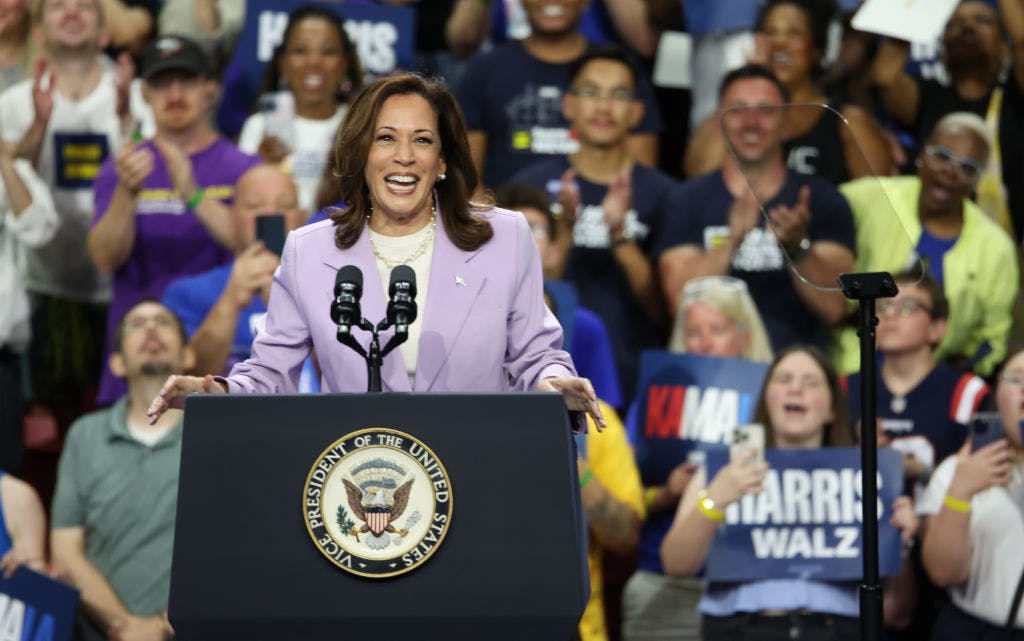
Vice President Kamala Harris will reportedly back a ban on price gouging on food and groceries, a policy proposal that pushes the blame of high prices away from the current administration and onto Corporate America. 

Price gouging is loosely defined, but is essentially when companies raise prices on essential items to unfair levels. It's not clear what the parameters of Harris' ban will be, or if she plans to execute it via legislation or a perhaps a rule from the Federal Trade Commission.

Harris is set to lay out her economic policy platform in greater detail on Friday. Everyone is confused about the economy, and it’s one of the defining issues of this election.

Americans have grappled with high prices for several years now, and despite signs that the economy is in good health, it's got people in a bad mood. That's not what you want as an incumbent.

Polls have reported that voters have generally preferred Donald Trump when it comes to the economy this election cycle, though it appears Harris is making some inroads on that front. Republicans are more likely to blame the government for inflation while Democrats are more likely to blame corporate greed, according to a June survey from Axios.

Presidents generally get outsized blame for economic outcomes, including inflation. Some things they control directly or indirectly, like tariffs or government spending, can be inflationary. But most of the factors that have driven this inflationary episode, like the pandemic and the war in Ukraine, aren’t really in their control. 

Others have blamed the Federal Reserve, which acts independently from the White House, and say the central bank may have been too slow to act to contain hot inflation.

Democrats like Harris tend to blame corporations that raised prices by more than their costs grew. 

There might be some truth to that. A January 2023 study from the Fed of Kansas City showed that corporate markup growth contributed for more than half of inflation in 2021, “a substantially higher contribution than during the preceding decade.” It’s also true that corporate profit margins haven’t been this good since the 1950s. 

Companies like PepsiCo and Kellogg increased their prices by double digits in the past two years, offsetting their own rising costs and widening their margins. Those companies have slowed down increases in recent quarters as consumers pulled back on their products, often opting for a private label.

The blame game isn't new. Before the Super Bowl, the White House posted a video featuring President Biden sitting next to a table stocked with snacks, calling on companies to put a stop to "shrinkflation."

"The American public is tired of being played for suckers," he said.

More Power

See all Power
power
Jake Lahut

Ceasefire holds on Tuesday morning following an “exchange of fire” and shipping clashes

The nearly one-month ceasefire in the Middle East was under threat of being shattered, The New York Times reports, after a series of strikes between the US and Iran escalated on Monday. That fragile ceasefire seems to be holding, however, early on Tuesday.

US warships intercepted Iranian cruise missiles aimed at Navy vessels, according to Admiral Brad Cooper, the leader of US Central Command. The US attacked Iranian speedboats in response, per the NYT, and sank six of them, Cooper reported.

On top of the UAE facing a barrage of Iranian missiles and drones the same day, hostilities appeared to be opening up on multiple fronts in the region. Al Jazeera reported one of the strikes hit a key oil facility in the emirate of Fujairah, setting it ablaze.

The BBC reported early Tuesday that Mohammad Ghalibaf, the speaker of Iran’s parliament and a top negotiator in last month’s talks, had written on X: “We know well that the continuation of the status quo is intolerable for America, while we are just getting started.”

Oil prices, by far the strongest and most immediate signal of investor sentiment about the prospect of future clashes, ticked lower on Tuesday morning as reports of attacks diminished and shipping giant Maersk said that one of its ships passed through the Strait of Hormuz under US protection.

US warships intercepted Iranian cruise missiles aimed at Navy vessels, according to Admiral Brad Cooper, the leader of US Central Command. The US attacked Iranian speedboats in response, per the NYT, and sank six of them, Cooper reported.

On top of the UAE facing a barrage of Iranian missiles and drones the same day, hostilities appeared to be opening up on multiple fronts in the region. Al Jazeera reported one of the strikes hit a key oil facility in the emirate of Fujairah, setting it ablaze.

The BBC reported early Tuesday that Mohammad Ghalibaf, the speaker of Iran’s parliament and a top negotiator in last month’s talks, had written on X: “We know well that the continuation of the status quo is intolerable for America, while we are just getting started.”

Oil prices, by far the strongest and most immediate signal of investor sentiment about the prospect of future clashes, ticked lower on Tuesday morning as reports of attacks diminished and shipping giant Maersk said that one of its ships passed through the Strait of Hormuz under US protection.

power
Jake Lahut

US on par for $4.50 per gallon in the next week or 2: Gas Buddy

Gas prices shooting up across several Midwestern states is putting the national average on track to hit $4.50 per gallon within the next two weeks, according to Gas Buddy’s Patrick De Haan.

In Michigan, the price went from $3.78 a week ago and $4.18 Tuesday to over $4.25 on Wednesday.

Loading...
 

(Event contracts are offered through Robinhood Derivatives, LLC — probabilities referenced or sourced from KalshiEx LLC or ForecastEx LLC.)

Wisconsin, where gas remained below the national average of $4.22 as of Wednesday afternoon, saw a more modest but similar jump up to $3.96 per gallon, according to the American Automobile Association.

De Haan also mentioned Ohio, Indiana, and Illinois in his post on BlueSky as contributing to the surge. Of those states, gas is most expensive in the Land of Lincoln, at $4.52 per gallon.

Loading...
 

(Event contracts are offered through Robinhood Derivatives, LLC — probabilities referenced or sourced from KalshiEx LLC or ForecastEx LLC.)

Wisconsin, where gas remained below the national average of $4.22 as of Wednesday afternoon, saw a more modest but similar jump up to $3.96 per gallon, according to the American Automobile Association.

De Haan also mentioned Ohio, Indiana, and Illinois in his post on BlueSky as contributing to the surge. Of those states, gas is most expensive in the Land of Lincoln, at $4.52 per gallon.

power

In a 1,100-word statement, United CEO says merger talks with American have ended

United’s pursuit of its rival American Airlines has ended, according to a lengthy statement from United CEO Scott Kirby on Monday.

Per Kirby, American “declined to engage” with his “big, bold vision” of a megamerger that would have controlled more than a third of the US market, instead “publicly closing the door.”

“American’s public comments make it clear that a merger like this is off the table for the foreseeable future,” said Kirby, who also believes regulators would have approved the deal.

Kirby’s effort — and sheer word count — in explaining the logic and benefits of the deal could be read as evidence that the executive is still in the market for a big combination. A common theory in the industry has been that the megamerger could have been a means to actually pitch a smaller (but still huge) merger between United and JetBlue.

President Trump last week told CNBC that he didn’t like the United-American idea and would instead “love somebody to buy Spirit.” In American’s earnings call last week, CEO Robert Isom swiftly rejected a United merger, saying the two carriers are “going to be roommates and we’re not getting married.”

“American’s public comments make it clear that a merger like this is off the table for the foreseeable future,” said Kirby, who also believes regulators would have approved the deal.

Kirby’s effort — and sheer word count — in explaining the logic and benefits of the deal could be read as evidence that the executive is still in the market for a big combination. A common theory in the industry has been that the megamerger could have been a means to actually pitch a smaller (but still huge) merger between United and JetBlue.

President Trump last week told CNBC that he didn’t like the United-American idea and would instead “love somebody to buy Spirit.” In American’s earnings call last week, CEO Robert Isom swiftly rejected a United merger, saying the two carriers are “going to be roommates and we’re not getting married.”

1
Jon Keegan

In December, the White House announced a new program to let wealthy foreigners get a shortcut to US citizenship — the Trump Gold Card. After paying a $15,000 application fee, passing a vetting process, and ultimately paying a $1 million “contribution,” the applicant gets a card in President Trump’s favorite color that grants the owner US citizenship “in record time.”

So, how many of these rich foreigners have received their shiny ticket to American residency? Commerce Secretary Howard Lutnick told a House committee today that only one of the cards has been issued, but “hundreds” of applications are being reviewed.

In December, Lutnick predicted that the cards could generate up to $1 trillion in revenue.

Latest Stories

Sherwood Media, LLC produces fresh and unique perspectives on topical financial news and is a fully owned subsidiary of Robinhood Markets, Inc., and any views expressed here do not necessarily reflect the views of any other Robinhood affiliate, including Robinhood Markets, Inc., Robinhood Financial LLC, Robinhood Securities, LLC, Robinhood Crypto, LLC, Robinhood Derivatives, LLC, or Robinhood Money, LLC. Futures and event contracts are offered through Robinhood Derivatives, LLC.