

Power
Cinder block about to fall on red alarm clock on white surface, yellow background
(Getty Images)
Against the clock

America seems ready to call time on daylight saving

A new poll finds that most US adults want to phase out the practice, as the government brings biannual clock changes into question.

Millie Giles

For those who woke up lamenting the sleep they lost last night, there’s some good news: the sun could soon be setting on daylight saving time (DST).

While President Trump described the removal of DST as a “a 50-50 issue” last Thursday, softening his previously hard-line anti-DST stance, more state-level lawmakers (and Elon Musk) are moving to scrap the time-honored ritual.

Call it a day

The biannual clock change (forward at the start of the spring; backward for winter) was initially introduced in the US during World War I and later formalized by Congress in 1966. Today, all US states besides Arizona and Hawaii participate — though 20 other states have since passed laws or resolutions to move to permanent DST, with state legislatures considering over 750 bills in recent years to establish year-round standard time as soon as federal law allows.

Generally, it seems that Americans are now less supportive of observing daylight saving. A new Gallup poll found that 54% of Americans surveyed did not support the practice, preferring year-round standard time instead — a complete reversal from decades prior, with 73% of respondents favoring DST in 1999.
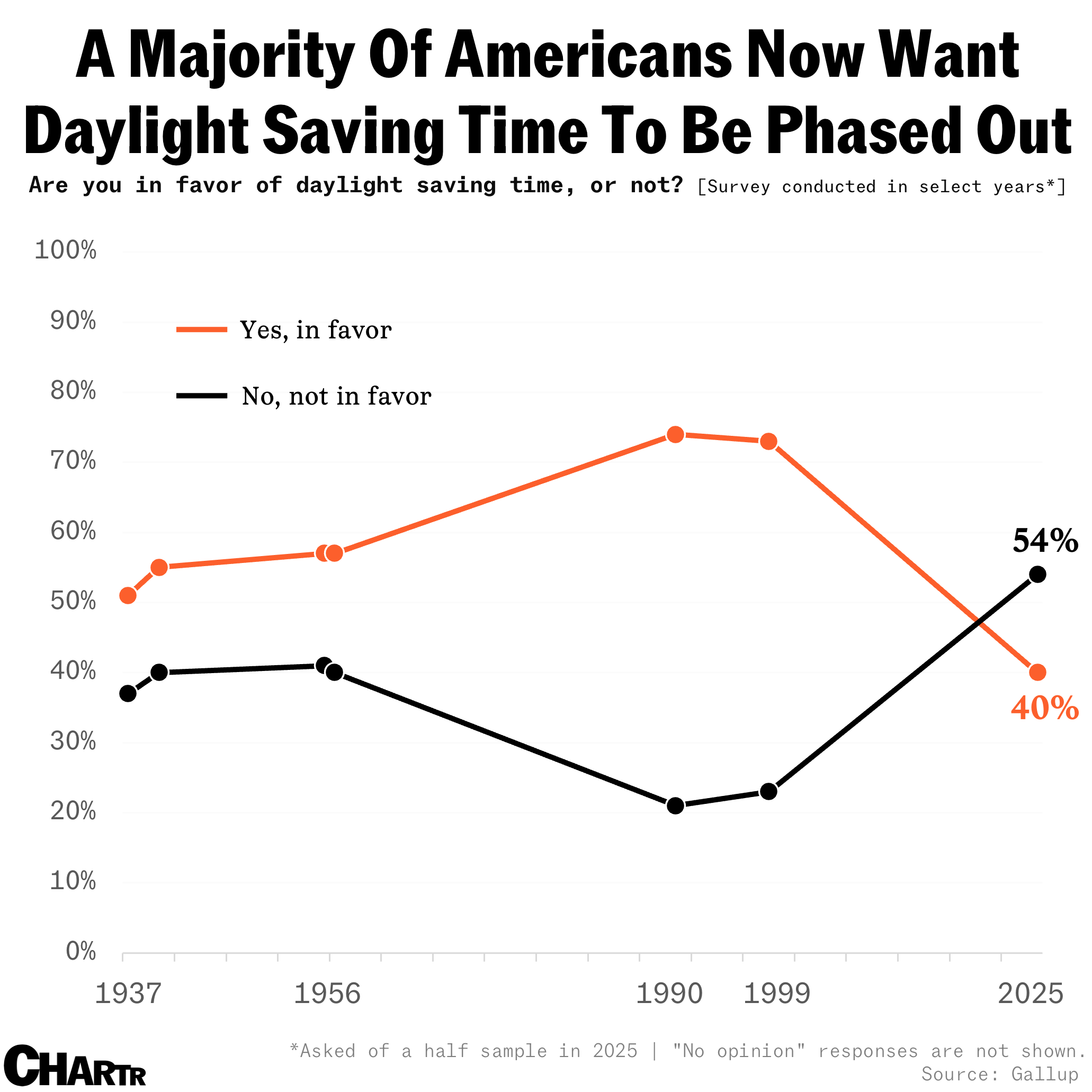
Daylight savings chart
Sherwood News

Still, this stark shift in opinion could have something to do with the 26-year gap between survey recordings, with an entire digital era in between where Americans might have become increasingly resentful of their smartphone’s untimely wake-up calls.

Cause for alarm? There’s growing evidence that twice-yearly time changes have several negative societal and health impacts, with days after the change seeing higher national rates of car accidents, strokes, heart attacks, overdoses, and even migraines, per NPR.

More Power

See all Power
power

Nvidia, Tesla, Apple, Micron CEOs head to China with Trump

Executives from some of America’s biggest companies, including Apple, Tesla, and Boeing, are joining President Trump on his trip to China this week to help facilitate trade and investment between the countries. After a last-minute invite, Nvidia CEO Jensen Huang, who was initially snubbed, is also part of a trip aimed, in part, at resolving a prolonged import-export standoff between China and the US regarding AI and semiconductor technology.

Meta President and Vice Chairman Dina Powell McCormick is also going. Recently China blew up one of Meta’s major AI bets by unwinding the company’s acquisition of AI agent startup Manus.

In a post on Truth Social, Trump said the group was journeying to China to ask President Xi to “‘open up’ China so that these brilliant people can work their magic, and help bring the People’s Republic to an even higher level!”

He added, “I have never seen or heard of any idea that would be more beneficial to our incredible Countries!”

Here’s the full list of company executives, per Reuters:

power
Jake Lahut

Iran discussing US proposal to reopen Strait of Hormuz, cease hostilities for 30 days: NYT

Iranian officials told The New York Times Thursday that they are discussing a one-page proposal with the United States to temporarily reopen the Strait of Hormuz for 30 days and cease hostilities for the same period of time.

The reopening would come in exchange for the US lifting its naval blockade and halting all hostilities for that period, per the Times. The strait would be open to commercial traffic if both sides agree to the deal, according to three Iranian officials who spoke with the NYT.

The US has not yet commented on this specific proposal.

Shortly after news broke of Iranian consideration of the proposal, the US struck oil ports on the island of Qeshm and the coastal city of Bandar Abbas, a US military official told Jennifer Griffin of Fox News. The strikes do not constitute a restarting of the war, the official said.

The reopening would come in exchange for the US lifting its naval blockade and halting all hostilities for that period, per the Times. The strait would be open to commercial traffic if both sides agree to the deal, according to three Iranian officials who spoke with the NYT.

The US has not yet commented on this specific proposal.

Shortly after news broke of Iranian consideration of the proposal, the US struck oil ports on the island of Qeshm and the coastal city of Bandar Abbas, a US military official told Jennifer Griffin of Fox News. The strikes do not constitute a restarting of the war, the official said.

power
Jake Lahut

Ceasefire holds on Tuesday morning following an “exchange of fire” and shipping clashes

The nearly one-month ceasefire in the Middle East was under threat of being shattered, The New York Times reports, after a series of strikes between the US and Iran escalated on Monday. That fragile ceasefire seems to be holding, however, early on Tuesday.

US warships intercepted Iranian cruise missiles aimed at Navy vessels, according to Admiral Brad Cooper, the leader of US Central Command. The US attacked Iranian speedboats in response, per the NYT, and sank six of them, Cooper reported.

On top of the UAE facing a barrage of Iranian missiles and drones the same day, hostilities appeared to be opening up on multiple fronts in the region. Al Jazeera reported one of the strikes hit a key oil facility in the emirate of Fujairah, setting it ablaze.

The BBC reported early Tuesday that Mohammad Ghalibaf, the speaker of Iran’s parliament and a top negotiator in last month’s talks, had written on X: “We know well that the continuation of the status quo is intolerable for America, while we are just getting started.”

Oil prices, by far the strongest and most immediate signal of investor sentiment about the prospect of future clashes, ticked lower on Tuesday morning as reports of attacks diminished and shipping giant Maersk said that one of its ships passed through the Strait of Hormuz under US protection.

US warships intercepted Iranian cruise missiles aimed at Navy vessels, according to Admiral Brad Cooper, the leader of US Central Command. The US attacked Iranian speedboats in response, per the NYT, and sank six of them, Cooper reported.

On top of the UAE facing a barrage of Iranian missiles and drones the same day, hostilities appeared to be opening up on multiple fronts in the region. Al Jazeera reported one of the strikes hit a key oil facility in the emirate of Fujairah, setting it ablaze.

The BBC reported early Tuesday that Mohammad Ghalibaf, the speaker of Iran’s parliament and a top negotiator in last month’s talks, had written on X: “We know well that the continuation of the status quo is intolerable for America, while we are just getting started.”

Oil prices, by far the strongest and most immediate signal of investor sentiment about the prospect of future clashes, ticked lower on Tuesday morning as reports of attacks diminished and shipping giant Maersk said that one of its ships passed through the Strait of Hormuz under US protection.

power
Jake Lahut

US on par for $4.50 per gallon in the next week or 2: GasBuddy

Gas prices shooting up across several Midwestern states is putting the national average on track to hit $4.50 per gallon within the next two weeks, according to GasBuddy’s Patrick De Haan.

In Michigan, the price went from $3.78 a week ago and $4.18 Tuesday to over $4.25 on Wednesday.

Loading...
 

(Event contracts are offered through Robinhood Derivatives, LLC — probabilities referenced or sourced from KalshiEx LLC or ForecastEx LLC.)

Wisconsin, where gas remained below the national average of $4.22 as of Wednesday afternoon, saw a more modest but similar jump up to $3.96 per gallon, according to the American Automobile Association.

De Haan also mentioned Ohio, Indiana, and Illinois in his post on BlueSky as contributing to the surge. Of those states, gas is most expensive in the Land of Lincoln, at $4.52 per gallon.

Loading...
 

(Event contracts are offered through Robinhood Derivatives, LLC — probabilities referenced or sourced from KalshiEx LLC or ForecastEx LLC.)

Wisconsin, where gas remained below the national average of $4.22 as of Wednesday afternoon, saw a more modest but similar jump up to $3.96 per gallon, according to the American Automobile Association.

De Haan also mentioned Ohio, Indiana, and Illinois in his post on BlueSky as contributing to the surge. Of those states, gas is most expensive in the Land of Lincoln, at $4.52 per gallon.

power

In a 1,100-word statement, United CEO says merger talks with American have ended

United’s pursuit of its rival American Airlines has ended, according to a lengthy statement from United CEO Scott Kirby on Monday.

Per Kirby, American “declined to engage” with his “big, bold vision” of a megamerger that would have controlled more than a third of the US market, instead “publicly closing the door.”

“American’s public comments make it clear that a merger like this is off the table for the foreseeable future,” said Kirby, who also believes regulators would have approved the deal.

Kirby’s effort — and sheer word count — in explaining the logic and benefits of the deal could be read as evidence that the executive is still in the market for a big combination. A common theory in the industry has been that the megamerger could have been a means to actually pitch a smaller (but still huge) merger between United and JetBlue.

President Trump last week told CNBC that he didn’t like the United-American idea and would instead “love somebody to buy Spirit.” In American’s earnings call last week, CEO Robert Isom swiftly rejected a United merger, saying the two carriers are “going to be roommates and we’re not getting married.”

“American’s public comments make it clear that a merger like this is off the table for the foreseeable future,” said Kirby, who also believes regulators would have approved the deal.

Kirby’s effort — and sheer word count — in explaining the logic and benefits of the deal could be read as evidence that the executive is still in the market for a big combination. A common theory in the industry has been that the megamerger could have been a means to actually pitch a smaller (but still huge) merger between United and JetBlue.

President Trump last week told CNBC that he didn’t like the United-American idea and would instead “love somebody to buy Spirit.” In American’s earnings call last week, CEO Robert Isom swiftly rejected a United merger, saying the two carriers are “going to be roommates and we’re not getting married.”

Latest Stories

Sherwood Media, LLC and Chartr Limited produce fresh and unique perspectives on topical financial news and are fully owned subsidiaries of Robinhood Markets, Inc., and any views expressed here do not necessarily reflect the views of any other Robinhood affiliate, including Robinhood Markets, Inc., Robinhood Financial LLC, Robinhood Securities, LLC, Robinhood Crypto, LLC, Robinhood Money, LLC, Robinhood U.K. Ltd, Robinhood Derivatives, LLC, Robinhood Gold, LLC, Robinhood Asset Management, LLC, Robinhood Credit, Inc., Robinhood Ventures DE, LLC and, where applicable, its managed investment vehicles.