

Estateenigma
The mystery of the dead billionaire
Who died and left the US $7 billion?
It was the biggest estate-tax payment in modern history, but no one knew who made it. Then an anonymous phone call pointed to one man.
Billionaires are like black holes. We deduce their existence from the fundamental laws of capitalism, see their gravity pull politics into their orbit, even detect signals of their existence in the public markets.
Determining exactly how rich anyone really is, though, can be a fool’s errand. The most profound revelation in Thomas Piketty’s era-defining “Capital in the Twenty-First Century” wasn’t that we were experiencing Gilded Age levels of inequality, but his argument that Forbes’ list of the ultrawealthy isn’t accurate — and we don’t really know the billionaires living among us, or the extent of their wealth.
Last year, observers with the economic equivalent of a radio telescope detected a radiating anomaly on the February 28, 2023, daily balance sheet of the US Treasury Department: a $7 billion estate- and gift-tax payment.
John Ricco, now an analyst at Yale University’s Budget Lab, first spotted the huge receipt while trying to answer a somewhat macabre question: how did senior-citizen deaths from Covid affect government revenues? (Quite a bit — high mortality and the frenzied pandemic stock market more than offset the Trump administration’s tax cuts.)
He was struck, though, by the appearance of that enormous deposit. “The degree by which this payment exceeds others in modern history — it’s not just, ‘Oh, this was the biggest one by 20%,’” Ricco said later. This was the biggest one by a factor of seven.
The data wasn’t erroneous, Treasury officials found, who are legally forbidden to discuss tax filings. But it was a mystery. Who died? And why didn’t they hire better tax attorneys?
It’s not just that this number is an outlier. These days, paying the estate tax is almost optional. Most estates aren’t taxed, and most people with an estate that is taxable — worth more than $13.6 million, or $27.2 million for a married couple — can afford to minimize its impact with careful tax planning and philanthropic largesse. When David Koch, the heir and conservative political activist, died in 2019, his reported $42.2 billion fortune didn’t leave a ripple in the estate-tax data. After that $7 billion payment, the next highest receipt since 2005 was just over $1 billion deposited on January 10, 2017.
You don’t wind up one of the richest people in the world without entanglement in the world of wealth-management advisers and tax attorneys. Martin Behn, an attorney at the firm Lathrop GPM who specializes in estate planning, said that sufficiently advanced planning and enough charitable donations can dramatically reduce an end-of-life levy.
There are many complexities, but one popular technique is to put assets into trusts that allow the returns to accrue for heirs without taxation. Nike founder Phil Knight, for example, put his company’s stock in a series of trusts to benefit his children. The trusts pay him a modest return, but the rest of the gains avoid incurring estate tax, including Nike shares that were worth $6.1 billion in 2021, Bloomberg reported. Such scrutiny was possible only because Knight’s position as an executive and board member at a publicly traded company entailed SEC disclosures.
Behn’s clients typically want to maximize the money they leave for their children or establish a philanthropic legacy; some seek to do both. But there’s a third group. “They say, ‘I don’t care, we’ll pay taxes. Why is the federal government any worse than the charity down the street?’”
“It feels a little un-American,” Behn said. “Usually European clients have that kind of mentality.” He referenced a quote by Learned Hand, the esteemed jurist who wrote that “there is not even a patriotic duty to increase one’s taxes” in a 1934 opinion.
Behn suspects our mystery estate originates from someone in that camp. There are other possible explanations, like dying without heirs, or without heirs you like enough to go to great lengths to preserve your dynastic wealth. Another could be family discord. A messy divorce could break apart carefully structured inheritance trusts, or cause a Rupert Murdoch-esque late-in-life reallocation between multiple heirs.
I tried to narrow down some suspects. Based on estimates of the average tax rate on estates, the February 2023 payment implied the death of someone possessing a fortune between $17.5 and $40 billion. At the upper range, it would make the person one of the 100 richest people in the world, at least on Bloomberg’s billionaire index.
And, typically, the estate tax has to be paid within nine months of death, though that can vary with extensions or audits. That suggests our billionaire strode off this mortal coil in 2022.
We lost a few that year: Herb Kohler, the plumbing magnate; Robert Toll, the homebuilder; Edward Johnson III, who built financial giant Fidelity. But despite each possessing a giant fortune, none was known, at least publicly, to have one large enough to incur a $7 billion levy — unless, against all odds, their estates made payments on the same day.
The Republican megadonor and casino mogul Sheldon Adelson passed in 2021 with an estate worth a reputed $35 billion. Could a dispute with the IRS have dragged out that payment until 2023?
No one would say, and it seemed we’d never know.
Last year, I published a brief story about the statistical mystery and had nearly forgotten about it months later when I got a phone call from a number I didn’t recognize.
The voice on the other end of the line was calling about my mysterious billionaire. A financial-services professional, the source was familiar with the handling of a certain large and publicly undervalued estate that matched the timing of the enormous payment.
Further, the person suggested that the late billionaire hadn’t sought to avoid the tax; they didn’t care about the bite being taken out of their fortune by the government, just as Behn suspected. The deceased was glad to pay up, this source said, because they came to the US as an immigrant and the country had provided them a huge opportunity.
The voice struck me as familiar with the world of high-end services available to family offices of the superwealthy. The tale seemed like a strange story to make up. If the family in question wanted to bask in the glow of public gratitude, why not simply announce it?
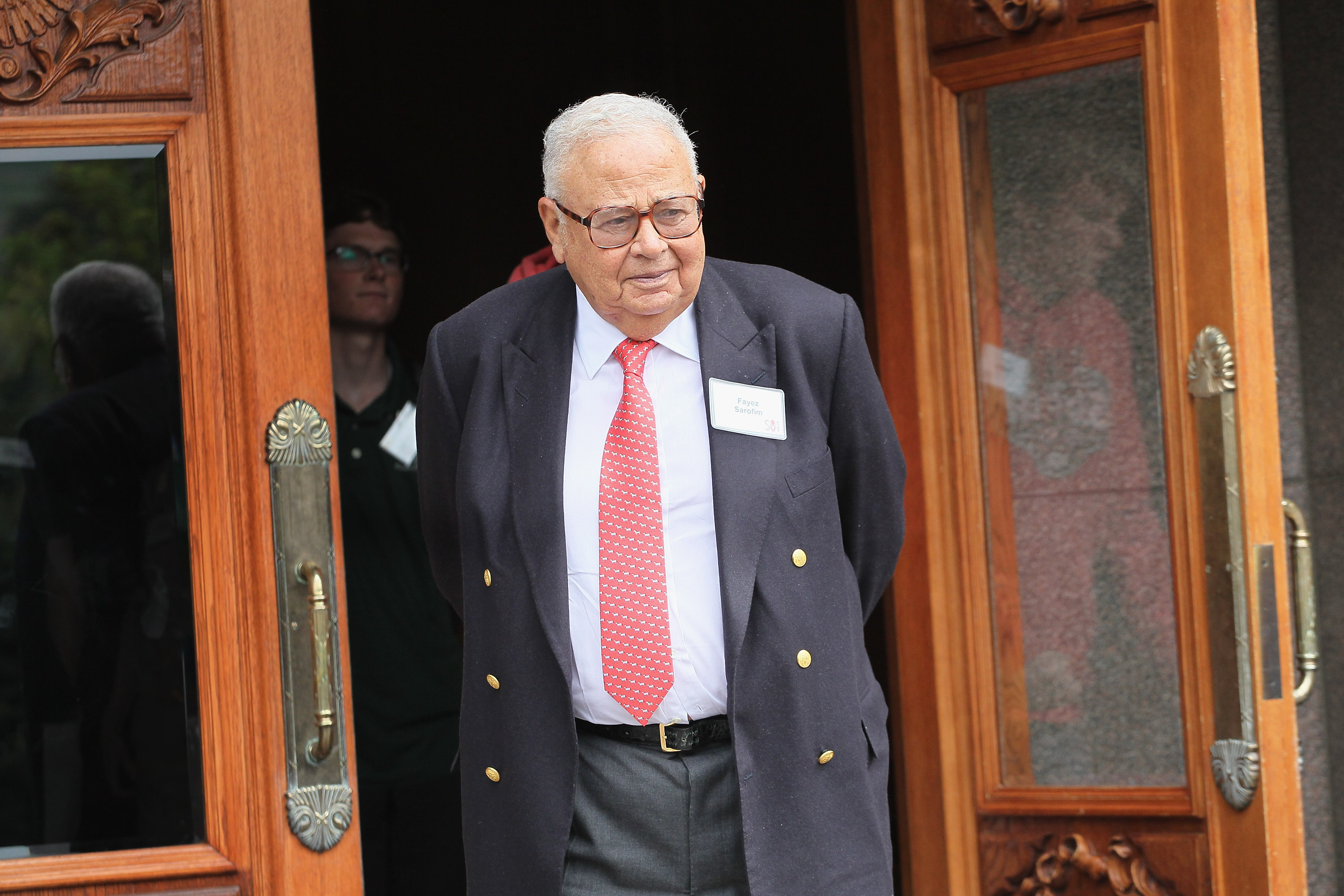
Of course, the phone number was a burner. But before they hung up, the source gave me a name for the nation’s late benefactor: Fayez Sarofim.
From afar, Sarofim fits the bill. A billionaire who existed largely beyond the eye of national news, he died in May 2022, and, most importantly to our purposes, made his fortune in opaque private-investment vehicles, not in publicly traded companies, over a six-decade career.
The son of an Egyptian landowner, Sarofim attended college in the US and moved to Houston in the 1950s. He soon hung out his shingle as an investment manager (reportedly with $100,000 from his father in hand) and gained a reputation for meticulous analysis, winning the business of Houston’s upper crust and managing the pensions of the companies they owned and universities they patronized.
Sarofim’s clients called him the Sphinx. As Texas Monthly wrote in 2000: “He spends most of his days at his office on the twenty-ninth floor of Two Houston Center, dressed as always in a tailored three-piece suit, silently smoking a cigar, his owlish face contemplative, as if he might never speak again but gradually turn into a monument.”
As a businessman, he was sagacious. Famously, he wouldn’t buy Enron because he couldn’t make sense of the balance sheet. He made headway into Houston society, marrying Louisa Stude, the adopted daughter of the founder of Brown & Root, the enormous oil-services company, and bought a mansion in the tony River Oaks neighborhood.
In 1979, though, love intervened. An affair resulted in a $250 million divorce, a new marriage, another expensive separation, and various other bits of soap-opera-worthy drama, culminating in his final marriage in 2015 to a son’s ex-wife’s mother.
But what about the money? Forbes, which first interviewed him in 1969, assessed his net worth in 2022 at $1.5 billion. He dropped off the Forbes 400 list in 2016. In 2000, Texas Monthly estimated his net worth at $2 billion to $3 billion and suggested his firm managed $45 billion. Upon his death, SEC filings pegged the firm’s assets under management at $31.6 billion.
Sarofim was also a minority owner of the NFL’s Houston Texans, which was purchased for $700 million in 1999 and valued at more than $5 billion last year. And he was an art collector with an eye for appreciation, purchasing works by Picasso, Mary Cassatt, Winslow Homer, and Andy Warhol.
We know that Sarofim made use of trusts. Tax filings for his foundation reveal nearly $400 million in post-death contributions from several Sarofim vehicles, including a management trust and his estate. In a 1999 interview with the New York Times, he even fretted about the effect of taxes on his investment strategies, which might be a point against the case that his estate is the source of our mystery tax payment. It’s safe to say that if he did expose some share of his fortune to the tax man, it was intentional.
Ultimately, my source said Sarofim’s net worth was north of $20 billion — and that was after the expensive divorces and high-end philanthropy, like $70 million for the Houston Museum of Fine Arts and $25 million to build a health center at the University of Texas.
How could public estimates of his wealth be so far off? A few factors seem relevant, including Sarofim’s wealthy father, who may have passed an inheritance of his own to his son with assets held abroad, beyond the easy reach of US authorities. Then there’s his job. Unlike billionaires like Phil Knight whose fortunes are made (and traced) through public companies, opacity is the nature of private-investment management. Some assets under management can be assessed through public filings, but fee structures and profit distribution are closely held.
Perhaps most important is what we know about Sarofim’s investment strategy. Whether or not he was patriotic about his tax payments, his reputation as an investor was betting on iconic US corporations and holding the stock long-term. He told Forbes in 1969 that it took a foreigner to see the potential of the US in the years before its post-World War II ascent as the world’s economic superpower.
Over 64 years of investing, there would have been a lot of compounding value. A single $100 investment in the S&P 500 in 1958, with dividends reinvested, would garner you more than $76,000 today, with inflation-adjusted returns of more than 7,000%. While managing a Dreyfus mutual fund between 1990 and 1999, for example, Sarofim averaged annual returns of just over 20%, Morningstar reported. Sitting on blue chip US stocks over a lifetime is the kind of thing that might just make you a secret billionaire.
Can I prove it? Try the oldest son, my source suggested; see if he’ll tell you.
He would not. Multiple emails and calls to Christopher Sarofim, who now leads his father’s firm, Fayez Sarofim & Co., were not returned. Another son, Phillip, contacted through his venture-capital firm, Trousdale Ventures, declined to comment. I didn’t hear back from Sarofim’s widow, Susan, after contacting her through her New Orleans art gallery. And Sarofim’s longtime colleague, Raye White, didn’t respond to messages left with her office or the Sarofim Foundation.
Still, there is another data point to support the allegation. As with most data produced by the federal government, more granular versions emerge with time. This year, a state-level update revealed that the $7 billion payment had indeed come from Texas. There aren’t any records to indicate the death of a different Texan with a (publicly known) fortune of that magnitude in the relevant time period.
The estate tax is a funny levy. These days, it hardly contributes to US coffers, and the earnings are a rounding error when compared to other taxes. But it plays an outsize role in the politics of taxation, with conservatives referring to the “death tax” and the (unsubstantiated) plight of family farms while progressives bring up the disproportionate power of the superwealthy.
In the US, estates have been taxed in various ways since 1797. A nation founded with a suspicion of aristocrats always prioritized political moves trimming inherited wealth. The modern estate tax emerged alongside the income tax when 20th-century progressives pushed against the robber barons — and had to answer World War I’s demands on the federal budget.
Despite growing formal and informal exemptions, today’s estate tax is the closest thing the country has to a wealth tax that someone like Sen. Bernie Sanders would like to enact. The situation seems unlikely to change when Trump’s 2017 package of tax cuts expires at the end of next year. Still, you can add “a once-in-a-decade chance to futz with tax policy” to the consequences of this year’s elections, should one party manage to win the presidency and control of Congress.
Absent confirmation from the Sarofims, there’s another potential source for that $7 billion payment. It’s the estate and gift tax, after all; the gift part is to keep people from avoiding the tax man by giving away their assets before they die.
Some tax attorneys I spoke with theorized that the $7 billion payment was in fact a gift tax paid as part of an estate-planning strategy designed to avoid an even larger payment down the road, a strategy they expect to be common ahead of the Trump tax expiration. (I note, without comment, that the richest person in the world, Elon Musk, moved to Texas in 2020.)
In other words, if the source isn’t the possibly patriotic Fayez, it means our secret billionaire is alive — and trying to minimize their taxes.
Tim Fernholz is a journalist in Oakland, CA. He is the author of “Rocket Billionaires: Elon Musk, Jeff Bezos, and the New Space Race.”