Tech
laptop with School textbooks popping out of the screen on a spring
(Getty Images)

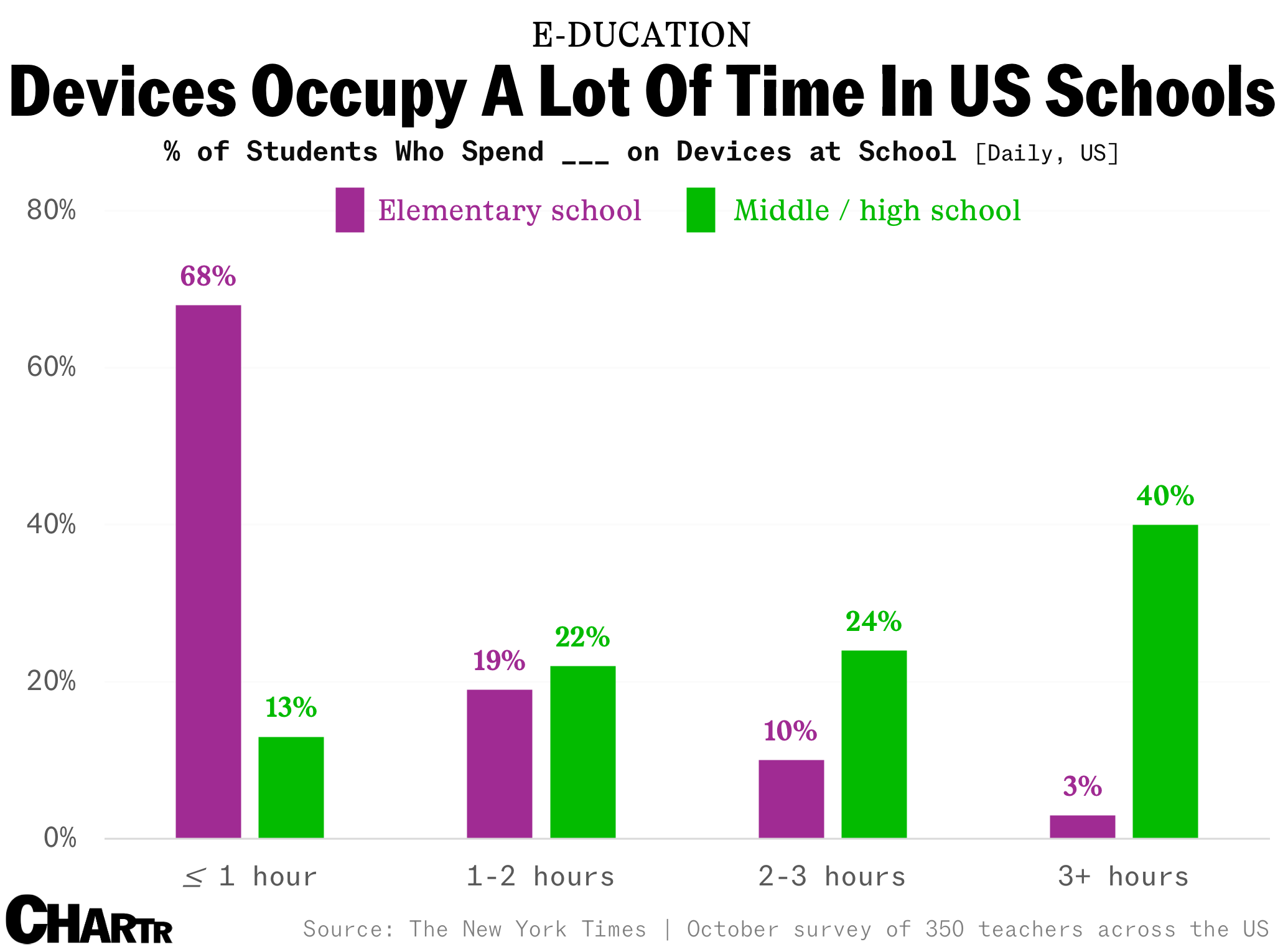
40% of middle and high school students spend about half the school day on devices

A recent NYT survey of US teachers reveals how much screen time American students get in class.

Tom Jones

In March 2020, when the pandemic had kicked off in earnest and schools shut around the world, educational institutions rushed to source e-learning devices to ensure kids could keep learning from home. Now, as we hurtle time-warpingly close to six years on from that point, students are back in class as normal, except they now arrive equipped with the devices that helped them through the remote learning era.

Plugged in

Per an October survey from The New York Times published by The Upshot last week, 8 in 10 American teachers say that students at their schools now have devices assigned to them, up from around a third who said the same in 2019. While that might not be the most surprising news to anyone who has kids or knows even a little bit about modern classroom dynamics, the amount of time some students are spending on those screens each day may come as a little more of a shock.
Student screen time chart
Sherwood News

As you might expect, tablets, laptops, and other school-issued tech are relied on less heavily in elementary schools, with a healthy majority of students spending less than one hour a day on devices in the classroom, according to their teachers. Older kids, however, spend more time with devices in school. Per the most recent Pew Research Center figures, the average school day is around six hours in the US, meaning that the 40% of middle and high school students who spend more than three hours on devices see at least half of their time in school consumed by tech.

Teachers are already worried about screens in schools — a different part of the survey revealed that 70% of respondents said devices are distracting students at least “a little” from schoolwork. Still, despite how you may personally feel, all of this becomes pretty tricky when you remember that many of the so-called “good jobs” that parents and teachers may hope children get are, when stripped back, basically just eight hours spent staring at a screen all day.


More Tech

See all Tech
tech

Report: OpenAI’s Stargate has been a chaotic mess

Just over a year ago, OpenAI CEO Sam Altman stood alongside President Trump, Oracle’s Larry Ellison, and SoftBank CEO Masayoshi Son to announce an ambitious $500 billion plan to build massive data centers in the US — Project Stargate.

While today an actual Stargate 1-gigawatt data center is certainly well under construction in Abilene, Texas, it turns out there wasn’t much of a plan in place at the time of the announcement, according to a new report from The Information.

The past year has been full of partner disputes, debt problems, and scuttled plans as the loosely defined project races to build the AI computing infrastructure that OpenAI is craving as competition heats up.

Per the report, OpenAI tried to build its own data centers as the project stalled, but lenders balked at funding the risky project. They eventually settled on the current plan, in which partner Oracle borrows the money and leases capacity back to OpenAI. OpenAI was still able to control the design of the facility.

The slow start for the project resulted in OpenAI missing its own goal of 10 gigawatts of AI computing capacity from Oracle and SoftBank by the end of 2025.

The past year has been full of partner disputes, debt problems, and scuttled plans as the loosely defined project races to build the AI computing infrastructure that OpenAI is craving as competition heats up.

Per the report, OpenAI tried to build its own data centers as the project stalled, but lenders balked at funding the risky project. They eventually settled on the current plan, in which partner Oracle borrows the money and leases capacity back to OpenAI. OpenAI was still able to control the design of the facility.

The slow start for the project resulted in OpenAI missing its own goal of 10 gigawatts of AI computing capacity from Oracle and SoftBank by the end of 2025.

tech

Ives says AI represents huge opportunity for cybersecurity firms as losses mount

Cybersecurity stocks continued to slide Monday, after Anthropic unveiled a new security feature for its AI model Friday. The company’s AI advancements have been wreaking havoc across software firms, and its latest foray appears to be doing the same to cybersecurity leaders, including CrowdStrike, Zscaler, and Cloudflare.

But similar to Dan Ives’ broader thesis on the software sell-off — which he has called “overblown,” arguing that the companies getting hit may ultimately become “core participants in the AI Revolution” — the Wedbush Securities analyst says AI is actually a positive for cybersecurity stocks.

“Anthropic going after this market with an initial tool validates our thesis that cyber security is the next frontier for the AI Revolution,” Ives wrote Monday morning, arguing that AI is elevating the risk environment — and the need for cybersecurity firms in the first place.

“AI will be a major tailwind to the cyber security sector over the coming years as protection of use cases, data, and endpoints expand markedly,” he said, adding that companies including CrowdStrike and Zscaler are well positioned to capitalize on the shift by incorporating AI into their strategies.

tech

Analysts slash Salesforce price targets ahead of Wednesday earnings, as narrative of AI eating its lunch persists

A number of analysts have significantly lowered their price targets for Salesforce, citing growing fears that AI workforce tools, including Anthropic’s Cowork, could threaten parts of its core business. According to reports, here are some of the recent cuts:

  • Morgan Stanley cut its price target nearly 30%, to $287 from $398.

  • Jefferies slashed its forecast 33%, to $250 from $375.

  • Barclays reduced its price target to $265 from $338.

  • Evercore ISI went to $260 from $340.

  • Last week, Citigroup also reduced its price target to $197 from $257.

Earlier this month, Wedbush Securities analyst Dan Ives offered a different view, adding Salesforce to his list of top 30 AI companies and calling the stock a “core participant” in the “AI revolution.” He described the recent software sell-off as “overblown.”

Shares of Salesforce, which reports earnings Wednesday, are down 30% year to date and 1% premarket today.

tech

Report: Amazon’s AI bots have been behind multiple AWS outages

Amazon’s AI tool Kiro, which launched in July and can code autonomously, was behind a 13-hour interruption to Amazon Web Services in December, according to reporting by the Financial Times.

The FT reports that the company’s AI tools have caused AWS service disruptions at least twice in recent months.

In the December outage, which Amazon called an “extremely limited event” that did not have an impact on customer-facing service, engineers allowed Kiro to make changes and the tool opted to “delete and recreate the environment.”

Amazon has a closely tracked internal target that 80% of its developers use AI to code once a week, employees told the FT. The company says the December incident was a “user access control issue” and not an issue with Kiro’s permissions.

AWS accounted for 57% of Amazon’s operating profit in 2025. In December, following a larger outage months earlier, AWS and Google announced a partnership to attempt to prevent massive network outages.

Update, February 20, 5:50 p.m. ET: In a statement to Sherwood News, an AWS spokesperson disputed the report, writing:

“These brief events were the result of user error — specifically misconfigured access controls — not AI. The December service interruption was an extremely limited event when a single service (AWS Cost Explorer — which helps customers visualize, understand, and manage AWS costs and usage over time) in one of our two Regions in Mainland China was affected. This event didnt impact compute, storage, database, AI technologies, or any other of the hundreds of services that we run. We are not aware of any related customer inquiries resulting from this isolated interruption. Following these events, we implemented numerous additional safeguards, including mandatory peer review for production access, enhanced training on AI-assisted troubleshooting, and resource protection measures. Kiro puts developers in control — users need to configure which actions Kiro can take, and by default, Kiro requests authorization before taking any action.”

In the December outage, which Amazon called an “extremely limited event” that did not have an impact on customer-facing service, engineers allowed Kiro to make changes and the tool opted to “delete and recreate the environment.”

Amazon has a closely tracked internal target that 80% of its developers use AI to code once a week, employees told the FT. The company says the December incident was a “user access control issue” and not an issue with Kiro’s permissions.

AWS accounted for 57% of Amazon’s operating profit in 2025. In December, following a larger outage months earlier, AWS and Google announced a partnership to attempt to prevent massive network outages.

Update, February 20, 5:50 p.m. ET: In a statement to Sherwood News, an AWS spokesperson disputed the report, writing:

“These brief events were the result of user error — specifically misconfigured access controls — not AI. The December service interruption was an extremely limited event when a single service (AWS Cost Explorer — which helps customers visualize, understand, and manage AWS costs and usage over time) in one of our two Regions in Mainland China was affected. This event didnt impact compute, storage, database, AI technologies, or any other of the hundreds of services that we run. We are not aware of any related customer inquiries resulting from this isolated interruption. Following these events, we implemented numerous additional safeguards, including mandatory peer review for production access, enhanced training on AI-assisted troubleshooting, and resource protection measures. Kiro puts developers in control — users need to configure which actions Kiro can take, and by default, Kiro requests authorization before taking any action.”

$830B

OpenAI is finalizing commitments on a funding round that could climb beyond $100 billion at a valuation of $830 billion, according to a report from The Information.

Per The Information, SoftBank is expected to invest $30 billion into the ChatGPT maker, spread across the year in three installments of $10 billion. Up to $50 billion could come from Amazon and $30 billion from Nvidia (up from the $20 billion Bloomberg reported earlier this month). An additional investment in the low billions could come from Microsoft.

OpenAI was last valued at $500 billion following a fundraising round completed in October. Earlier this month, its rival Anthropic took in $30 billion from investors including Microsoft and Nvidia at a $380 billion valuation.

Latest Stories

Sherwood Media, LLC produces fresh and unique perspectives on topical financial news and is a fully owned subsidiary of Robinhood Markets, Inc., and any views expressed here do not necessarily reflect the views of any other Robinhood affiliate, including Robinhood Markets, Inc., Robinhood Financial LLC, Robinhood Securities, LLC, Robinhood Crypto, LLC, or Robinhood Money, LLC.