Waymo, Lyft, Tesla: Who’s behind the wheel of the US robotaxi industry?
When it comes to autonomous ride-hailing, no company is an island — except maybe Tesla. We mapped out the relationships.
The race to put self-driving taxis on American roads has reached Autobahn speeds in 2025.
As more vehicles, tests, and partnerships are announced by the day, keeping track of the industry is becoming even more difficult.
The first thing you need to understand is that many of the leaders in the robotaxi space, including Uber, Lyft, and Google’s Waymo, are relying on relationships with other companies — autonomous tech outfits, vehicle makers, fleet managers — to help furnish grand ambitions of driving Americans around autonomously.
Thankfully, we’ve mapped out the extensive web of partnerships for you, and the diagram is pretty mind-blowing. Hover over any company and you’ll see which other companies they’re tied to.
For example, Waymo has partnered with Uber and Lyft in different markets to manage their fleets or use their existing ride-hailing platforms. Waymo, which also has its own titular ride platform, creates much of its autonomous tech in-house. It adds that tech to vehicles made by Jaguar Land Rover, which is owned by Tata Motors, and Zeekr, which is owned by Geely Automobile Holdings.
Uber and Lyft themselves work with vehicle manufacturers and autonomous tech companies for their own robotaxi ambitions, too. In April, Volkswagen and Uber announced a long-term partnership, with service planned to begin next year in Los Angeles. This month, the first vehicle (of 20,000) from Uber’s partnership with luxury EV maker Lucid was delivered to the autonomous tech maker Nuro.
These relationships — between tech companies, automakers, ride-hailing platforms, and even car rental giants (did you know Avis will manage Waymo’s Dallas fleet?) — reveal a deeply interconnected yet competitive industry: dog-eat-dog, dog-help-dog, dog-help-dog-eat-dog, and so on.
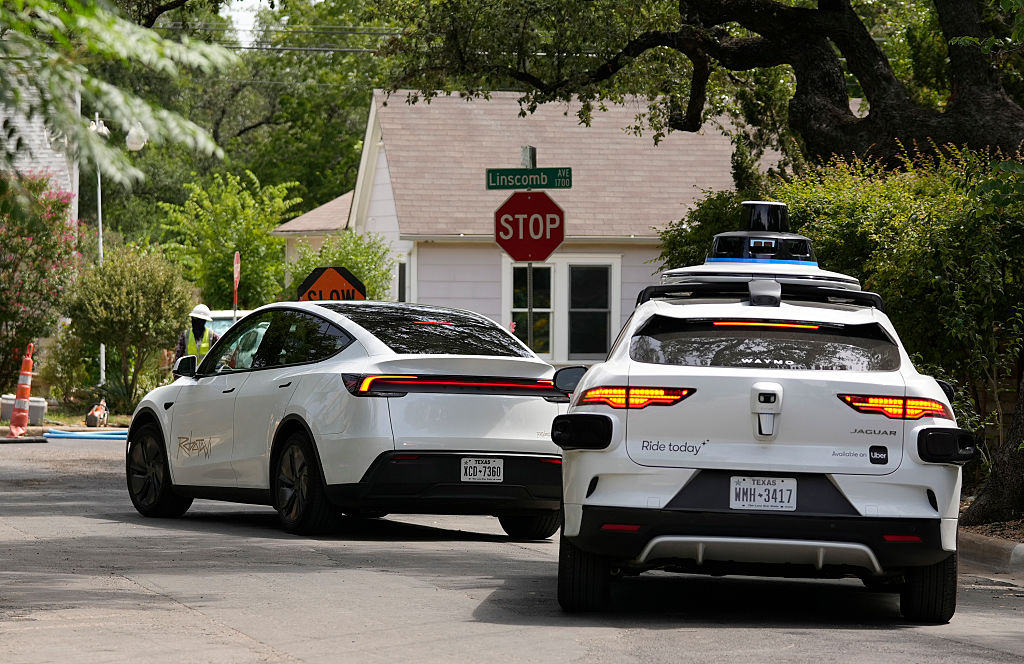
Tesla is the odd man out in that it’s a robotaxi, platform, autonomous tech company, vehicle manufacturer, and fleet manager all in one. The company currently runs an autonomous robotaxi operation with a human safety monitor in the passenger seat, and sometimes the driver’s seat, with roughly 30 vehicles in Austin. It’s conducting more traditional ride-hailing, with a driver using Full Self-Driving technology in the driver’s seat, in the Bay Area. Tesla, which didn’t respond to a request for comment on this piece, is testing its robotaxis in California and Nevada, and has applied to do so in Arizona as well.
Zoox, which is owned by Amazon and is also a bit of an island as far as partnerships go, recently rolled out free rides in its autonomous, toaster-esque cars on the Vegas Strip.
Nvidia is also a player of note in the robotaxi space, supplying chips for a number of autonomous vehicles including Zoox and Hyundai — though we didn’t consider that relationship to be a direct partnership when building out the web.
Not included in any of this are several scrapped US robotaxi plans and partnerships that have already hit the industry. General Motors pulled the plug on Cruise earlier this year after investing nine years and $10 billion into the program. And last year, Hyundai-backed Motional suspended its robotaxi service in Las Vegas, where it was partnered with Uber and Lyft, amid funding struggles.
As of today, America’s operational robotaxi services are limited: there’s Waymo in Atlanta, Austin, LA, Phoenix, and San Francisco; Tesla in Austin; and Zoox in Las Vegas. Plans for services in Dallas, Miami, Nashville, and Washington, DC, have been announced, and testing is underway or recently wrapped in even more markets. Still more pilots, like Lucid and Uber’s service announced in July and set to launch next year, have yet to make their first city public.
Even with a limited launch, robotaxis are making a big dent in the markets they enter. In May, Uber CEO Dara Khosrowshahi said Waymo’s roughly 100 vehicles in Austin were completing more trips than 99% of human drivers in the city. By the end of Uber’s first month offering Waymo rides in the city, the robotaxis accounted for roughly a fifth of all Uber rides.
Currently, Waymo is the biggest robotaxi operation in the US, with more than 2,000 vehicles in service. But autonomous companies and their boosters have much bigger ambitions.
Waymo aims to be “the world’s most trusted driver.”
Tesla CEO Elon Musk, meanwhile, has said he expects autonomous ride-hailing to be available to “half the population of the US by the end of the year” and believes that Tesla will achieve 99% market share.
Ark Invest has said that autonomous driving will reduce the cost of ride-hailing and expand the market for such services, estimating that robotaxi platforms could scale to about $4 trillion in net revenue in 2030, with a total addressable market worth $10 trillion.
Of course, to achieve those goals, the companies will have to not only overcome numerous technical challenges, but they’ll also have to convince the public to get into their self-driving vehicles in the first place.
That could be tough. About 70% of Americans in a recent survey by Electric Vehicle Intelligence Report said they wouldn’t ride in one, and about 40% think they should be illegal.