
Tech
Data tunnel
(Getty Images)

AI is eating the startup world

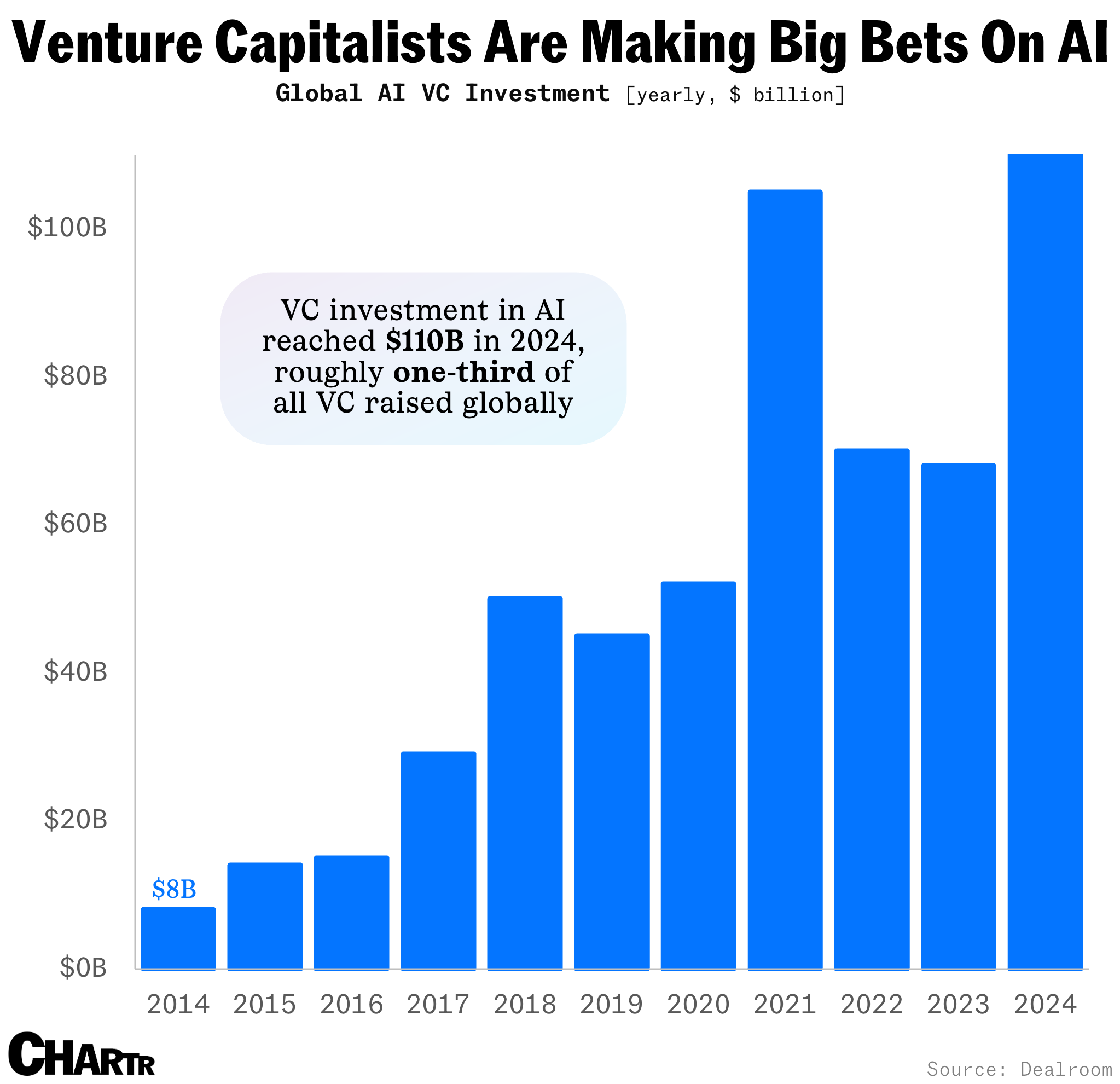
Venture capitalists splurged $110 billion on AI startups last year.

Increasingly, the due diligence for getting an ambitious world-changing technology business funded starts with a simple question: how does it use AI?

If the answer is it doesn’t, don’t expect the global gatekeepers of startup capital to go out of their way to write you a check. According to new data out this week from analytics firm Dealroom, the AI funding frenzy continued at pace last year with ~$110 billion pouring into the sector globally, about 33% of the total investment in the entire VC space.

This figure included outsized funding rounds like AI’s poster child OpenAI raking in $6.6 billion and AI data-processing platform Databricks with an even more staggering $10 billion.
AI VC investment
Sherwood News

But the boom isn’t just limited to more established, later-stage companies. Even at the very earliest stages of the venture capital funding ladder — seed and pre-seed stages — the omnipresence of AI is staggering.

AI: In everything, everywhere, all at once

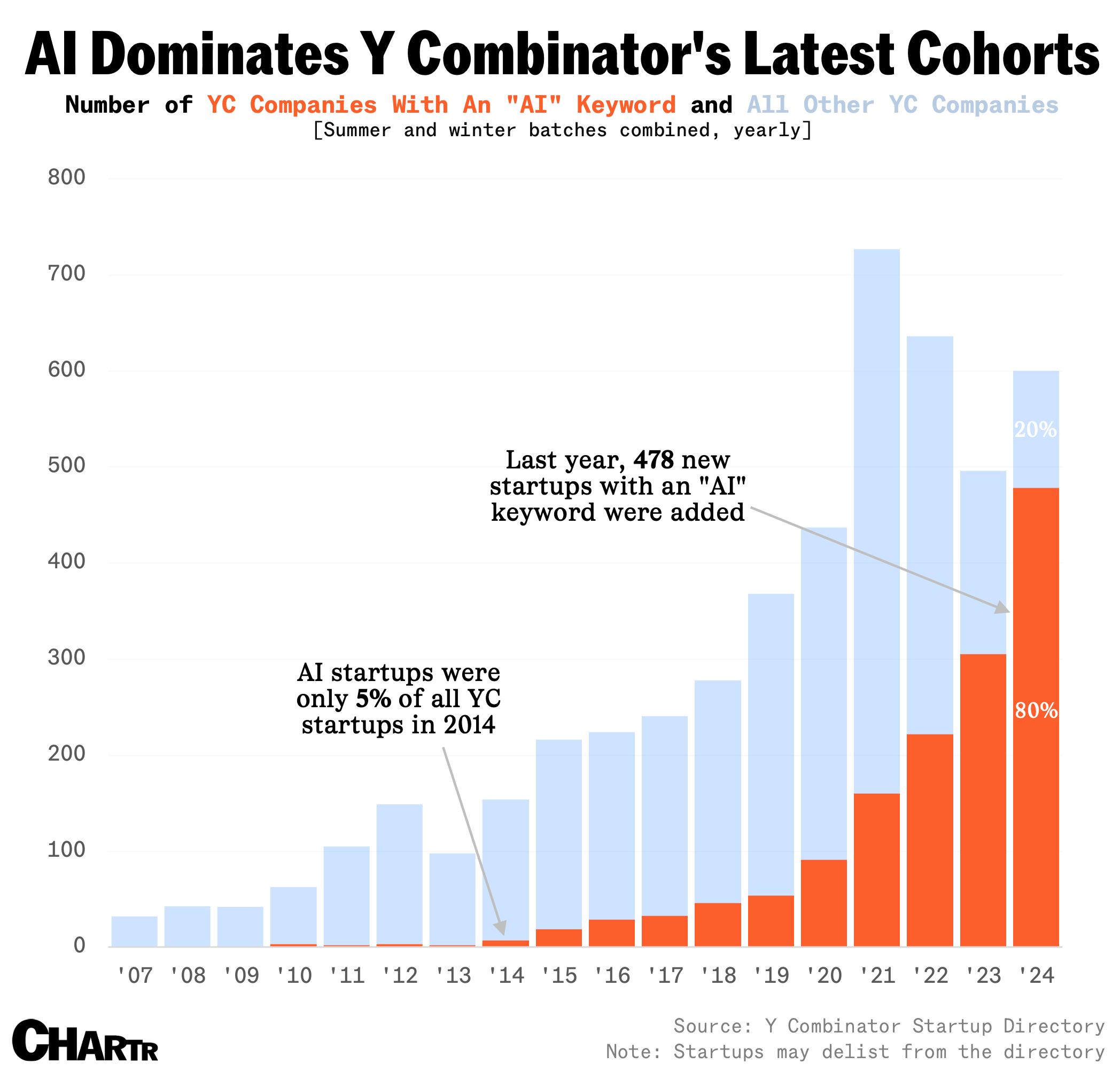
Last year we wrote about how Y Combinator — the world’s preeminent startup accelerator that has backed Airbnb, Reddit, and Stripe — was seeing an overwhelming influx of founders and startups working in AI.

Indeed, data from Y Combinator reveals that some 80% of the companies in its Startup Directory last year had “AI” in either the company name or description of what it does. Just five years ago, that proportion was only 15%.
Y Combinator proportion of startups with “AI” in name or description chart
Sherwood News

Clearly, there are multiple factors at play. Some are straightforward:

  • AI is progressing on a weekly or even daily basis, creating new opportunities for entrepreneurs to use AI as a tool in almost every industry.

Some are a bit more cynical, like FOMO, signaling, or playing the odds:

  • VC investors don’t want to miss out on the boom, with some blindly backing almost anything AI-adjacent.

  • Startup founders know that AI is the hot thing now, and are finding ways to incorporate it into their products... no matter what their original product idea was.

Winners and losers

Venture capital investing is inherently a high-risk endeavor. The typical model for a VC fund follows a power law and requires that one or two breakout mega-successes pay for the dozens of failures.

That law will undoubtedly play out again in the AI space. Most of the startups will fail as they scramble to figure out a viable business model. And raising billions isn’t always enough — Inflection AI, for one, made no money and had to fold its original generative-AI business even after raising $1.5 billion. Even the tech giants, like Meta, admitted earlier last year that the company is “scaling the product before it is making money,” pledging to spend up to $65 billion on AI this year.

Ultimately, it’s still unclear to almost everyone exactly where in the value chain the profit pools will finally accumulate. Will the infrastructure and chip providers like Nvidia be the ultimate winners? Or will it be the creators of the foundational models like OpenAI, Meta, or Alphabet? What about the downstream effects? Will Duolingo, a language-learning app, become completely obsolete because AI will provide perfect translation in real time? Or will AI enable Duolingo to build more powerful tools than ever before?

It’s still too early to tell, which is why the VC market has exploded in almost every vertical, even after the end of the global zero-interest rate era. After a record year in 2021, the VC world rightsized in 2022 and 2023 before a 30% jump in total capital raised last year, thanks primarily to a 62% growth in AI-related venture capital, while investments in the rest of tech fell 12%. VC investors can’t hang around on the sidelines.

More Tech

See all Tech
tech

Apple poaches Meta’s chief legal officer

Just a day after Meta announced that it had hired away Apple’s user interface design lead, Apple has announced that it’s poached Jennifer Newstead, Meta’s chief legal officer, to become Apple’s new general counsel. Kate Adams, Apple’s general counsel since 2017, will be retiring late next year.

Apple also announced the retirement of Lisa Jackson, vice president for Environment, Policy, and Social Initiatives, who will leave the company in late January 2026.

The flurry of high-level management changes at Apple happens amid fervent speculation that CEO Tim Cook may be retiring soon.

Apple also announced the retirement of Lisa Jackson, vice president for Environment, Policy, and Social Initiatives, who will leave the company in late January 2026.

The flurry of high-level management changes at Apple happens amid fervent speculation that CEO Tim Cook may be retiring soon.

tech

EU calls for bids to build “AI gigafactories” in 2026

The European Union wants to shore up its domestic AI infrastructure and reduce its dependence on American tech companies.

To further this goal, the bloc is planning on accepting bids to build EU-based “AI gigafactories,” according to a report from The Wall Street Journal.

EU Executive Vice-President for Tech Sovereignty, Security and Democracy Henna Virkkunen announced that bids would begin in January or February, per the report.

As the AI arms race heats up, countries are racing to secure their own sovereign AI infrastructure, including building their own AI models that reflect their culture and language and offer control over cloud computing resources.

Europe is lagging behind the US and Asia in AI infrastructure. But it may be hard for the EU to fully break free of American tech — unlike the US and China, there is no European alternative for the powerful GPUs needed to train and run AI models. It’s very likely that any AI gigafactories in the EU will be filled with GPUs from Nvidia.

EU Executive Vice-President for Tech Sovereignty, Security and Democracy Henna Virkkunen announced that bids would begin in January or February, per the report.

As the AI arms race heats up, countries are racing to secure their own sovereign AI infrastructure, including building their own AI models that reflect their culture and language and offer control over cloud computing resources.

Europe is lagging behind the US and Asia in AI infrastructure. But it may be hard for the EU to fully break free of American tech — unlike the US and China, there is no European alternative for the powerful GPUs needed to train and run AI models. It’s very likely that any AI gigafactories in the EU will be filled with GPUs from Nvidia.

tech

Google’s AI chip business could be a $900 billion boon for the company

Google may be sitting on a massive new business that it has yet to fully exploit.

Google’s custom tensor processing unit (TPU) AI chips have been getting a lot of attention recently, making the tech world wonder if there are other ways to power its AI dreams rather than just by using Nvidia’s GPUs.

Bloomberg spoke with analysts who estimate that, if it does decide to sell its chips to others, Google could capture 20% of the AI market, making it a $900 billion business. For comparison, Google Cloud pulled in $43.2 billion of revenue last year.

Even if Google just sticks with renting access to its TPUs, it will continue to drive down costs and increase margins as it ekes out performance improvements, such as the 30x improvement in power efficiency that the latest generation of TPUs has delivered for the company.

Bloomberg spoke with analysts who estimate that, if it does decide to sell its chips to others, Google could capture 20% of the AI market, making it a $900 billion business. For comparison, Google Cloud pulled in $43.2 billion of revenue last year.

Even if Google just sticks with renting access to its TPUs, it will continue to drive down costs and increase margins as it ekes out performance improvements, such as the 30x improvement in power efficiency that the latest generation of TPUs has delivered for the company.

tech

OpenAI’s Sam Altman has explored bringing his feud with Tesla’s Elon Musk to space

Billionaires, they’re just like us: they want to bring their terrestrial beefs to outer space.

OpenAI CEO Sam Altman has explored buying or partnering with a rocket company to compete with Tesla CEO Elon Musk’s SpaceX, The Wall Street Journal reports. The two billionaires have had numerous public feuds over the years that have played out in the courts and on social media. They also both lead AI companies that have insatiable needs for data centers and have publicly discussed building data centers in space.

Altman seems like he thinks this could be more than science fiction. He reportedly reached out to rocket maker Stoke Space to potentially make equity investments in the company to get a controlling stake, though the talks are no longer active, WSJ reports.

Or perhaps he just wanted a Sherwood bobblehead of himself.

tech

Report: Meta to slash metaverse, VR spending by up to 30%

Four years after changing its name to reflect its focus on the loosely defined “metaverse,” Meta is planning deep cuts to the company’s money-losing virtual reality efforts, according to a report from Bloomberg.

Meta’s Reality Labs division, home to the teams working on metaverse products — which include Quest VR headsets, Horizon Worlds, and its Ray-Ban Meta glasses — has lost about $70 billion since the company started breaking out the unit in 2020.

The company has struggled to get consumers to buy into CEO Mark Zuckerberg’s vision of working and playing in virtual reality worlds, like the company’s Horizon Worlds platform.

Investors seem to love the news of the pivot, as shares shot up as much as 5% in early trading.

Meta’s recent hiring spree of AI superstars from competitors for its Meta Superintelligence Labs shows that the company’s attention is now all in on AI.

Meta’s Reality Labs division, home to the teams working on metaverse products — which include Quest VR headsets, Horizon Worlds, and its Ray-Ban Meta glasses — has lost about $70 billion since the company started breaking out the unit in 2020.

The company has struggled to get consumers to buy into CEO Mark Zuckerberg’s vision of working and playing in virtual reality worlds, like the company’s Horizon Worlds platform.

Investors seem to love the news of the pivot, as shares shot up as much as 5% in early trading.

Meta’s recent hiring spree of AI superstars from competitors for its Meta Superintelligence Labs shows that the company’s attention is now all in on AI.

Latest Stories

Sherwood Media, LLC produces fresh and unique perspectives on topical financial news and is a fully owned subsidiary of Robinhood Markets, Inc., and any views expressed here do not necessarily reflect the views of any other Robinhood affiliate, including Robinhood Markets, Inc., Robinhood Financial LLC, Robinhood Securities, LLC, Robinhood Crypto, LLC, or Robinhood Money, LLC.