
Tech
CHINA-ECONOMY-FORUM
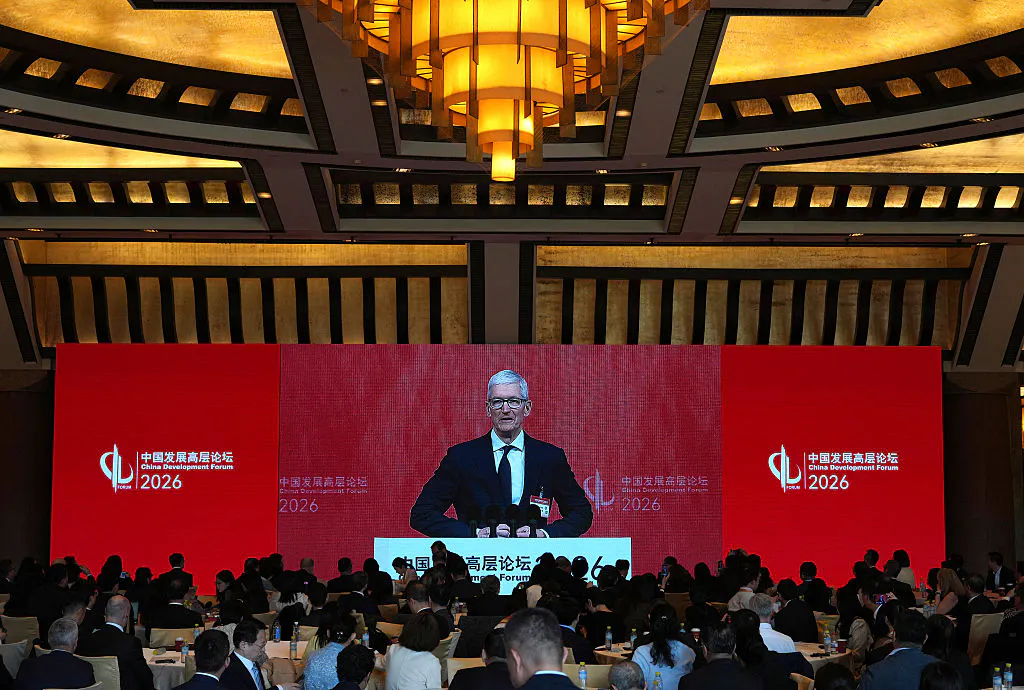
Apple CEO Tim Cook on a big screen broadcasting his speech live at the opening of the China Development Forum 2026 in Beijing in March (Ng Han Guan/Getty Images)
Let Tim Cook

Apple is on its way to becoming the biggest smartphone seller in China

The memory crunch has made iPhones a more popular alternative as competitors’ prices rise.

Apple CEO Tim Cook earlier this year hailed the company’s holiday quarter as “the best iPhone quarter in history in Greater China,” with sales jumping 38%. New data for the first quarter of 2026 suggests Apple’s success in the world’s largest smartphone market is continuing, with shipments up double digits even as overall smartphone sales in China declined. That growth was fueled in part by the iPhone 17 itself, whose new design and colors helped Apple capitalize on a massive upgrade cycle.

The result: Apple’s smartphone shipment market share jumped to 19% in Q1 — typically a weak quarter for Apple — putting it just behind China’s own Huawei. And analysts expect Apple’s string of luck to continue, even as Cook, who is largely responsible for Apple’s success in China, steps down as CEO.

“Apple will very likely become number one in China,” Francisco Jeronimo, vice president of client devices at IDC, told Sherwood News, noting that in the first quarter, the gap between Huawei and Apple’s market share was less than 1% — a vulnerability exacerbated by recent launch delays for Huawei’s latest Mate 80 series. He estimates that Apple could take the top spot as early as the end of the year.

How did Apple get to this spot, when many American tech companies struggle to gain a foothold or even access to the Chinese market? There are two main reasons: one old, one new.

Apple became such a strong brand in China partly because the iPhone is manufactured in China, a move driven and nurtured by Cook that not only made Apple a household name there, but unintentionally set off a wave of copycats that also further boosted Apple’s cachet.

“Manufacturers in China learned how to build iPhones and started replicating that design,” Jeronimo said. “That gave consumers an option to buy a device that is not an iPhone, but looks exactly as an iPhone.”

Meanwhile, those who could afford the real thing bought the actual iPhone.

The result was a powerful dual effect: Apple’s design became the standard across China’s smartphone market, while the iPhone itself remained a premium, aspirational product. Building its devices in China also gave Apple the relationships and footing needed to operate in the lucrative market in the first place. Even as cheaper look-alikes spread, they reinforced demand for the real thing, helping cement the iPhone as a status symbol that consumers continue to trade up to, even in a slowing market.

More recently, rising memory costs have helped put the aspirational iPhone within reach for more consumers. As lower-end smartphone makers are forced to raise prices by roughly 30% to 50%, Apple has used its leverage over suppliers to keep its own prices relatively stable. Coupled with expanded Chinese smartphone subsidies, that has brought iPhones much closer in price to competing devices, making the trade-up easier to justify.

“Memory inflation is forcing many Chinese brands into a loss-leader pricing mentality just to maintain volume — Apple doesnt face the same structural pressure,” Ivan Lam, a senior analyst at Counterpoint Research, told Sherwood. The situation has “narrowed the price gap with iPhone and made Apples value case even cleaner.”

Going forward, analysts expect Apple’s winning streak to continue.

For one, Cook is staying on as Apple’s executive chairman, where he can continue the diplomacy that helped preserve Apple’s standing in both China and the United States.

Apple also has another potential tailwind on the horizon: it is expected to release a foldable phone this fall, and China is already the world’s biggest market for foldables.


More Tech

See all Tech
tech

Microsoft loses exclusive access to OpenAI’s models and tools while ending revenue-sharing deal with ChatGPT maker

Microsoft shares dropped as it announced a revised agreement with OpenAI.

The amended agreement ends revenue-sharing payments from Microsoft to OpenAI, and also ends Microsoft’s exclusive access to OpenAI’s intellectual property (i.e. models and products).

OpenAI’s revenue sharing with Microsoft will end in 2030, is subject to a total cap, and is no longer dependent on its achieving artificial general intelligence.

Amazon, a likely beneficiary of this lack of exclusivity, initially popped on the news but erased those gains.

This is a developing story.

tech

China just blew up one of Meta’s key AI bets

China has ordered Meta to unwind its $2 billion acquisition of Manus, a Chinese startup (since relocated to Singapore) that makes AI agents and was central to Meta’s push to turn its massive AI investments into a real business. The move is part of the Chinese government’s effort to stop US firms from gaining access to Chinese talent and intellectual property, as Washington continues to restrict sales of advanced AI chips to Chinese companies.

Unlike its tech peers, which can sell AI through cloud services, Meta mainly uses AI to improve its existing ad business rather than as a stand-alone revenue driver. The decision strips away one of Meta’s clearest paths to monetizing AI — leaving it spending like a hyperscaler, without a hyperscaler business model.

Unlike its tech peers, which can sell AI through cloud services, Meta mainly uses AI to improve its existing ad business rather than as a stand-alone revenue driver. The decision strips away one of Meta’s clearest paths to monetizing AI — leaving it spending like a hyperscaler, without a hyperscaler business model.

tech
Jon Keegan

DeepSeek releases new V4 series models highlighting efficiency and long context

Chinese AI lab DeepSeek has released a major new version of its eponymous open-source AI models that are nipping at the heels of leading frontier models in some areas.

The most significant DeepSeek-V4 Pro and DeepSeek-V4 Flash both have a 1 million-token context — the amount of information the model can actively work with in a single session — which is a crucial feature for complex, long-running coding tasks.

DeepSeek rebuilt how the models process information under the hood, making them substantially more efficient — and that efficiency is what makes the large context window actually usable.

Also, the new models’ coding skills have closed the gap with the major frontier models from Anthropic, OpenAI, and Google.

The authors of the model acknowledge some of V4’s shortcomings, such as its lower scores on reasoning benchmarks, saying that V4 “trails state-of-the-art frontier models by approximately 3 to 6 months.”

As open-weight models, V4 can be run on any user’s own hardware, making the V4 models among the top-performing open-source models out there. V4’s large context and token efficiency are especially significant among open-source models.

But like with earlier DeepSeek models, don’t ask it about Tiananmen Square.

DeepSeek rebuilt how the models process information under the hood, making them substantially more efficient — and that efficiency is what makes the large context window actually usable.

Also, the new models’ coding skills have closed the gap with the major frontier models from Anthropic, OpenAI, and Google.

The authors of the model acknowledge some of V4’s shortcomings, such as its lower scores on reasoning benchmarks, saying that V4 “trails state-of-the-art frontier models by approximately 3 to 6 months.”

As open-weight models, V4 can be run on any user’s own hardware, making the V4 models among the top-performing open-source models out there. V4’s large context and token efficiency are especially significant among open-source models.

But like with earlier DeepSeek models, don’t ask it about Tiananmen Square.

$28.5T
Rani Molla

SpaceX thinks its total addressable market (TAM) is a whopping $28.5 trillion for its businesses, according to an S-1 filing for its upcoming IPO reviewed by Reuters. And most of that market isn’t rockets. The company says roughly 90% could come from AI — largely selling artificial intelligence tools to businesses.

“We believe that our enterprise strategy, which is focused on serving the digital needs of the world’s largest industries with Al solutions, positions us competitively to pursue this rapidly ⁠growing opportunity,” ​SpaceX said in the filing. “We believe we have identified the largest actionable total addressable market in human ​history.”

TAM, of course, assumes capturing every possible customer. But even a small slice of a $28.5 trillion market would be enormous.

tech
Rani Molla

Tesla Cybercab production has begun

On Tesla’s earnings call earlier this week, CEO Elon Musk said production of the company’s steering-wheel-less Cybercab had begun. Since then, Musk and Tesla have posted videos showing the gold two-seater rolling off the line at its Texas Gigafactory and onto the road.

The Cybercab — meant both for consumers and Tesla’s Robotaxi network — is widely seen as central to the company’s future. “The future of the company is fundamentally based on large-scale autonomous cars and large scale and large volume, vast numbers of autonomous humanoid robots,” Musk said last year.

Whether these cars actually make it to consumers is another question. For now, regulations generally require steering wheels, and Tesla still has to prove the vehicles can reliably drive themselves.

On the earnings call, Musk said production would be “very slow” but would ramp up and go “kind of exponential towards the end of the year and certainly next year.”

Latest Stories

Sherwood Media, LLC produces fresh and unique perspectives on topical financial news and is a fully owned subsidiary of Robinhood Markets, Inc., and any views expressed here do not necessarily reflect the views of any other Robinhood affiliate, including Robinhood Markets, Inc., Robinhood Financial LLC, Robinhood Securities, LLC, Robinhood Crypto, LLC, Robinhood Derivatives, LLC, or Robinhood Money, LLC. Futures and event contracts are offered through Robinhood Derivatives, LLC.
