America’s high-stakes drone problem
The Trump administration wants to “unleash American drone dominance,” but that might be harder than making iPhones in America.
There is a new sense of urgency in the US government: America needs to be a leader in drones, and it needs to happen fast.
A number of major obstacles lie in the way of this ambitious goal, and most of them originate in China. A choke hold on rare earth magnets used in motors, tightly integrated supply chains for sensors and microcontrollers, and the huge market dominance of Chinese manufacturer DJI are all stacking the odds against the US.
The stakes could not be higher. Three years of brutal warfare following Russia’s invasion of Ukraine have elevated the humble quadcopter-style drone to a crucial weapon for fighting modern wars. Strategies for defeating swarms of Chinese drones are the subject of war games run by military commanders in the US and Taiwan. Recent tests of how American forces could both use low-cost portable drones in warfare and defend against them did not bode well for the current state of American drone warfare.
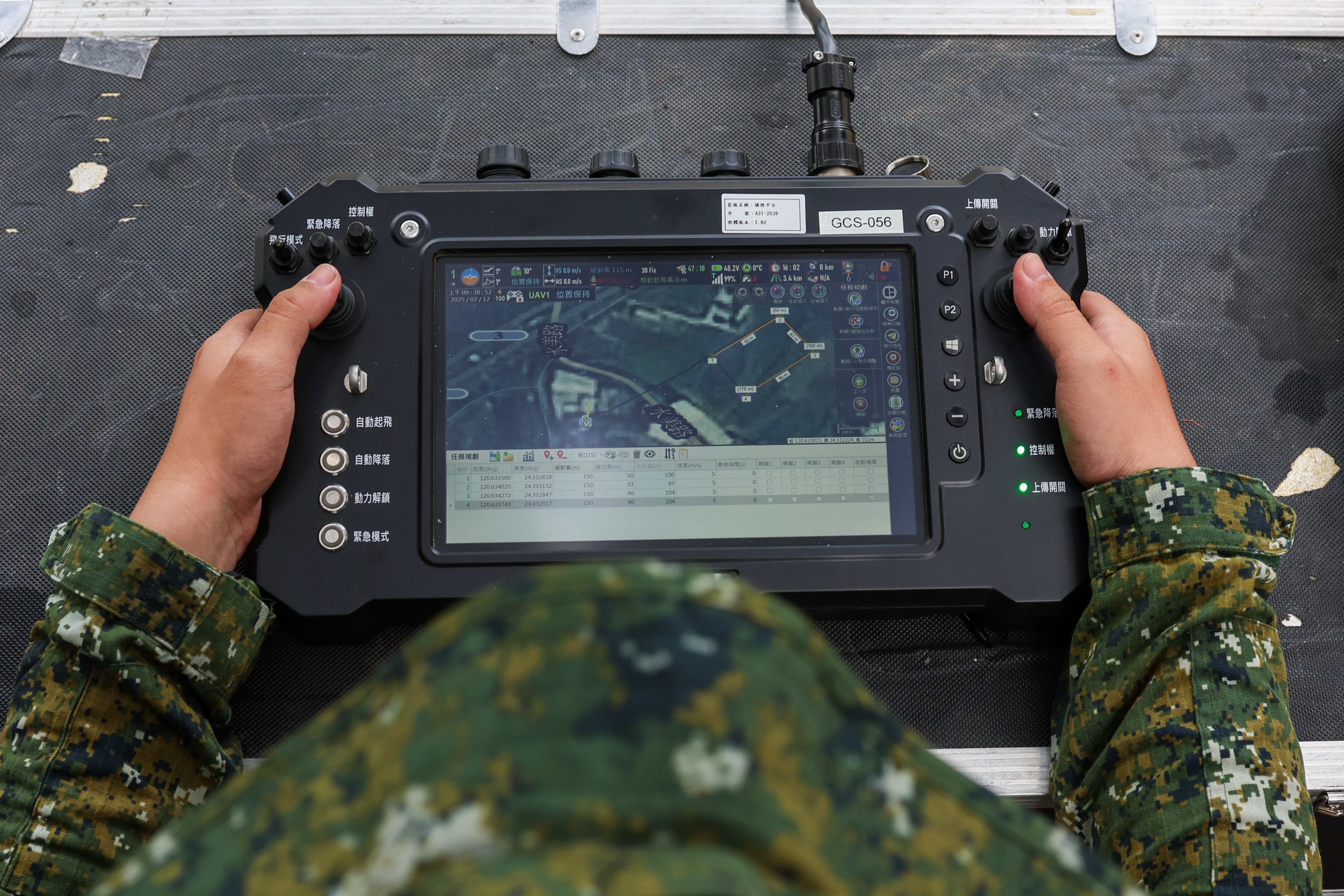
A January report from the Defense Innovation Board titled, “A pathway to scaling unmanned weapon systems,” highlighted China’s government-supported advantage to manufacture brushless motors and batteries “at scales and costs that are difficult for U.S. manufacturers to match.” The report warned: “Waiting until we are confronted with footage of American service members falling victim to enemy first-person view (FPV) drones is not an option. We must act now with the urgency this challenge demands.”
Section 232
The Trump administration is taking steps to block China’s drone industry.
In July, the Department of Commerce published a notice in the Federal Register that the agency had initiated an investigation “to determine the effects on the national security of imports of unmanned aircraft systems (UAS) and their parts and components.” This kind of investigation is known as a Section 232 investigation, named for the provision of the Trade Expansion Act of 1962 that allows the president to impose tariffs to protect national security if the investigation finds grounds for concern. Starting a Section 232 investigation is the first step before such a tariff is put in place.
But drones have become hugely popular in America, embraced not just by hobbyists, but by businesses large and small as well as first responders and law enforcement. Steep tariffs on drones and drone components could lead to shortages with wide-ranging effects.
In a signal of the public’s interest in the issue, the notice of the investigation received over 650,000 comments on regulations.gov.
One public comment warned of the consequences to public safety, written by Daniel Cavanagh, the chief of the Gerritsen Beach Fire Department in Brooklyn, New York. Cavanagh said that his department relies on many drones and accessories subject to the investigation. He wrote:
“Imposing tariffs or restrictions would drastically raise our costs and force us to reduce service. That translates directly to slower response times, reduced coverage, and increased risk to the public in emergencies.”
China’s choke hold on drones
In the worldwide (nonmilitary) drone market, DJI is the undisputed leader. With a global market share estimated to be north of 90%, the company has basically defined the industry over the past 12 years, since introducing its Phantom drone in 2013.
“So many people love DJI because the products that they make are head and shoulders above everything else on the market,” said Joshua Bardwell, who runs an educational YouTube channel about drones.
Bardwell said that not everyone in the drone world is a huge fan of DJI, such as first-person view racing drone enthusiasts, but in general, people love its products. “Talk to anybody who uses DJI-style drones and they’ll just tell you that DJI just makes a categorically superior product, and ironically, often at a lower price,” Bardwell said. He stressed that this was his honest opinion and he isn’t paid to endorse the brand.
If that makes you want to rush out to get one of DJI’s latest consumer drones, you might be out of luck if you live in the US.
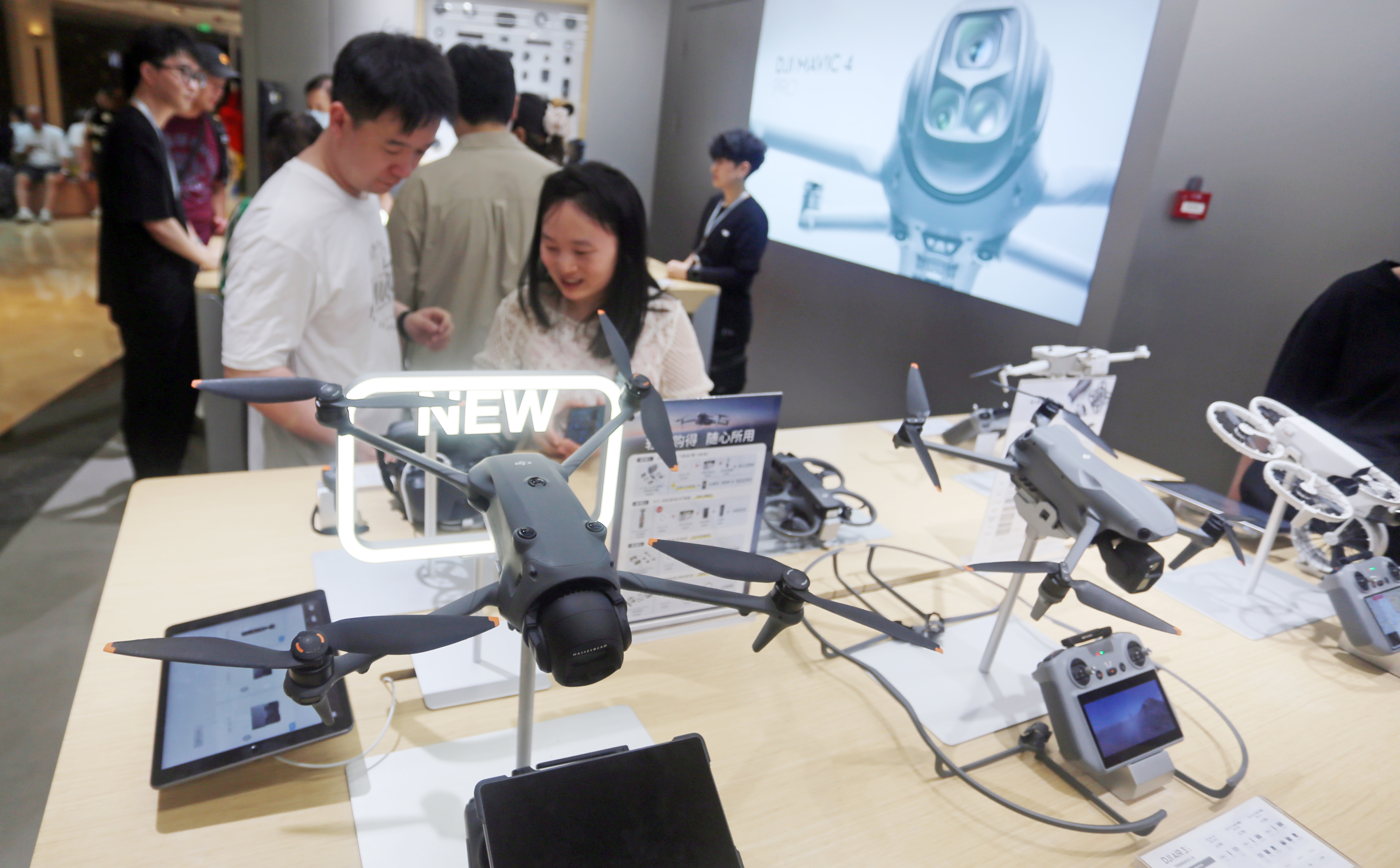
It appears that despite DJI being “committed to the US market,” its products are nowhere to be found in any US-based retail stores. Executives chalk up the shortage to a “customs-related misunderstanding” with US Customs and Border Protection related to the Biden administration’s Uyghur Forced Labor Prevention Act, which aims to sanction companies using forced labor by Uyghurs in Xinjiang. DJI says that CBP cited the law as the holdup, and asserted that the allegations are “entirely unfounded and categorically false.” The act also prevents US citizens from investing in sanctioned companies.
To make things even worse for DJI’s US sales, it may face an import ban by the end of the year. Last year, the passage of the National Defense Authorization Act (NDAA) for Fiscal Year 2025 started a one-year countdown to DJI being placed on a Federal Communications Commission blacklist due to national security concerns, unless a national security agency conducts a “disassembly and analysis” of DJI’s drones. That would effectively ban DJI from the US market entirely. The US Army banned the use of DJI drones in 2017 over cybersecurity concerns. Despite lobbying, the company is having a hard time getting any lawmakers to talk.
Bardwell said that such a ban on DJI’s popular drones would impact many types of small business as well as first responders. “There’s no question that taking DJI away reduces the capacity, reduces the ability of everyone who uses these drones, from real estate agents doing landscape photography, from hobbyists, search and rescue, police, you name it. It reduces their ability to do the things that they do,” Bardwell said.
A spokesperson for DJI told Sherwood News:
“We encourage the Department of Commerce to carefully consider the substantial impact that any disruptions to the current supply chain would have on American small businesses, public safety agencies, and the broader drone industry. DJI drones have been subject to tariffs since 2017, and any additional costs could place significant burdens on small businesses, hinder the growth of the American drone industry, and disrupt the U.S. drone ecosystem that we have continually supported.”
So, how hard could it be to start making drones in the US? Pretty hard, it turns out.
An iPhone with propellers
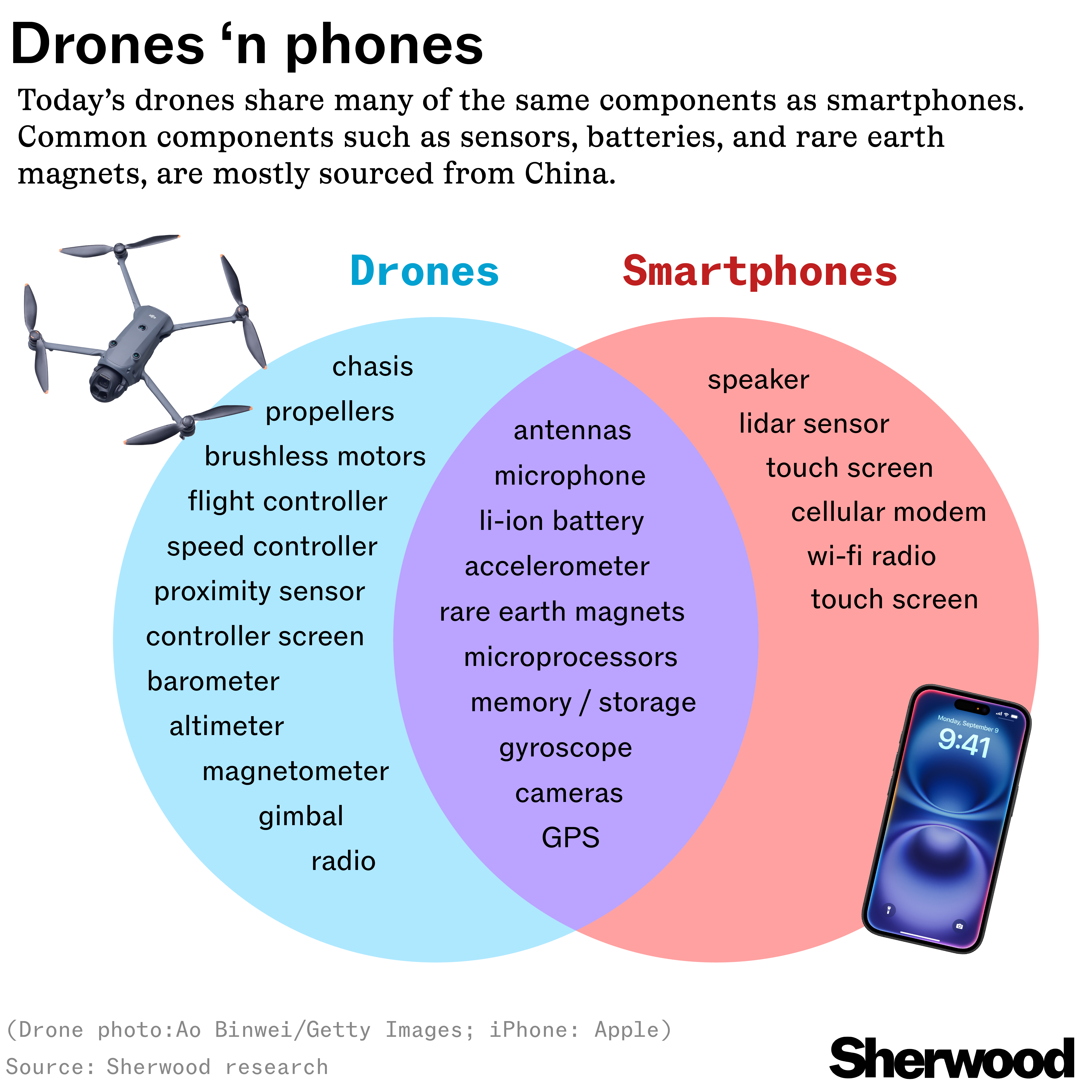
If you look at a drone sitting next to an iPhone, they may seem like they don’t have much in common. But under the hood, the two devices are close relatives with common technological DNA. Both use lithium-ion batteries, tiny high-quality cameras, rare earth magnets, sensors like gyroscopes and accelerometers, and of course the microprocessors that power their digital brains.
No matter how many carbon-fiber drone frames and propeller blades you make in the US, an American drone will need to get many of its key components from outside the US. China dominates the supply chain for most drone components, making local sourcing extremely difficult.
Former President Obama once asked Apple cofounder Steve Jobs at a dinner in 2011 what it would take to make the iPhone in America, to which Jobs reportedly replied that the jobs to manufacture electronics had moved to China and “aren’t coming back,” according to The New York Times. China’s government support for manufacturing, cheap skilled labor, and tightly integrated supply chains in cities purpose-built for manufacturing, like Shenzhen, would make an American-built iPhone cost upward of $3,500 by some estimates.
The Times quoted an anonymous “high-ranking Apple executive” who explained:
“The entire supply chain is in China now. You need a thousand rubber gaskets? That’s the factory next door. You need a million screws? That factory is a block away. You need that screw made a little bit different? It will take three hours.”
American drone makers ramp up
Several American drone companies are moving to take advantage of the policies that are edging China out of the US market.
The biggest American competitor to DJI is the privately held California-based Skydio, which exited the consumer drone market in 2023 to focus on the enterprise, government, and military market. Skydio sent hundreds of its drones to help Ukrainian troops fend off Russia’s invasion, but it didn’t go well; the company’s drones didn’t hold up in real-world battle conditions. The company was also sanctioned by China last year for selling drones to Taiwan, which affected the company’s lithium-ion battery supply chain.
Unusual Machines is a Florida-based manufacturer of crucial drone components, including brushless motors, cameras, and flight controllers, that comply with the regulations in the NDAA, allowing use by government agencies. The company raised $5 million in an IPO in February and is now expanding into a 17,000-square-foot drone motor factory in Orlando.
The Department of Defense also publishes a list of compliant drone systems for use in the military, which includes American companies like Anduril, Neros Technology, and Shield AI.
But drones ≠ phones
The race to build an American drone supply chain is part of a larger effort to cajole companies to bring manufacturing lines back to the US. Last week saw the effect of the Trump administration’s pressure on one of the largest companies in the world.
Apple is run by Tim Cook, the executive who spearheaded the offshoring of Apple’s manufacturing. Last week, Cook visited President Trump in the Oval Office, bringing even more gold to the increasingly ornate office in the form of a trophy celebrating an additional $100 billion in Apple’s US manufacturing investment and its commitment to make more of its products’ components in the US.
But it will take more than a shiny bauble to bring the components and skills needed for America to catch up to China’s drone industry.