
Tech
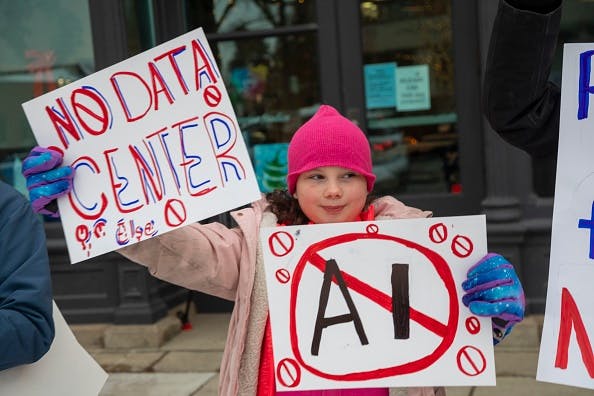
Protest Against Michigan Data Center
(Jim West/Getty Images)

As public pushback against data centers grows, AI companies promise they’ll be good neighbors

Communities concerned with energy prices, pollution, and water usage are starting to push back on Big Tech’s AI data center building spree. The companies are trying to assure the public that they will pay their way.

Jon Keegan

Small towns all across the US have been adjusting to the reality that some of the biggest companies in the world have just become their neighbors.

Big Tech’s unprecedented race to build AI data centers in rural, often poor areas has raised local concerns about pollution, water usage, and electricity supplies. The public is starting to push back on these often secretive projects, forcing tech companies to reassure communities that they will be good neighbors as massive data centers go up in their midst.

Even President Trump is aware of the public’s growing concern that all these data centers might be part of the reason why their electricity costs are soaring, posting on Truth Social:

“Under Sleepy Joe Biden and the Radical Left Democrats, the average American Household’s monthly Utility bills went up MASSIVELY — over 30%! I never want Americans to pay higher Electricity bills because of Data Centers.”

In his post, Trump said his team had been working with Microsoft to address the issue.

The company soon released a five-point “community-first AI infrastructure action plan” outlining steps it would take to lessen any negative impacts that its data centers might have on communities. While the plan largely reflects the steps the company has been taking so far — such as paying for the electricity it uses and minimizing water usage — formalizing it helps codify the approach, and it gives its competitors a model for how to do the same.

This week at the World Economic Forum in Davos, Switzerland, Amazon CEO Andy Jassy said the company would follow suit. Jassy said:

“We don’t expect other people to pay for us. We expect to fund the power that we need. And we create a lot of good jobs in the communities in which we’re building a lot of data centers. And we intend to continue to do so.”

Yesterday, OpenAI also got in line with a blog post announcing its own version of a community plan, called “Stargate Community.” The company is well into construction on its massive Abilene, Texas, Stargate data center, the first in a series of planned facilities around the world to achieve 10 gigawatts of computing power.

“Going forward, every Stargate site will have its own locally tailored Stargate Community plan, driven by community input and local concerns. They will all rest on this same core premise: Stargate is a partnership with communities, and we can only achieve our mission by being good neighbors.”

Like the other companies, OpenAI says it will pay for the energy infrastructure upgrades it requires. The company also said it would plan its energy needs “transparently” with local and state utility regulators.

Transparency has been an issue for other tech companies as they build out their massive AI data centers.

When Meta set out to build its Hyperion data center in Richland Parish, Louisiana, the company applied for its generator permits using a subsidiary named “Laidley LLC,” and made efforts to hide its identity from the public.

Organized efforts to slow or stop data center projects are spreading across the US. According to Data Center Watch, a research firm that tracks opposition to data center projects, an estimated $98 billion worth of data center projects were blocked or delayed in the second quarter of 2025.

More Tech

See all Tech
tech

OpenAI reportedly delaying erotica feature to focus on “gains in intelligence”

OpenAI is delaying its planned “adult mode,” as it seeks to shore up ChatGPT’s core capabilities before the chatbot can generate erotic content.

A source within OpenAI told tech news site Sources that the company will miss its Q1 target for launching the feature:

“We’re pushing out the launch of adult mode so we can focus on work that is a higher priority for more users right now, including gains in intelligence, personality improvements, personalization, and making the experience more proactive.”

The company said it still believes in “treating adults like adults,” but said it wants to get the experience right. OpenAI has been testing user age estimation technology ahead of the planned release.

“We’re pushing out the launch of adult mode so we can focus on work that is a higher priority for more users right now, including gains in intelligence, personality improvements, personalization, and making the experience more proactive.”

The company said it still believes in “treating adults like adults,” but said it wants to get the experience right. OpenAI has been testing user age estimation technology ahead of the planned release.

Man taking picture of Times Square using smart phone, personal perspective view

Ads have entered the chat

Advertisers are crowding into the next digital frontier.

tech

Anthropic will sue the Pentagon over supply chain risk designation, Amodei says

Anthropic CEO Dario Amodei said in a public post that the company will sue the Pentagon after receiving a letter from the Department of Defense officially designating Anthropic as “a supply chain risk to America’s national security.”

Amodei says that the effect of the unprecedented designation for an American company is more narrow than originally described, and that most of its customers would not be affected.

“With respect to our customers, it plainly applies only to the use of Claude by customers as a direct part of contracts with the Department of War, not all use of Claude by customers who have such contracts.”

Amodei says the company does not “believe this action is legally sound, and we see no choice but to challenge it in court.”

The CEO also apologized for statements he made in a leaked internal memo in which he claimed that the company was targeted because it didn’t show “dictator-style praise” for President Trump.

“With respect to our customers, it plainly applies only to the use of Claude by customers as a direct part of contracts with the Department of War, not all use of Claude by customers who have such contracts.”

Amodei says the company does not “believe this action is legally sound, and we see no choice but to challenge it in court.”

The CEO also apologized for statements he made in a leaked internal memo in which he claimed that the company was targeted because it didn’t show “dictator-style praise” for President Trump.

$40B💰

SoftBank is going to great lengths to double down on OpenAI — including taking on significant debt. After completing a $40 billion investment to become one of the ChatGPT maker’s largest backers, the Japanese conglomerate is now seeking a roughly $40 billion loan with a 12-month term, Bloomberg reports.

The financing would be SoftBank’s largest-ever dollar-denominated deal. The AI investment has helped lift profits, but it is also pressuring SoftBank’s credit profile.

Latest Stories

Sherwood Media, LLC produces fresh and unique perspectives on topical financial news and is a fully owned subsidiary of Robinhood Markets, Inc., and any views expressed here do not necessarily reflect the views of any other Robinhood affiliate, including Robinhood Markets, Inc., Robinhood Financial LLC, Robinhood Securities, LLC, Robinhood Crypto, LLC, or Robinhood Money, LLC.