Tech
Collage of objects related to environment
(Getty Images)
cleaning up

Clean energy investment hit a new record last quarter, mostly driven by EVs

Spending rose 8% to a whopping $75 billion in Q3.

Tom Jones

The expiry of electric vehicle tax credits didn’t just do wonders for the sales figures of automakers like Tesla; it also contributed to the best quarter of clean energy investment ever in Q3 this year, per a new report.

According to new data from the Clean Investment Monitor, a joint project from MIT and the Rhodium Group, clean energy investment across the US reached a record-breaking $75 billion last quarter, up 8% from the same period last year, as efforts to curb our economy’s emissions continue.

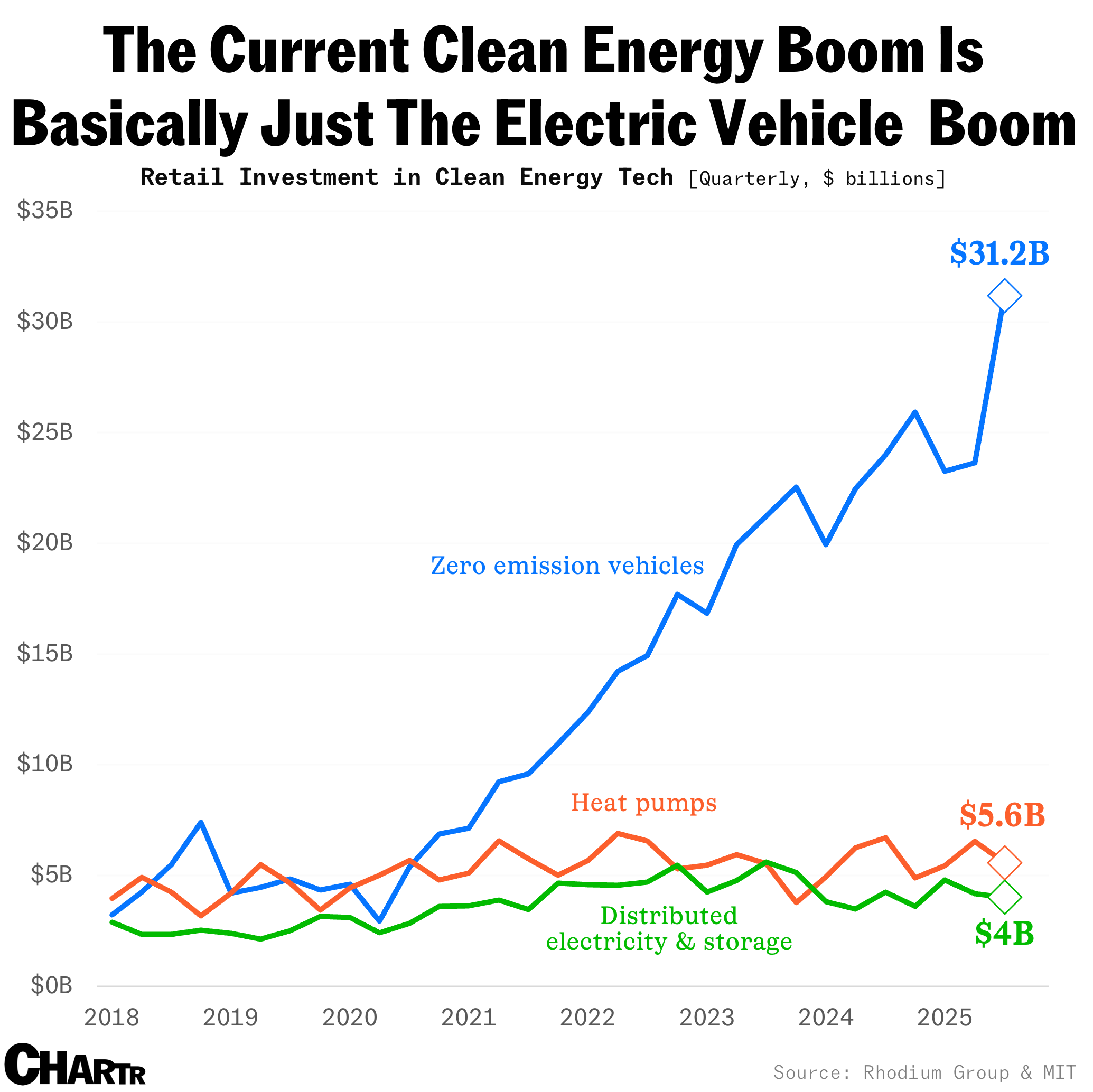
The monitor endeavors to track the entire supply chain, from industrial clean energy projects and zero-emissions factories, to consumers buying electric cars and solar panels to charge them. While there has been a growing wave of new investment in solar and wind projects, as well as a burgeoning manufacturing footprint focused on making batteries, solar equipment, and other clean tech products, the reality is that much of the boom was fueled simply by people buying electric vehicles.

Indeed, retail made up the bulk of the spending tracked, with consumers alone investing $31.2 billion into zero-emission vehicles in the US in Q3, as people rushed to snap up EVs before Biden-era tax relief credits expired at the end of September. That means that zero-emission vehicles accounted for more than 40% of the record-breaking clean energy investment.
Clean energy boom chart
Sherwood News

However promising the latest results, the third-quarter overall figure might be a record that’s unlikely to be broken any time soon, as Axios pointed out, given that other signals on how the clean energy industry is faring seem suggest things are going in the other direction.

More Tech

See all Tech
tech

Report: Some of Meta’s new AI models will eventually be open source

Axios is reporting that Meta is close to releasing its first new AI models after setting up its "superintelligence" team led by former Scale.AI CEO Alexandr Wang, and some of the models will eventually be released with an open source license.

Per the report, Meta sees an opportunity to focus on consumers, rather than the lucrative enterprise market which both OpenAI and Anthropic have been focusing on.

Meta had previously embraced open source AI with its Llama models, with CEO Mark Zuckerberg writing a manifesto declaring open source AI as "the path forward." Axios says that Meta will be pursuing more of a hybrid strategy of proprietary and open source models going forward.

The New York Times previously reported that Meta was delaying the launch of its new AI model because of performance issues.

Meta had previously embraced open source AI with its Llama models, with CEO Mark Zuckerberg writing a manifesto declaring open source AI as "the path forward." Axios says that Meta will be pursuing more of a hybrid strategy of proprietary and open source models going forward.

The New York Times previously reported that Meta was delaying the launch of its new AI model because of performance issues.

1328213286	CSA-Printstock

OpenAI’s plan for an AGI world: AI for all and a 4-day work week

The company’s policy paper calls for a new social contract that includes AI at the center of everything, which could lower costs and create cures for diseases, but also warned it may upend the public safety net.

🏠 $2.15M

The median price for a house in San Francisco is now $2.15 million, jumping 18% from last year. The AI startup boom is pushing what was already one of the most expensive housing markets to dizzying new heights. The median price for condos in the city jumped 27% to reach $1.36 million, according to data from Compass, reported by Bloomberg.

tech

Report: OpenAI on track to burn $85 billion in 2028, expects profitability by 2030

Anthropic and OpenAI are racing to go public this year, and all eyes are on how long they can sustain burning billions in cash before they achieve something that looks like a viable business.

Investors have seen both companies’ projections, and there’s no sign of slowing down, according to a report from The Wall Street Journal.

OpenAI expects to burn tens of billions per year for the rest of the decade, peaking at $85 billion in 2028, before achieving profitability in 2030, per the report.

Anthropic will also continue to burn cash for years — far less than OpenAI — but it projects that 2026 will be its biggest year of losses. It targets 2029 for profitability, fueled by exploding enterprise revenue.

OpenAI expects to burn tens of billions per year for the rest of the decade, peaking at $85 billion in 2028, before achieving profitability in 2030, per the report.

Anthropic will also continue to burn cash for years — far less than OpenAI — but it projects that 2026 will be its biggest year of losses. It targets 2029 for profitability, fueled by exploding enterprise revenue.

Form Energy iron-air battery system leaving Form Factory 1

Big batteries are the newest answer to Big Tech’s big energy needs

America’s booming energy demand is creating a powerful case for large-scale energy storage.

Patrick Sisson4/2/26

Latest Stories

Sherwood Media, LLC produces fresh and unique perspectives on topical financial news and is a fully owned subsidiary of Robinhood Markets, Inc., and any views expressed here do not necessarily reflect the views of any other Robinhood affiliate, including Robinhood Markets, Inc., Robinhood Financial LLC, Robinhood Securities, LLC, Robinhood Crypto, LLC, Robinhood Derivatives, LLC, or Robinhood Money, LLC. Futures and event contracts are offered through Robinhood Derivatives, LLC.