OpenAI’s plan for “democratic AI”
OpenAI laid out a vision of US-approved “democratic” sovereign AI, by selling its tech to countries and turning them into investors.
Last month, a phalanx of tech executives joined President Trump on his trip to the Middle East to secure some blockbuster deals with American AI companies.
Nvidia announced it was partnering with Saudi Arabia-owned Humain to build a massive 500-megawatt data center, powered by 18,000 of Nvidia’s latest GB300 GPUs. Humain also announced a $10 billion venture capital fund that is reportedly in talks with OpenAI and xAI.
A week later, OpenAI announced the first international iteration of its Stargate mega data centers, “Stargate UAE.” The US-based Stargate project is still very much under construction.
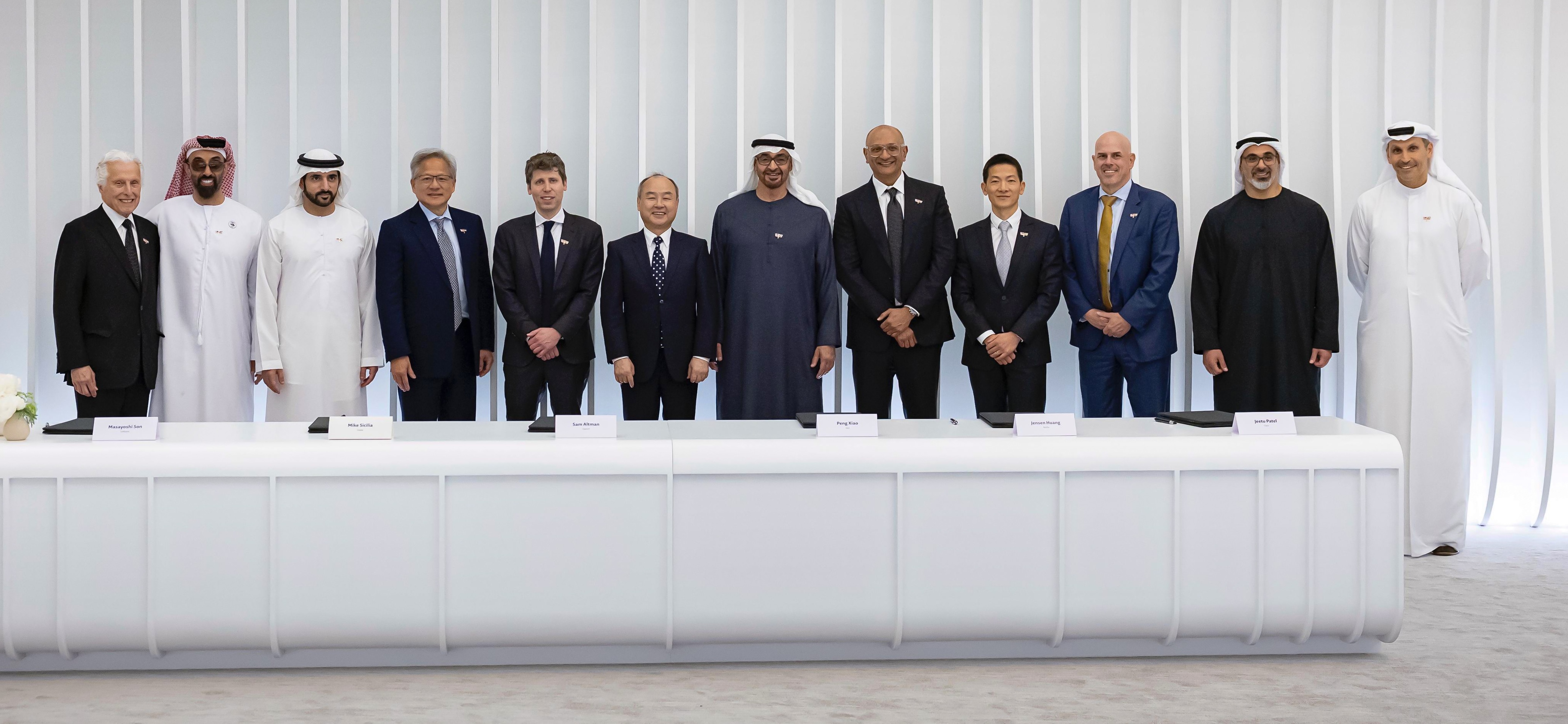
The allure of AI-hungry nation-states with pockets as deep as Saudi Arabia and the UAE drew representatives from the biggest tech companies, including Nvidia’s Jensen Huang, Amazon’s Andy Jassy, AMD’s Lisa Su, OpenAI’s Sam Altman, Tesla and xAI CEO Elon Musk, and Palantir’s Alex Karp to the Middle East.
Leading chipmaker Nvidia is selling advanced AI GPUs as fast as it can make them to pretty much every Big Tech company in existence, while getting boxed out of the massive Chinese market by the Trump administration’s AI export controls. Sovereign AI offers the company a deep bench of potential customers — sovereign nations that are eager to secure their own homegrown AI, freeing them from a dependency on US-based Big Tech companies. Huang has called sovereign AI one of several key “multibillion-dollar vertical markets” that the company is pursuing.
The race for sovereign AI is heating up
Countries are racing to secure AI infrastructure to spin up data centers inside their borders for scientific research, commerce, and defense. The US has a head start in the AI field, as the home to the leading model makers and infrastructure companies. It’s using export controls to prevent its adversaries from getting a leg up in the fast-evolving industry.
The European Union is executing a plan to build 13 “AI Factories” across the continent as part of the “European High Performance Computing Joint Undertaking.” Member states are also developing their own homegrown supercomputing clusters and AI models.
Some countries like South Korea find themselves as laggards in the AI race, despite a global reputation for advanced technology expertise and talent. China’s DeepSeek AI breakthrough spurred South Korea into action, and the government is partnering with its leading search engine, Naver, to tap into its vast data stores to build its domestic AI systems, such as Naver’s Korean-language HyperCLOVA X model.
Last month, Israel announced it’s investing more than $140 million to build a national AI supercomputer and “national models.” The government is partnering with Nebius (the spin-off of Russian tech giant Yandex’s European operations) to build a 16-petaflop system using 4,000 Nvidia Blackwell GPUs. The Israeli military has embraced the use of Israeli-built AI systems in the battlefield as it conducts its war in Gaza.
The UK is investing $34 billion for domestic AI data centers, creating a “National Data Library” and building a $300 million “Isambard-AI” supercomputer.
OpenAI for Countries
A few weeks before announcing the Stargate UAE, OpenAI announced an initiative called “OpenAI for Countries,” which aims to help countries develop and host their own AI infrastructure locally.
“We’ve heard from many countries asking for help in building out similar AI infrastructure — that they want their own Stargates and similar projects. It’s clear to everyone now that this kind of infrastructure is going to be the backbone of future economic growth and national development,” the announcement said.
Perhaps the most interesting part of the announcement touched on the ability for nations to craft their AI models to reflect the values of each country: “This will be AI of, by, and for the needs of each particular country, localized in their language and for their culture and respecting future global standards.”
The announcement said that OpenAI has a goal of pursuing an initial batch of projects with 10 countries, and will then grow from there.
How “sovereign” exactly?
There are some parts of this announcement that raise questions about how free any country would be to shape and customize their new AI systems through this program. Of course, this isn’t a plan to let countries roll up their own models from scratch — it involves customizing OpenAI’s tech.
Before listing the benefits of the partnership, the document says that through “formalized infrastructure collaborations, and in coordination with the US government,” OpenAI would partner with countries to build out data centers, customize ChatGPT for each country’s citizens, build a startup fund, invest in the Stargate project, and work to improve security and safety for its models.
A requirement that the US government would essentially approve another country’s “sovereign” AI project seems problematic.
Ten days after this announcement was posted, the post was updated with a link to a curious PDF with the heading, “Our Approach to Security,” which reinforces that the plan is to have OpenAI and the US government running the show:
“As other nations look to us for guidance and partnership as the leaders on this technology, we can set the global standard for AI infrastructure rooted in democratic values, transparency, and security. This is a moment when we can support countries that would prefer to build on democratic AI rails, and provide a clear alternative to authoritarian versions of AI that would deploy it to consolidate power.”
The mention of “democratic rails” is notable, as Saudi Arabia and UAE are both monarchies with a history of human rights violations.
This addendum also reiterates that countries that participate in the plan are expected to invest in the US Stargate project:
“That’s why we are proactively engaging with U.S. government entities — including those overseeing export controls — to ensure that our international partnerships meet the highest standards of security and compliance, and why our OpenAI for Countries initiative includes commitments from partner nations to invest in expanding our Stargate project here in the U.S.”
The document reads like the Trump administration had some notes for OpenAI to clarify a few things about the program. Without knowing which countries will be part of the initial cohort, we’ll have to wait and see how the company is able to stick to these principles in the face of all that sweet, sweet capital.
OpenAI did not respond to a request for comment.