Small cities, big data centers
WHEN AI COMES TO TOWN

The power play behind Hyperion, Mark Zuckerberg’s colossal data center being built in rural Louisiana
$10 billion of investment. Code names to disguise projects and companies. Mixed opinions. Skyrocketing property values. And enough tax breaks to pay every state cop in Louisiana for seven years.
In July of last year, community leaders in rural Richland Parish, Louisiana — population 20,043 — approved financing terms for a new project tied to billions of dollars in tax breaks.
A Delaware company called Laidley LLC wanted to build “a multi-billion-dollar datacenter campus in the Parish resulting in several hundred new good paying jobs,” according to the text of the resolution, published later in the local newspaper. At a special meeting, in the middle of the day on a Thursday, the commissioners passed the plan with no opposition. It set a course for the transformation of hundreds of acres of state-owned farmland into a modern-day AI factory.
Just a few months later, the actual company behind the planned development was revealed to the public. A newly minted Facebook page for the Richland Parish Data Center made its first post ever. It began: “Hello, Louisiana!”
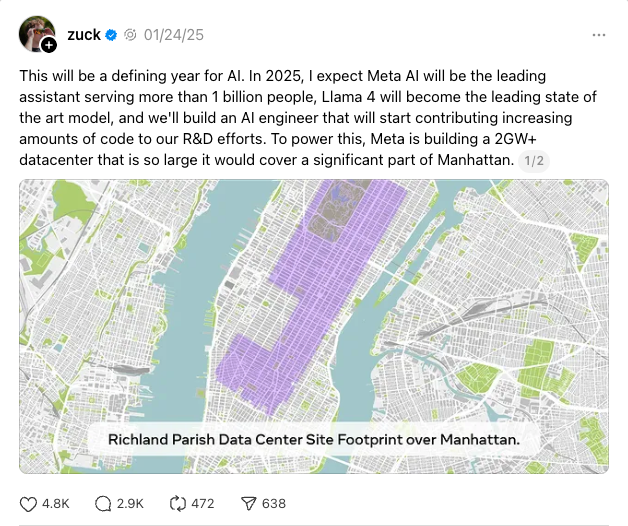
It turns out, Laidley LLC is a little-known subsidiary of Meta, the $1.6 trillion social media behemoth that owns Facebook. Documents approved by local officials called the covert development “Project Sucre” — a code name for what Meta CEO Mark Zuckerberg now calls Hyperion, a gargantuan AI data center being built that he says will be “so large it would cover a significant part of Manhattan.” Meta says the data center, the first phase of which is expected to open in 2028, will be an investment totaling more than $10 billion.
Meta and other hyperscalers are making similar moves all across the country as they pour tens of billions of dollars into data center construction, looking to satiate computing needs for the artificial intelligence that they say will change the world and business as we know it.
But a power imbalance is playing out. The tech companies are able to secure humongous tax breaks from local governments that are loath to pass up an opportunity to turn otherwise underutilized land into potential investment dollars and the promise of good-paying jobs. But many times, the number of local jobs isn’t guaranteed, and massive demands on water and power resources burden the infrastructure at unprecedented levels. Property values near data center sites skyrocket, which makes homes harder to purchase for those looking to move in. For existing residents, it also sends things into a bit of disarray: residents’ home values soar, but that also means tax assessments could rise, leading to higher property tax bills.
The tax breaks and incentives that Louisiana gave Meta are worth billions. The company will pay no sales tax on the tens of billions of dollars’ worth of expensive GPUs and advanced networking gear that will fill the data center’s racks. The local power authority even agreed to build new power lines and infrastructure to accommodate the astonishing amount of electricity that will be needed to feed the data center, which will be one of the largest in the world.
A Sherwood News analysis shows that the breaks afforded to Meta on just the sales tax of GPUs would come out to more than $3.3 billion — enough to build 33 new high schools, pay the salaries of all the state’s public school teachers for more than a year, or pay for more than seven years of the Louisiana State Police budget. (The secretary from the Parish committee that approved the financing plans declined to comment, and the chair of the committee didn’t respond to requests for comment.)
Here’s how the story plays out when Meta and other hyperscalers bring AI to small-town America:
Louisiana’s Richland Parish is home to over 500 farms that produce soybeans, corn, and cotton across a quarter million acres of rural countryside in the northeast corner of the state. The rich, fertile soil is what gave this area its name. Recently, farms have been disappearing in the parish (what Louisiana calls its counties) — an 11% drop in the number of farms between 2017 and 2022. But now that farmland is gaining value — not for the crops that can be grown from its soil, but because of a massive AI data center from one of the world’s biggest tech companies.
In January, Zuckerberg bragged about the massive scale of the data center, Meta’s 23rd in the US, calling it “a 2GW+ datacenter that is so large it would cover a significant part of Manhattan” and noting that it would power Meta’s Llama AI models. This enormous 4.1-square mile data center named after Hyperion, the Titan from Greek mythology, is currently under construction on 2,250 acres of former farmland in Richland Parish.
The announcement that Meta was going to make Richland Parish the site for the company’s most ambitious piece of AI infrastructure to date was welcome news for a lot of the region’s 20,000 residents, who have seen large employers like Lumen Technologies, whose headquarters now sits empty, relocate jobs out of the parish. About a quarter of the parish’s population is below the poverty line, above the 19% average for the state.
“Our economy is built on the back of small business. We don’t have big industry here,” said Brian Bendily, a realtor at John Rea Realty in Monroe, Louisiana, a city 30 miles west of the construction site. “This has been a shot in the arm for us,” said Bendily, who is seeing the effects of one of the world’s largest tech companies showing up and turning unused farmland into the engine for its AI ambitions.
“So around the data center, for sure. You went from premium farmland at $6,500 an acre to where you’re seeing prices are exceeding, you know, $30,000 an acre in some cases.” In fact, some farmland near the Hyperion site is currently listed for sale at $73,000 per acre. Real estate listings for properties near the site also reflect the new attention to the area. Redfin data shows that the median sale price of homes in Richland Parish is up 172% year on year, compared to a 2.6% bump statewide and 1.7% increase nationwide. Some listing prices have soared as much as 6,900% since the announcement, as sellers sought to capitalize on the expected economic boom surrounding the data center.
Meta says the project will employ more than 5,000 skilled trade worker jobs during peak construction. But after construction is finished in 2030, the sprawling data center will drop by 90%, employing around 500 “operational” full-time jobs, according to the company.
A spokesperson from Meta told Sherwood, “Our commitment goes beyond investment — we are dedicated to building lasting relationships and creating opportunities that strengthen the fabric of north Louisiana.”
Every signal from Corporate America and the White House suggests AI as the future of our economy: data center construction is close to eclipsing office construction, and hundreds of billions of capex dollars are flowing to AI infrastructure projects.
When Meta went looking for a site for its massive Hyperion data center, the company was holding all the cards. Whatever plot of farmland it decided would be the home of its new data center would bring billions of dollars of investment to the area and have the power to change perceptions. There were lots of places Meta could bless with its billions of capex dollars, so the company used the substantial leverage it had to get the most favorable package of incentives.
In January 2024, Meta executives met with power company Entergy Louisiana, seeking a site to build what could be the world’s largest data center, Louisiana newspaper The Advocate reported. That meeting kicked off a frantic race by state leaders to deliver a basket of generous incentives that could lure Meta to vacant state-owned farmland in northeast Louisiana. Per the report, the package of tax breaks and incentives was achieved through local officials bound by nondisclosure agreements, quietly struck legislative deals, and parliamentary sleight of hand to avoid public scrutiny of the deal.
So the residents of Richland Parish did not have much of a heads-up on what was coming.

“There is this huge imbalance of information, and you cannot really have a good conversation about cost and benefits if you don’t have access to basic information, basic data,” said Kasia Tarczynska, a senior research analyst with Good Jobs First, a nonprofit public interest research organization.
“Based on my experience doing this work around data centers, what I’ve seen happening across the country is that there are more benefits to companies for these deals than to the community or even the state,” Tarczynska said.
A Meta spokesperson told Sherwood in an emailed statement that keeping details confidential helps increase the speed and efficiency of a project. “We treat our preliminary discussions as confidential because it is a competitive process and there are a number of steps needed for the project to ultimately move forward.”
Meta says that after the project was announced, the company met with the community in a series of “community fireside chats.” “These sessions provided transparent, factual updates about the Richland Parish Data Center,” the spokesperson said.
Sherwood spoke with several residents in Richland Parish to find out what effect Meta’s presence was having in the community. Several noted the heavy presence of trucks, damage to roads, and increased noise near the construction site, while others said they were seeing signs of Meta patronizing local businesses for catering, signage, and banners. A few had heard of Meta donating to local schools.
Power play
At a November 20, 2024, Louisiana Public Service Commission (LPSC) hearing, the agenda listed an item titled “Application for approval of generation and transmission resources in connection with service to a single customer for a project in North Louisiana.” Entergy was requesting permission to install three new generators at a site for $3.2 billion, with total potential output of 2.3 megawatts. Entergy told the commissioners in its application for the generators, “the Customer has an urgent need for capacity and energy,” and requested that the customer’s identity not be revealed.
Just two weeks later, Meta and the Louisiana government announced the project to the public.
In a joint brief opposing the project, a coalition of groups including the environmental law nonprofit Earth Justice, Louisiana energy watchdog the Alliance for Affordable Energy, and the nonprofit science advocacy group the Union of Concerned Scientists focused on the extreme strain such a power-hungry facility would put on the area’s electric grid:
“Serving a data center’s load, which can fluctuate wildly over very short periods of time, poses unique challenges to the stability of the grid. Yet Entergy Louisiana, LLC… has brushed aside these concerns, seeking to spend billions of dollars to serve a proposed data center. In doing so, ELL has made a massive bet, one that risks overburdening captive ratepayers with stranded costs that could ultimately exceed a billion dollars.”
The Hyperion data center could use as much as nearly 20% of the state’s overall energy consumption, by some estimates.
Entergy’s application also noted that ratepayers would bear the cost of a new 60-mile, 500-kilovolt power transmission line to serve the facility, with a cost of $470 million. Meta will be on the hook for the cost of building several new substations near the site, and has agreed to pay a “minimum monthly charge” for the generators for 15 years.
“Any of the costs for the data center should be paid by the data center, and none of the costs should be put on other ratepayers,” said Susan Miller, a senior attorney with Earth Justice, in an interview with Sherwood.
In its application to LPSC, Entergy requested that the generators — two of which are on Meta’s site — be listed as “system resources” rather than customer-owned “behind-the-meter” equipment. Having these huge generators listed as part of the overall system with this classification allows Entergy to get a regulated rate of return on its capital investment for the project, as well as make a better case to the public that it’s a good project for all of its ratepayers. For Meta, it locks in a predictable regulated rate and frees the company from having fossil fuel-burning equipment on its books.
Entergy did not respond to multiple requests for comment.
A recent analysis by Bloomberg of wholesale electricity prices found that ratepayers within 50 miles of data centers saw rates increase up to 276% over the past five years.
Not as many jobs at the AI factory
In June, GrowNELA, a Louisiana pro-business development nonprofit, published an analysis that looked at how the project would affect the region’s tax income, employment, and other factors. The assessment assumed that of the 5,000 construction jobs, only a quarter would go to local workers, “keeping in line with industry standards.”
Electricians and other skilled trade workers have been reported to travel around the country, following the boom in data center construction.
The agreement Meta has with Louisiana says that the company will employ more than 5,000 “full-time equivalent” jobs during the construction phase. Once the data center is up and running, there are estimated to be 300 to 500 full-time equivalent jobs, with a pledge to hire local workers. But according to reporting from Wired, those jobs are not legally required to go to local workers.
GrowNELA’s report expects salaries at Hyperion after construction to average $75,000 per year. Estimates in the GrowNELA analysis predict that after construction ramps down in 2028, the number of local jobs will stay flat at around 326 positions for decades. That’s about the same number of jobs as a typical Walmart supercenter.
Richland Parish high school grads aren’t likely going to work in the data center training new AI models — in reality, the jobs are more likely to be roles that just keep the power flowing, the computers cool, and the wires plugged in to the right places. Most of the technical AI work is remotely operated.
“This is a big project for our region. Five hundred jobs is a lot of people,” said Rob Cleveland, president and CEO of GrowNELA. In an interview with Sherwood, Cleveland said that considering the small population of Richland Parish, the project would have to rely on a large portion of nonlocal workers. Per the analysis, “we only have 7,200 people currently in the construction industry,” he said, “and so it’s impossible to think that Meta was going to absorb all of the workers.”
Cleveland said they are seeing the business impact they expected “at every level.” “We have seen that economic impact, and it has exceeded expectations and we are nowhere near the finish line,” he warned.
When asked about the potential sales tax revenue that the state was giving up as part of the incentives for the deal, Cleveland said the state is competing nationally for investments like this, and it was obviously in its interest to take the deal.
“I’ll be the first person to stop offering tax incentives when the other 49 states do it as well. I mean, there is an arms race. It is what it is. And so we can either participate and try to bring new jobs and investment, or we can sit it out,” he said.
A Meta spokesperson said, “Our data center will support a variety of positions and job types, including technical operators, electricians, air conditioning and heating specialists, logistics staff, security and more, and we will make a concerted effort to hire locally.”
Tax-free GPUs
Thanks to the bill that quickly moved through the state legislature to secure this deal, the Hyperion data center will be exempt from any state, local, sales, and use taxes on data center equipment, such as servers, networking gear, and cooling systems. That provision is by far the biggest break for Meta, potentially worth billions.
Louisiana’s combined state and local sales tax stands at 9.56%. Industry estimates say the cost of building a new 1-megawatt data center works out roughly to $50 billion. $35 billion of that goes to the most crucial component of any AI data center: the GPUs needed to train and run AI models.
If Meta had to pay the full state and local sales tax for $35 billion worth of GPUs, the residents of Louisiana would reap over $3.3 billion in taxes — equal to 2% of Meta’s annual revenue last year.
Project Sucre’s sweet deal
The lease agreement between Louisiana Economic Development and Laidley LLC, Meta’s subsidiary, for Project Sucre spells out the favorable terms of the lease that Meta is getting for the property the site is situated on. The 1,400-acre parcel that sits at the heart of the facility was formerly Franklin Farms, which was purchased by the state in 2006 for a development that never materialized. It had sat vacant since then, until tractors started reshaping the land for the data center.
The Advocate reported that Meta wanted to purchase the parcel, but the state-owned land would require a public bidding process by state law, so it rented the land instead. The annual rent for the site is $732,000 per year, and Meta has the right to buy the property for $12 million before the end of the lease.
Since the property is leased, Meta makes PILOT payments (payment in lieu of taxes) based on the amount that the company invests and the number of jobs it fills. The more it invests, the smaller its PILOT payment. That falls under a separate PILOT lease agreement with Northwest Louisiana Finance Authority.
If Meta follows through on its announcement of investing $10 billion and hiring 500 “full-time equivalent” workers, it will have to pay only 20% of the regular real property tax. For this scenario, GrowNELA’s analysis found that the state would pull in $800 million in property taxes over 25 years, or an average of $32 million per year.
Meta has also pledged $200 million in infrastructure improvements, and will pay the minimum energy costs for 15 years.
Llama stumbles, AI reboot
While the construction is humming along at the Hyperion data center site, exactly what all that compute power will be used for is something that is still being figured out back in Menlo Park, California.
When Zuckerberg announced Hyperion in January 2025, Meta’s Llama 3.3 AI model was doing pretty well on the LLM leaderboards, beating OpenAI’s GPT-4o and Google’s Gemini Pro 1.5 in some popular benchmarks, and the company was hyping its next-gen model Llama 4.
On Threads, Zuckerberg boasted about his ambitions for a city-sized data center.
But by April, much had changed for the company. After delays, reports emerged that Llama 4 was not performing as well as expected. Meta released two smaller versions of Llama 4, but its flagship Behemoth model was delayed and the AI industry criticized Meta for publishing misleading benchmark scores.
As Meta’s position at the front of the pack in the AI race started to slip, Zuckerberg undertook an audacious plan to rebuild the company’s AI efforts with a new “superintelligence” team, poaching top AI researchers from OpenAI, Apple, and Google with nine-figure pay packages. Recent reports have indicated that the new team has created tension within the company as it seeks to shake things up.
Additionally, talk of an AI bubble has accelerated recently, which raises the question of what happens to a huge project like Hyperion if an expensive oversupply of AI infrastructure deflates the bubble.
The agreement Meta signed with Louisiana Economic Development does include provisions dealing with a possible early exit for Meta. Since it only leases the property, if the company breaks the terms of the agreement, the tax abatements end. In the unlikely event that the company stops making its PILOT installments, the state of Louisiana could reclaim the property and then own one of the largest data centers in the world (but likely not the pricey computers inside). Meta would still be on the hook for the 15-year minimum payments to Entergy for the generators at the site, which could still be used to deliver power to the wider grid.
States revisit deals
Good Jobs First is proposing a list of reforms for states to adopt when considering taxpayer subsidies for large data center projects. Some of the proposed changes include greater transparency, such as banning the common use of code names and shell companies and disallowing nondisclosure agreements for public officials. The nonprofit is also proposing that rather than a permanent use and sales tax abatement, states should cap the exemption at 50% and sunset it after three years. States like Indiana have moved away from bespoke, negotiated agreements for each data center project, instead taking a “tariff approach” that charges a standard fee for “large load” electricity users.
As more and more of the public sees Big Tech’s data center playbook being used in their communities, resistance to these projects is growing.
Grassroots opposition is fueled by rising electricity costs, the drain on natural resources, and a lack of local jobs. In August, Amazon canceled plans to build a large data center in Tuscon, Arizona, after significant pushback from the community. In response to a similar public outcry, in September Google canceled a planned data center in Marion County, Indiana. Microsoft also walked away from plans to build a data center in Caledonia, Wisconsin, in September.
Back in Louisiana this August, the Louisiana Public Service Commission voted 4-1 to approve Entergy’s application, clearing the way for the gas-fired generators to be installed at the site. Zuckerberg has said the Richland data center is one of several multi-gigawatt “titan clusters.”
And without giving many details, he also said he has plans to grow Hyperion, which “will be able to scale up to 5GW over several years.”