

I checked out this fake Ray Dalio Instagram investing scam so you don’t have to
Social media has been flooded with investment scams, so I decided to find out how they’d try to reel me in.
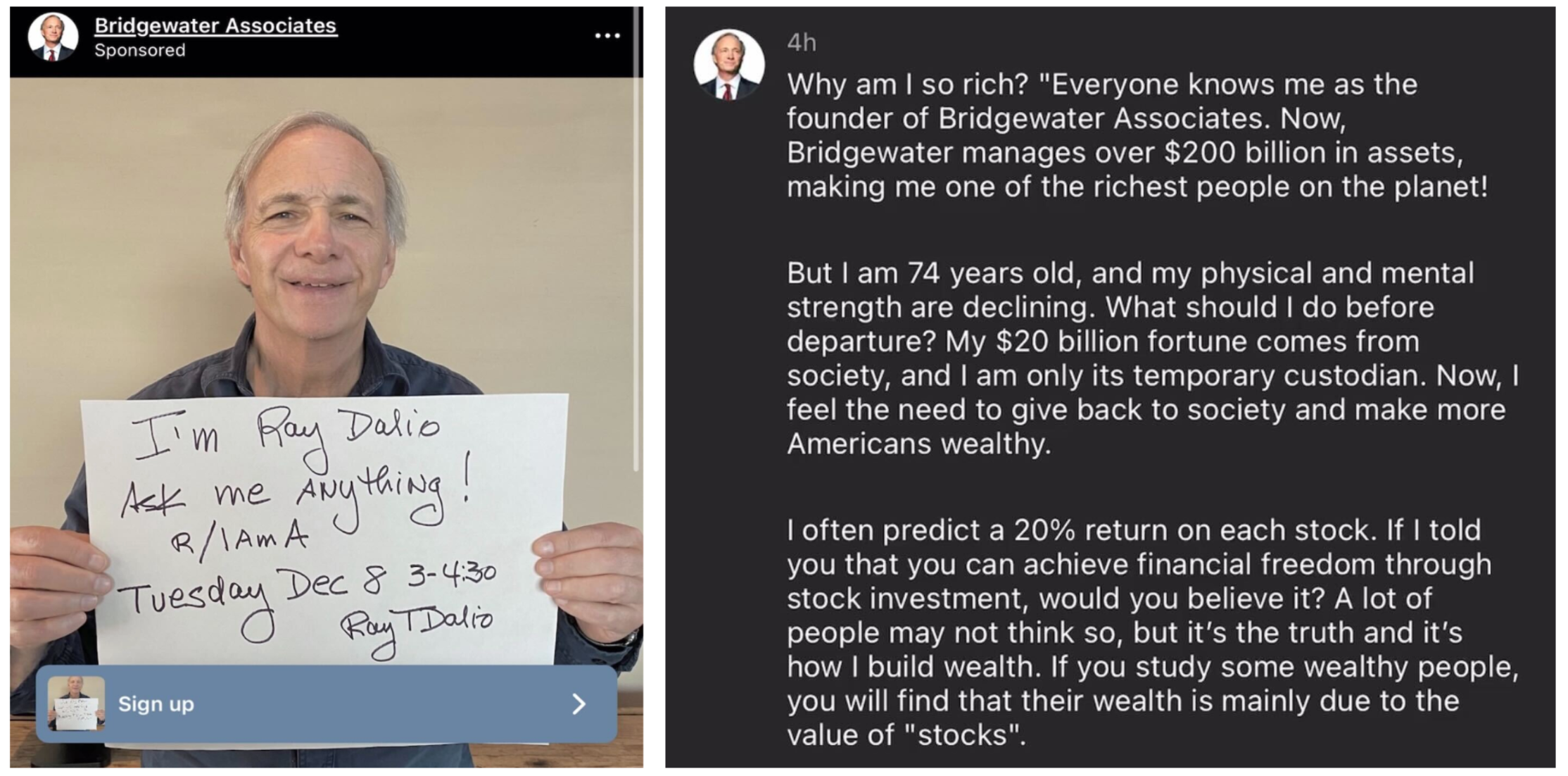
Yesterday, while mindlessly scrolling through Instagram (as one does), a surprising face appeared: Ray Dalio, the founder of legendary Bridgewater Associates. I was looking at an advertisement for a Facebook community named after Dalio’s firm.
The caption under the ad, which was using a picture from Ray Dalio’s AMA on Reddit four years ago, continued to say:
Last month, I predicted in the group that Nvidia's stock price would surge by at least 25% within a month. The stock has gained 64.2% so far this year. Many people did not believe it and missed this opportunity. There are also investors who listened to my advice and received good returns. This is much easier than picking up money. If you still have questions, welcome to join my free discussion group and observe for yourself. Verify. You have nothing to lose, but missing out on this opportunity could cost you real money.
Of course, my success today would not be possible without your support. So today I decided to share my secrets on "How to Get Richer". But since many friends ask me, it is difficult for me to answer alone. So, I decided to create a WhatsApp group to explain it all to you!
Imagine if there was a way to make your stock investment return dozens or even hundreds of times more than your hard work. One cannot always just work; you have to do something to get out of your current situation. Otherwise, can you continue to work when you are old? Is your salary enough to support your family? Are you willing to open the door to new wealth?
So the initial set up is: Ray Dalio, who is worth $15.4 billion, is slinging stock picks in a WhatsApp chat, and he’s highlighting your financial insecurities to entice you to join. “Welcome to join my free discussion group!” It’s incredible copywriting, really.
This is simply the newest wave of a long line of financial scams being propagated on Instagram. The FTC reported that Americans lost $1.4 billion to social media scams in 2023, and Instagram has been a hotbed for fraudsters for years. In 2022 alone, fake bitcoin schemes cost users billions of dollars.
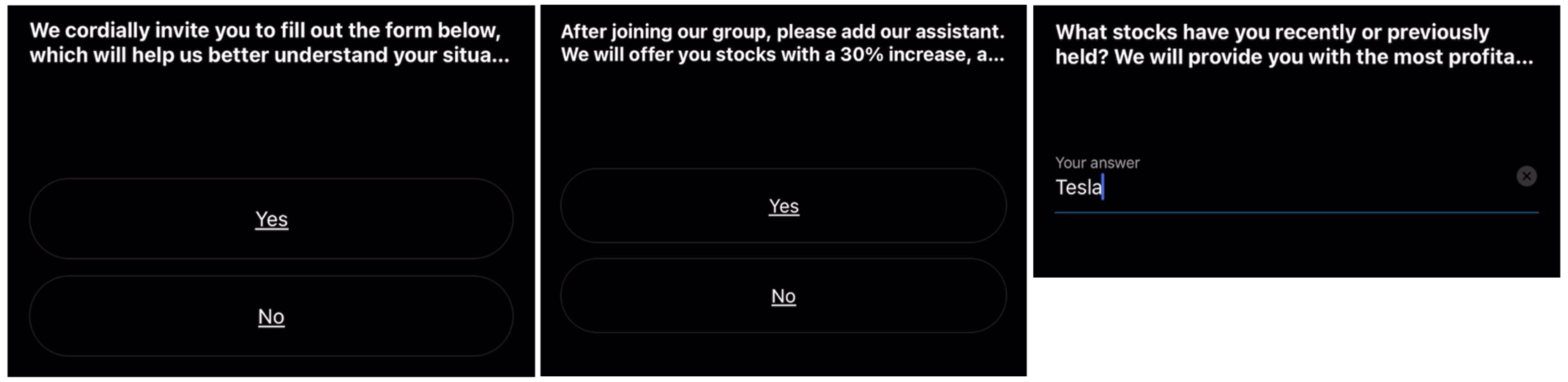
Normally, I would ignore the ad and keep scrolling, but I wanted to see what this WhatsApp scam actually involved. Would they ask for my bank information immediately? Would I need to send money to a foreign entity to generate a “10x” return? Would they just send me stock picks? Curiosity won, and I decided to check out what this “Dalio” was offering. After clicking the sign-up link, I was directed to answer a poorly-constructed survey consisting of three halfway published questions. Definitely the kind of above-board, compliance-reviewed survey a certified investment professional would send out.
“We cordially invite you to fill out the form below (there was no form), which will help us better understand your situa…”
I clicked “yes,” though I wasn’t sure what I was saying “yes” to.
“After joining our group, please add our assistant. We will offer you stocks with a 30% increase, a…”
I once again clicked “yes,” though I was still waiting on a question.
“What stocks have you recently or previously held? We will provide you with the most profita…”
I typed “Tesla,” because that seems like a reasonable stock pick for this target demographic.
After submitting my answers, I clicked a button that said, “Join the Ray Dalio group,” which sent me to a WhatsApp chat with an “Emme Osborne.” The message, “I’m interested in learning stock trading. Could you provide some advice?” auto-populated in my chat box. I hit send, and “Emme” invited me to a different Whatsapp group with 54 members called “US Stock Exchange Group-0038.” No one has sent any messages there yet.
Emme told me that she was a “senior account manager for Fortis Capital Management LLC,” and that Mr. Dalio would be participating in “all of our premium US stock codes.” When I asked about Mr. Dalio’s connection to Fortis Capital Management, she told me, “Mr. Dalio is a partner in our firm and has invested in our organization. But the main operation is by our Mr. Mike.”
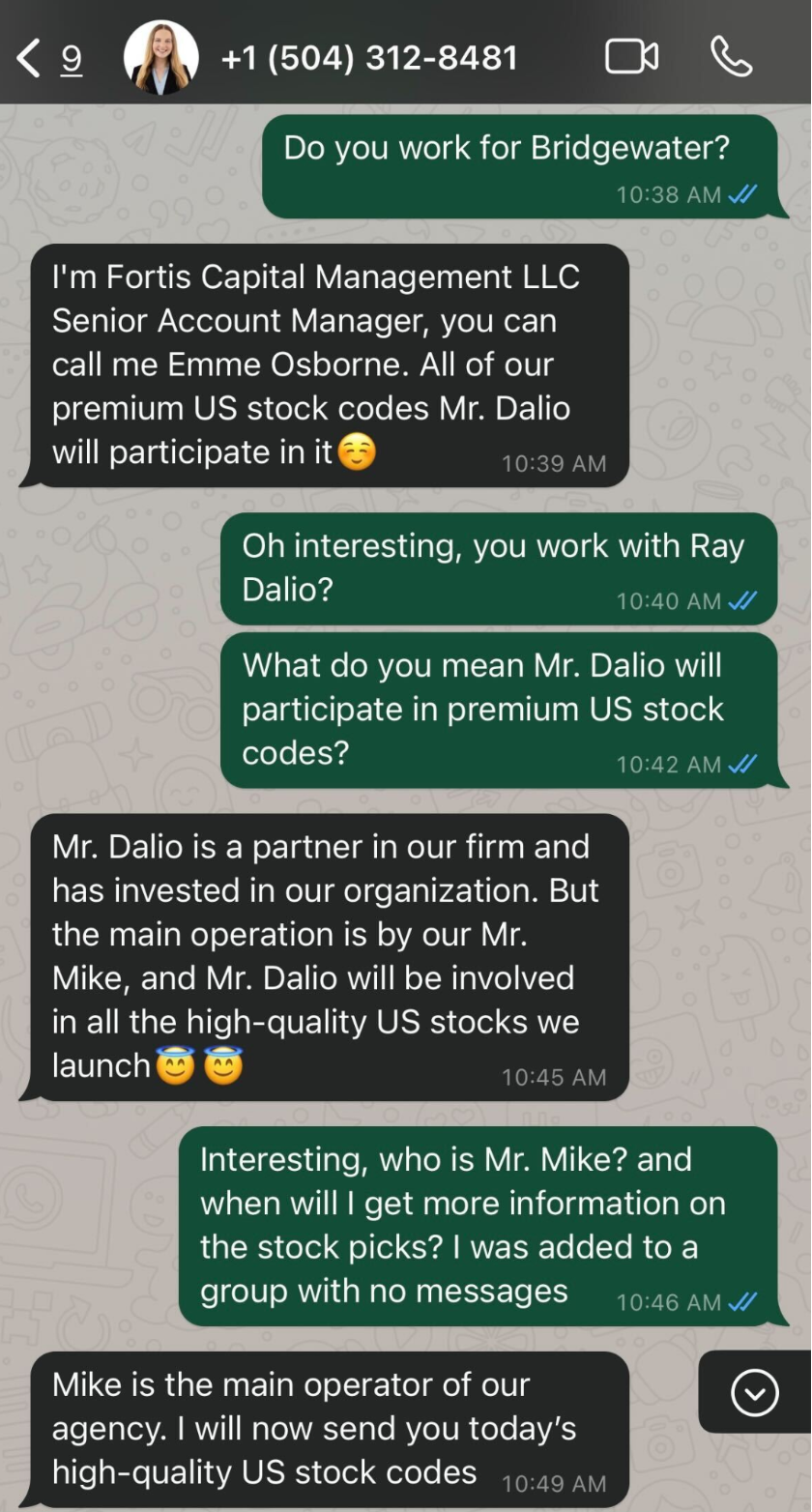
She then sent the following message:
“🔥🔥Strong trading strategy for US stocks on May 21 🔥🔥
Stock code: PLTR
Buying price: $20.60-$22.50
Expected return: 6%-15%”
Followed by a paragraph of garbled text concerning Palantir’s earnings expectations, and a bit of technical analysis.
When I asked, “Who created this stock idea?” She replied, “Mike Boroughs. This is the popular stock code recommended by Mr. Mike today. You can trade according to the information sent by Mr. Mike.”
This pick was free (how generous!) as I was currently a trial member, but after a trial period of 65 days, I would have to sign a cooperation agreement to join a formal partnership (this is, I imagine, where I would lose all of my money). Emme asked for proof that I had purchased the stock, and she guaranteed 2-3 high quality stock picks each week (to her credit, they sent me another pick this morning), with a minimum monthly return for each VIP customer above 80%. She also promised to compensate me for any losses stemming from investments related to their recommendations. Considering that the S&P 500 averages a 9% annual return, this, seemed like a remarkable and super non-shady investment opportunity.
I decided not to invest in Palantir Technologies (PLTR), but I was curious about “Big Mike.” After searching for “Mike Boroughs” on Linkedin, I was surprised to see that there was a real Mike Boroughs, who is a managing partner at Fortis Financial Group, a mid-sized financial planning and wealth management firm in Bellevue, Washington. I also found a linkedin page for Emme Osborne and both are listed on the about us page for Fortis.
However, that was where the reality of Emme’s story ended. One month ago, Boroughs warned Linkedin about WhatsApp groups impersonating him and his firm.
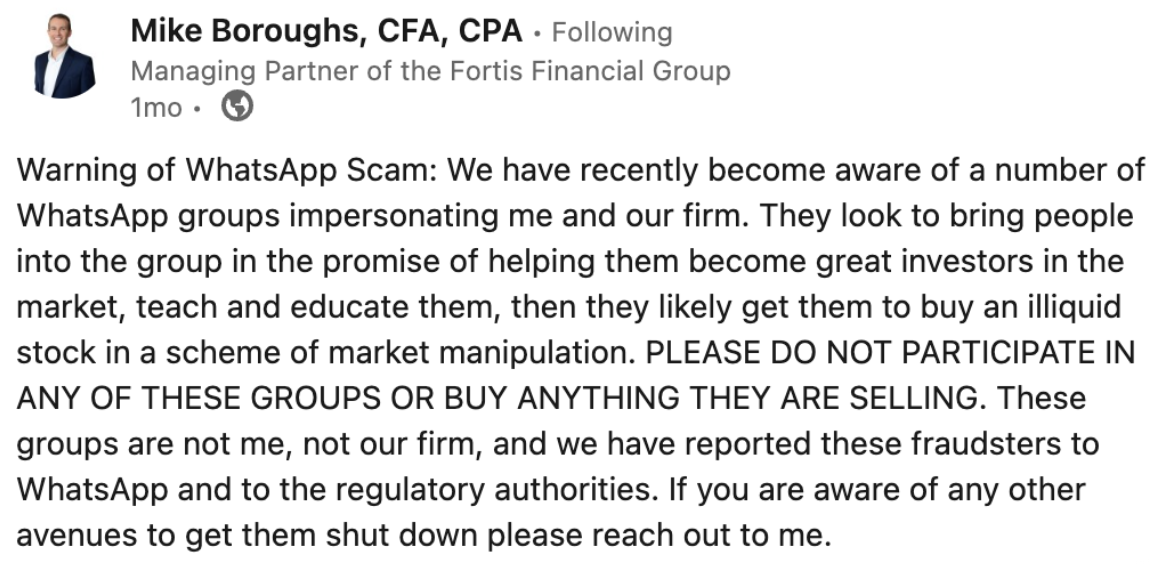
I asked “Emme,” the supposed Fortis Financial account manager, about Mike’s post, and she assured me that they had “submitted the information and were going through the legal process.” That definitely seems legit!
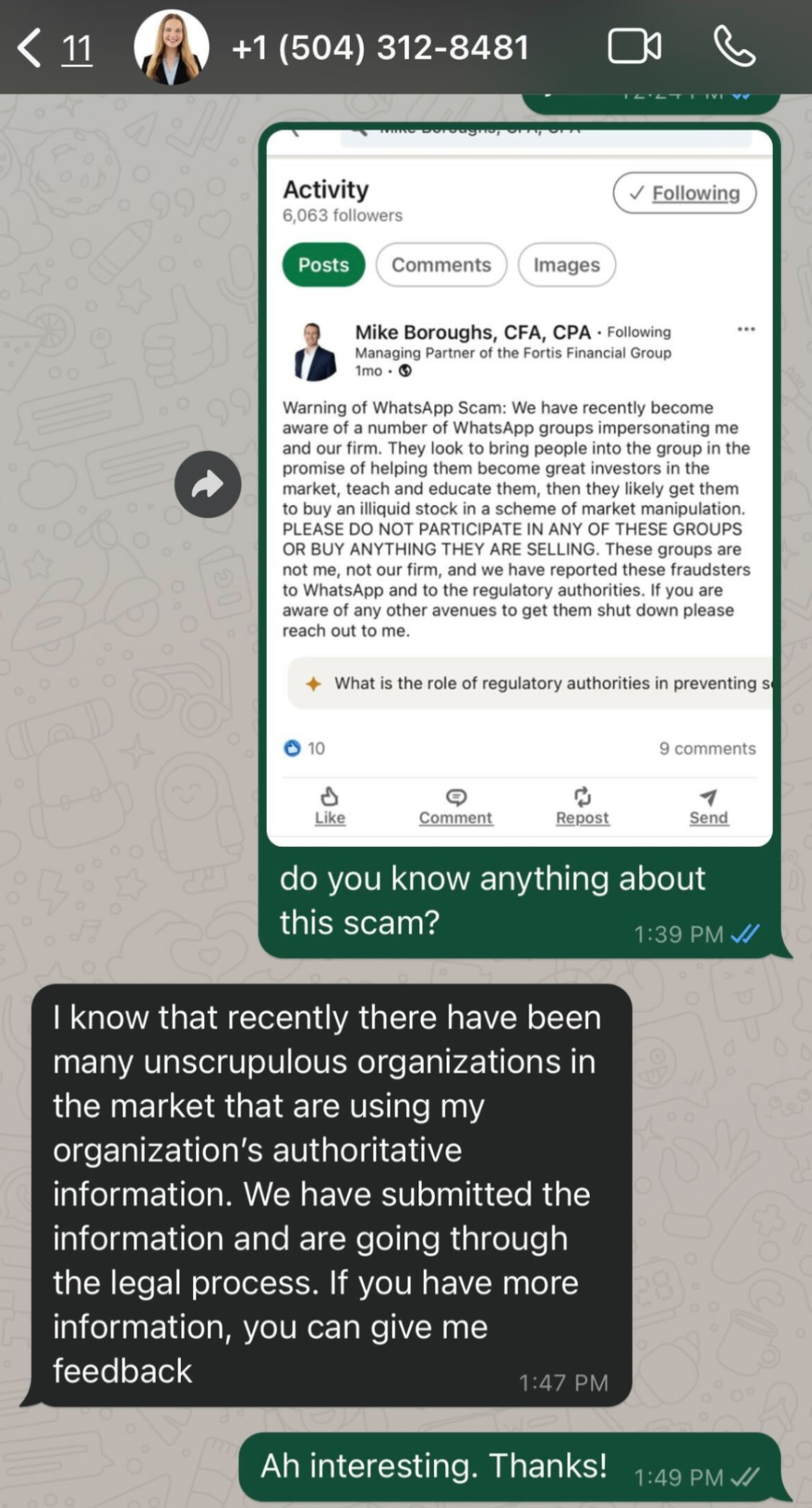
I reached out to Boroughs and Fortis Financial, hoping to figure out why a scammer chose Mike Boroughs, a random financial planner with 6,000 LinkedIn followers, as the face of his organization, but they haven’t replied. However, Mike’s LinkedIn post shed some light on where the scam itself kicks in:
“They look to bring people into the group in the promise of helping them become great investors in the market, teach and educate them, then they likely get them to buy an illiquid stock in a scheme of market manipulation.”
This looks to be a case of a classic pump and dump:
Get someone to join the WhatsApp chat;
Send them stock picks for a few weeks;
After establishing some level of comfort, tell them to buy an illiquid stock, so you profit.
Scammers steal billions of dollars each year through schemes like this, so here is a rule of thumb for avoiding this trap. If you see Ray Dalio, or any other billionaire investor for that matter, advertising a WhatsApp stock picking group, there is a 99.9999% chance that it’s a scam. Anyone promising outsized returns and “no risk” should raise red alerts: those are the hallmarks of someone running a Ponzi or other scam.
And in the 0.0001% chance that it’s not a scam, it’s probably still a bad investment.




