Tech
tech

Investors loved BYD’s new superfast chargers, but how do they stack up against the competition?

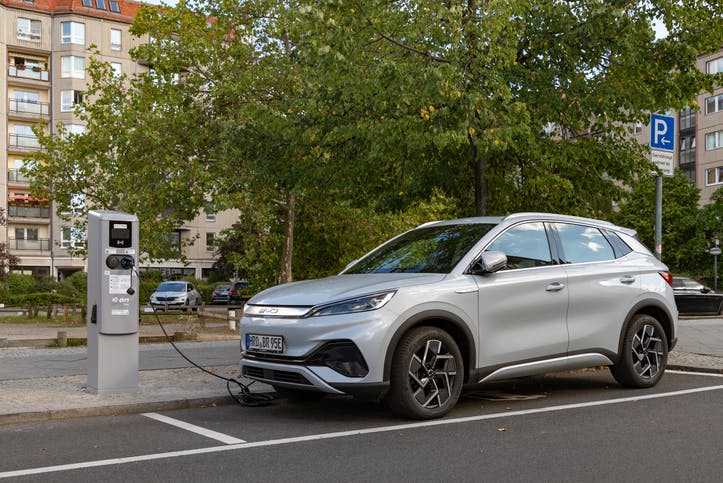
BYD investors were cheering at the start of the week, after the Chinese electric vehicle giant unveiled its new superfast charging tech at an event in Shenzhen on Monday, with plans to install 4,000 “Super e-Platform” ports across its home nation to try and quell range anxiety.

But just how fast is “superfast”? And how does BYD’s new technology stack up against some of its biggest competitors in the EV market?

Though there’s no one-size-fits-all standardized measure of charging speeds, electric vehicle manufacturers tend to discuss milestones or benchmarks — like BYD claiming that it can add ~250 miles of range in five minutes. From those claims, we can work out how many miles of range are added per minute.

Tesla, for example, says that its Superchargers can add “up to 200 miles in 15 minutes of charge” — the equivalent of about 13 miles added per minute of charging. Mercedes-Benz claims that its “CLA 250+ with EQ Technology can be recharged to a range of up to 325 kilometres within ten minutes,” or roughly 20 miles every minute.

Here’s how a few major EV makers stack up, based on public statements about charger tech and company claims about their fastest-charging models (where available).
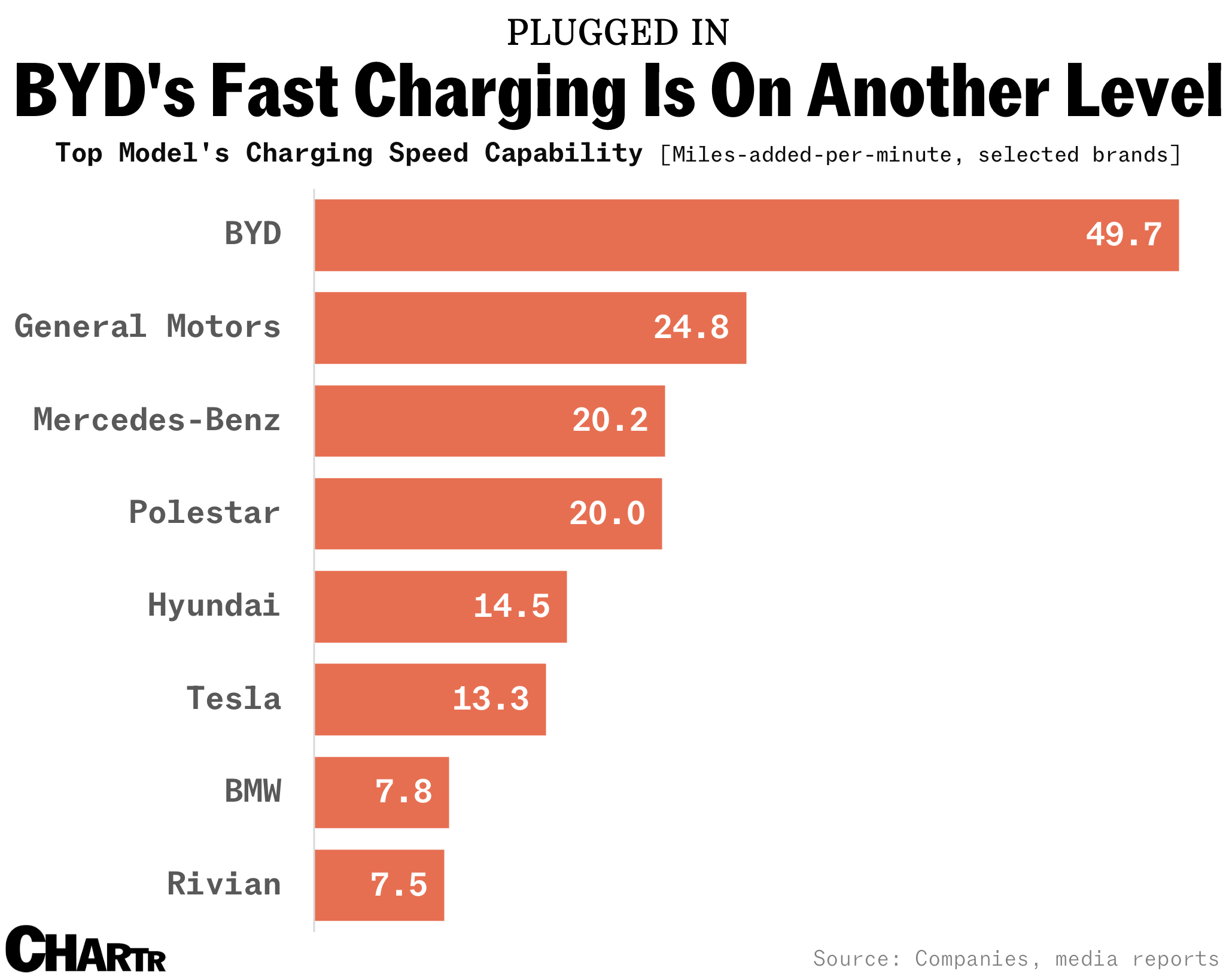
BYD vs. Tesla vs. Ford electric vehicle charging speeds
Sherwood News

Per Wang Chuanfu, BYD’s founder and CEO, the company aims to “make the charging time of electric vehicles as short as the refuelling time of petrol vehicles.” If the new charging tech is as quick as the automaker says, that goal isn’t far off. 
But just how fast is “superfast”? And how does BYD’s new technology stack up against some of its biggest competitors in the EV market?

Though there’s no one-size-fits-all standardized measure of charging speeds, electric vehicle manufacturers tend to discuss milestones or benchmarks — like BYD claiming that it can add ~250 miles of range in five minutes. From those claims, we can work out how many miles of range are added per minute.

Tesla, for example, says that its Superchargers can add “up to 200 miles in 15 minutes of charge” — the equivalent of about 13 miles added per minute of charging. Mercedes-Benz claims that its “CLA 250+ with EQ Technology can be recharged to a range of up to 325 kilometres within ten minutes,” or roughly 20 miles every minute.

Here’s how a few major EV makers stack up, based on public statements about charger tech and company claims about their fastest-charging models (where available).

BYD vs. Tesla vs. Ford electric vehicle charging speeds
Sherwood News

Per Wang Chuanfu, BYD’s founder and CEO, the company aims to “make the charging time of electric vehicles as short as the refuelling time of petrol vehicles.” If the new charging tech is as quick as the automaker says, that goal isn’t far off. 

More Tech

See all Tech
tech

Tesla sales drop in Germany, adding to declines across Europe

Tesla sales in Germany, one of its biggest European markets, fell 20% in November and are down nearly 50% through November compared with a year earlier, deepening what has largely been a year of sales declines across the continent.

CEO Elon Musk has said Europe, Tesla’s third-largest market, is its “weakest market,” blaming the lack of regulatory approval for its Full Self-Driving tech.

For what it’s worth, even in places where FSD is allowed, adoption isn’t strong. On the company’s most recent earnings call, CFO Vaibhav Taneja said that globally, only 12% of Tesla’s existing fleet pays for FSD.

tech

Report: Anthropic hires law firm to prepare for possible IPO in 2026

Anthropic has taken the first steps toward a possible initial public offering next year, according to a new report from the Financial Times.

Anthropic has hired West Coast law firm Wilson Sonsini to begin work on the IPO, per the report.

Anthropic’s valuation has skyrocketed recently, reaching as high as $350 billion by some estimates. An IPO for Anthropic would allow investors one of their first real cracks at tapping into white-hot demand for the private companies at the heart of the generative-AI boom that started three years ago with OpenAI’s release of ChatGPT.

Anthropic’s valuation has skyrocketed recently, reaching as high as $350 billion by some estimates. An IPO for Anthropic would allow investors one of their first real cracks at tapping into white-hot demand for the private companies at the heart of the generative-AI boom that started three years ago with OpenAI’s release of ChatGPT.

tech

Microsoft drops after report that it lowered AI sales quotas in the face of lower-than-expected demand

Microsoft was down around 3% this morning after The Information reported that multiple divisions within the tech giant have lowered their sales quotas for AI products as traditional customers resist paying more for largely unproven tech. The stock pared some of those losses after CNBC reported that Microsoft issued a statement saying it hadn’t lowered sales quotas or targets. The Information has updated its headline to say “Microsoft Lowers AI Software Growth Targets as Customers Resist Newer Products.”

While AI spending has been a major revenue lift for Microsoft, The Information noted that much of that revenue is booked from AI companies themselves, which rent cloud infrastructure from the hyperscaler — arrangements critics have described as circular deals that inflate apparent growth. Microsoft’s stock has been struggling following its earnings report in late October, when the company reversed its guidance on capital spending, meaning its AI expenses would continue to grow.

Earlier this year, Bloomberg reported that Microsoft salespeople were having trouble selling the company’s chatbot, Copilot, with consumers preferring OpenAI’s ChatGPT instead.

While AI spending has been a major revenue lift for Microsoft, The Information noted that much of that revenue is booked from AI companies themselves, which rent cloud infrastructure from the hyperscaler — arrangements critics have described as circular deals that inflate apparent growth. Microsoft’s stock has been struggling following its earnings report in late October, when the company reversed its guidance on capital spending, meaning its AI expenses would continue to grow.

Earlier this year, Bloomberg reported that Microsoft salespeople were having trouble selling the company’s chatbot, Copilot, with consumers preferring OpenAI’s ChatGPT instead.

+6%

Apple iPhone shipments are expected to jump 6.1% to a record 247.4 million units this year, according to a new report by IDC, “thanks to the phenomenal success of its latest iPhone 17 series.”

Meanwhile, smartphone sales overall are expected to grow 1.5% this year compared with 2024.

Apple’s previous annual record was in 2021, when the iPhone 13 came out. The IDC Apple estimate is higher than a recent one by Counterpoint Research, which pegged shipments at 243 million.

tech

Uber beats Google’s Waymo to Dallas

Uber jumped more than 2% premarket after announcing that users in Dallas could be matched with its Avride robotaxis beginning today. The coverage area is small to start with — 9 square miles of Dallas, including downtown — though the company plans to expand that operating territory in the future. Uber didn’t disclose how many robotaxis would be operating in that area.

The move makes Uber the first company to offer an autonomous car service in the city.

Google’s Waymo said last month that it would begin operations in Dallas and a number of other markets in 2026. Lyft also plans to launch there next year. Uber now has autonomous vehicles on its platform in four cities, including Phoenix, Austin, and Atlanta, which are all in partnership with Waymo.

Uber has had its autonomous eyes set on Dallas since at least 2019 and announced its partnership with Nebius-owned autonomous car company Avride in October 2024.

The move makes Uber the first company to offer an autonomous car service in the city.

Google’s Waymo said last month that it would begin operations in Dallas and a number of other markets in 2026. Lyft also plans to launch there next year. Uber now has autonomous vehicles on its platform in four cities, including Phoenix, Austin, and Atlanta, which are all in partnership with Waymo.

Uber has had its autonomous eyes set on Dallas since at least 2019 and announced its partnership with Nebius-owned autonomous car company Avride in October 2024.

Latest Stories

Sherwood Media, LLC produces fresh and unique perspectives on topical financial news and is a fully owned subsidiary of Robinhood Markets, Inc., and any views expressed here do not necessarily reflect the views of any other Robinhood affiliate, including Robinhood Markets, Inc., Robinhood Financial LLC, Robinhood Securities, LLC, Robinhood Crypto, LLC, or Robinhood Money, LLC.