
Tech
Tesla Robotaxi
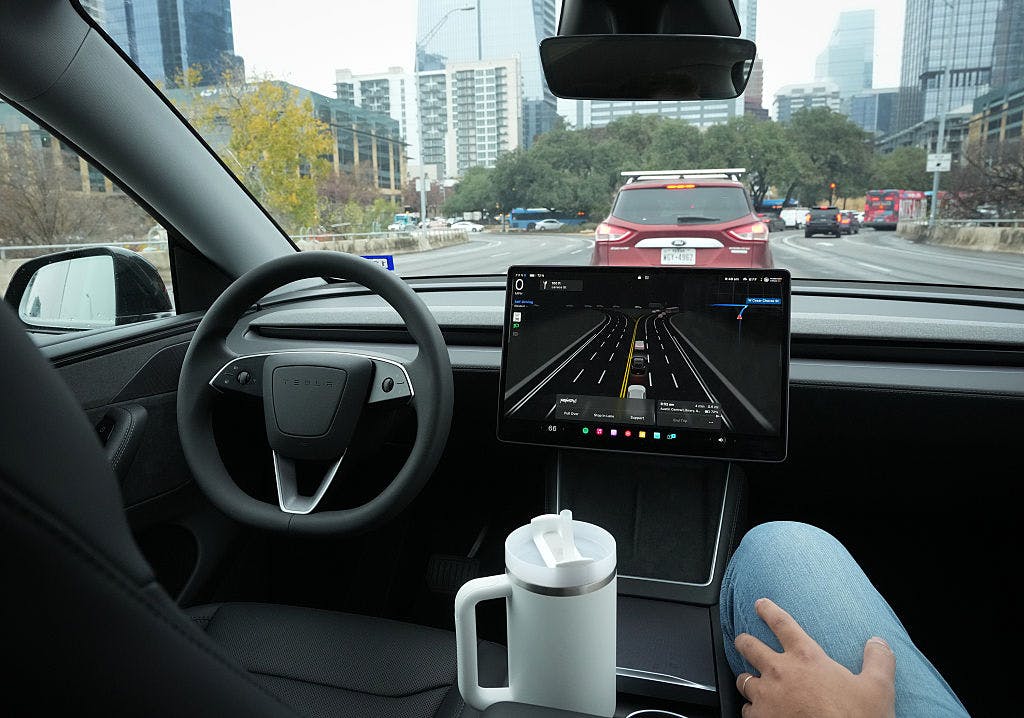
A safety monitor rides in the front passenger seat as a Tesla Robotaxi drives in Austin (Jay Janner/Getty Images)

The vast majority of Tesla Robotaxi rides in Austin still have a safety driver

In January, Tesla announced its Robotaxis would begin operating without safety monitors. It doesn’t appear to have scaled up much.

Rani Molla

When Tesla CEO Elon Musk announced in January that Austin Robotaxis were beginning to operate without safety monitors in the front seats, the stock jumped, signaling investor excitement about progress toward full autonomy.

At the time, observers estimated that just two of the roughly 45 Robotaxis in the fleet were without monitors, but Tesla said the ratio would increase quickly.

“We, obviously, are being very cautious about this because we want to have no injuries or serious accidents along the way,” Musk said of removing safety drivers from Austin Robotaxis on the company’s fourth-quarter earnings call a few days later. “But you’ll see the amount of autonomy increase dramatically, I think, every month essentially.”

More than a month later, that increase hasn’t materialized. A report late last week from Jefferies analysts found that just two of the 15 Austin Robotaxi rides they took were without a safety driver. (Separately, they found that while Robotaxis were cheaper than Waymos and regular Ubers operating in the same area, their wait times and trip times were notably longer — consistent with previous reporting from ride-share comparison app Obi.)

Unsupervised Tesla Robotaxis in Austin
Note that just one of these unsupervised Austin Robotaxis has been seen in the past week (Robotaxi Tracker)

Data from Robotaxi Tracker has identified eight unsupervised Tesla Robotaxis. But only one has been spotted in the past week; the rest were last seen roughly three weeks ago. In other words, the number of monitor-less Teslas currently on the road, compared to the time of the initial announcement, appears somewhere in the range of largely unchanged to possibly down.

Tesla said it plans to expand its Robotaxi fleet to a half dozen new markets in the first half of 2026. (It’s currently also in the Bay Area with drivers using supervised Full Self-Driving tech.) As we’ve noted, if Tesla’s Robotaxi expansion goes forward, it will probably look a lot more like a traditional driver-having Uber than an autonomous Waymo.


More Tech

See all Tech
tech

Anthropic launches “Claude Design,” sending shares of Figma and Adobe down

Anthropic has been slowly and steadily gaining a leading share in the enterprise AI market by focusing on coding, spreadsheets, and other common productivity and workplace apps.

Now it’s going after design apps.

Today Anthropic launched Claude Design, a dedicated app powered by its latest model, Claude Opus 4.7, that lets users use text prompts to build website designs, user interface prototypes, presentations, and marketing materials.

Shares of Figma and Adobe sank on the news.

While Claude has previously had the ability to create designs and user interfaces, breaking it out into a dedicated app signals a major new piece of its enterprise strategy alongside its popular Claude Code product.

Today Anthropic launched Claude Design, a dedicated app powered by its latest model, Claude Opus 4.7, that lets users use text prompts to build website designs, user interface prototypes, presentations, and marketing materials.

Shares of Figma and Adobe sank on the news.

While Claude has previously had the ability to create designs and user interfaces, breaking it out into a dedicated app signals a major new piece of its enterprise strategy alongside its popular Claude Code product.

tech

Apple’s China iPhone shipments surged 20% in Q1 even as overall smartphone shipments fell

Apple’s iPhone shipments in China jumped 20% last quarter, even as the country’s overall smartphone market fell 4%, according to new data from Counterpoint Research. Rising memory costs have pushed prices higher across the industry, weighing on demand.

Apple appears poised to ride out the broader smartphone slump. Its strength at the less price-sensitive high end of the market and its unusual leverage over suppliers, which helps keep costs in check, give it an edge over rivals.

Greater China remains a critical region for Apple, making up about 18% of its total revenue in the fourth quarter. The company accounted for 19% of China’s smartphone market in the first quarter, up from 15% a year earlier, per Counterpoint.

tech
Rani Molla

Anthropic has surged past OpenAI in capturing business spending on generative-AI software

Last quarter, Anthropic attracted the lion’s share of trackable business spending on generative-AI software, according to new data from Ramp, a fintech company that provides corporate cards and expense management software for small firms and Fortune 500 companies alike.

The data showed that in the first quarter, Anthropic saw 37% of spending, its biggest share yet, versus 33% for OpenAI. Notably, the dataset doesn’t capture spending by Google or Microsoft.

OpenAI, which makes ChatGPT, still leads in overall adoption at 81% of AI buyers, but Anthropic is catching up, at nearly 63% in March. Overall, more than half of Ramp’s customers currently pay for AI, up from just 18% two years ago.

Anthropic’s enterprise tools, including Claude Code and Cowork, have been making waves among the business class, sending its revenue soaring.

Anthropic’s revenue share is even higher among companies spending on AI for the first time.

“Anthropic has definitely been on a tear,” Ara Kharazian, Ramp’s economist, told Sherwood News. “Its increase in adoption rates has been driven by its ability to sell to less technical users and smaller contracts than it typically has.”

It’s notable that midway through the first quarter, Anthropic had a falling-out with one of its biggest customers, the US government, which near the end of February decided to shun Anthropic’s products and lean into working with OpenAI.

tech
Jon Keegan

Report: Google ditches its objection to defense work, pitches Gemini to Pentagon

In 2018, Google employees protested against the company’s tech being used for the US military’s Project Maven — a drone targeting program — reminding the company of its “don’t be evil” motto.

After the controversy, the company declined to renew the contract with the Pentagon, drawing a bright line between Big Tech and the national security establishment.

What a difference a few years makes.

Google is now actively working to get its Gemini AI model to be used in classified national security settings, according to a new report from The Information. Seeking a similar deal to the one OpenAI hashed out with the Pentagon, Google reportedly wants a contract that allows use of Gemini in classified work, but with a prohibition on mass domestic surveillance and autonomous lethal weapons.

But Google is playing catch-up in a major way. Amazon and Microsoft both have been widely used for classified defense work, and contractors are already experienced in working with their cloud systems, while Google’s services have never been used in classified work.

What a difference a few years makes.

Google is now actively working to get its Gemini AI model to be used in classified national security settings, according to a new report from The Information. Seeking a similar deal to the one OpenAI hashed out with the Pentagon, Google reportedly wants a contract that allows use of Gemini in classified work, but with a prohibition on mass domestic surveillance and autonomous lethal weapons.

But Google is playing catch-up in a major way. Amazon and Microsoft both have been widely used for classified defense work, and contractors are already experienced in working with their cloud systems, while Google’s services have never been used in classified work.

Latest Stories

Sherwood Media, LLC produces fresh and unique perspectives on topical financial news and is a fully owned subsidiary of Robinhood Markets, Inc., and any views expressed here do not necessarily reflect the views of any other Robinhood affiliate, including Robinhood Markets, Inc., Robinhood Financial LLC, Robinhood Securities, LLC, Robinhood Crypto, LLC, Robinhood Derivatives, LLC, or Robinhood Money, LLC. Futures and event contracts are offered through Robinhood Derivatives, LLC.
