
Tech
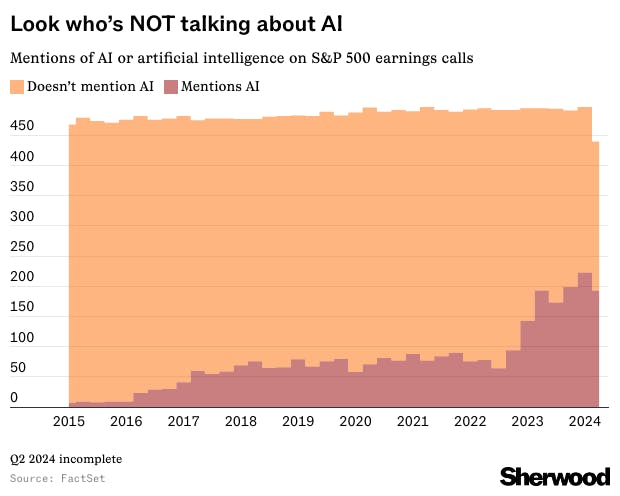
Mentions of AI or artificial intelligence on S&P 500 earnings calls
Sherwood News

Most companies aren’t talking about AI

AI has been the buzziest of buzzwords for years. A minority of America’s most notable companies are actually talking about it.

Given the fever pitch at which everyone and their grandpa is talking about AI — not to mention spending money on it — it might surprise you to know the majority of big companies are mum on the subject.

So far this quarter, 44% of S&P 500 companies that have had earnings calls have mentioned “AI” or “artificial intelligence,” while 56% have not. That ratio has been steadily shifting in recent years as companies try to use the technology to save money and boost profits, but the majority of these companies have still yet to embrace AI.

Some of the companies and their industries are pretty obvious and it would probably be a stretch for them to try and pounce on the AI boom. For example, construction materials company Vulcan Materials, which sells crushed stone, sand, gravel and asphalt, has never mentioned AI on a call. Neither have beer maker Molson Coors or energy drink producer Monster Beverage.

Even for a company with a tech bent like Disney, the topic has rarely come up. Last year, an analyst asked CEO Bob Iger about how AI could impact Disney’s business.

“I'm looking forward to a time where maybe AI does earnings calls for me,” Iger joked.

“It's pretty clear that AI developments represent some pretty interesting opportunities for us and some substantial benefits. In fact we're already starting to use AI to create some efficiencies, and ultimately, to better serve consumers,” he said. “On the other hand, I think that there's a lot we're going to have to contend with that will be quite disruptive and quite challenging. Getting more specific is not something I really am prepared to do right now.”

Hilton Worldwide CEO Christopher Nassetta uttered the letters AI once, back in 2018, when the definition of AI was very different than it is now.

Nassetta did talk about it when asked at Skift’s Global Forum last year about genAI.

“Listen, we've been using AI for – in one form or another — for many years and ChatGPT, generative AI is obviously the next step in the evolution,” he said. “When we wake up in 10 or 20 years, it'll be revolutionary in a whole bunch of different ways. But I think it's going to take time, and my personal experience with it so far and our teams' experience with it is, we have a long way to go before it's in that form super productive. But AI has tremendous application already. Not ChatGPT directly, but AI. And we're already, as I said, using it in really powerful ways.”

Indeed, the pivot to AI will likely take longer than many company leaders hope, and returns on investment might not come soon enough for investors wondering what all this AI spending will amount to.

But perhaps, as they say, talk is cheap. While John Deere hasn’t mentioned AI on recent earnings calls, it’s already been using AI for autonomous tractors and to spray herbicide. It discussed AI on earnings calls a few years back, and now has moved on to action.


More Tech

See all Tech
tech
Tom Jones

Prediction markets have, predictably, been given a boost by the summer of sports

Major platforms like Kalshi and Polymarket have seen huge upticks in users of late, thanks in no small part to what’s felt like a recent sporting smorgasbord, with major competitions across hockey, basketball, and soccer soaking up fans’ time (and spending, clearly) at the outset of summer.

While gaming industry groups may not like it, there’s been a huge change in the methods people are using to put money on the big games, with everyone from fortunate NYC bar owners, to a far less fortunate Spanish supporter, turning to prediction markets to try and turn their sports know-how into cold, hard cash.

According to a new report from Adam Blacker for apptopia, that shift might have been even more seismic than imagined in the wake of the NBA and NHL finals and around the 2026 World Cup kicking off.

While gaming industry groups may not like it, there’s been a huge change in the methods people are using to put money on the big games, with everyone from fortunate NYC bar owners, to a far less fortunate Spanish supporter, turning to prediction markets to try and turn their sports know-how into cold, hard cash.

According to a new report from Adam Blacker for apptopia, that shift might have been even more seismic than imagined in the wake of the NBA and NHL finals and around the 2026 World Cup kicking off.

South by Southwest Conference and Festivals

Gold Tesla Cybercabs are piling up, but they’re not picking up passengers yet

Low-volume production started in April. Now people are noticing them more and more in the wild.

Rani Molla6/15/26
tech
Jon Keegan

Anthropic pulls Fable and Mythos access worldwide after Trump administration bars their use by foreign nationals

Only days after releasing two versions of its next-gen AI model, Anthropic has disabled them for users worldwide.

Anthropic says it received a Friday night order from the Trump administration to suspend access to the models for any foreign national (anywhere in the world) — a group that included some Anthropic employees. In response, the company turned off access to everyone.

Last week, the company released to the public its much-anticipated Claude Fable 5 model (and its restricted version Claude Mythos 5, which is still being tested with trusted partners). Anthropic said in a blog post announcing the action that officials cited national security concerns with the new models, while offering few specific details.

The post said that the government gave the company “verbal evidence of a potential narrow, non-universal jailbreak” of the public Fable 5 model. A jailbreak is a means by which users can evade restrictions built into the code to unlock prohibited functionality. Anthropic downplayed the significance of the attack, and said other major models, such as OpenAI’s GPT-5.5, could also be affected by the technique described.

Fears of these first Mythos-class models being misused are running high, after Anthropic warned the cybersecurity world in May that the advanced cyber capabilities of Mythos have rapidly discovered thousands of vulnerabilities in ubiquitous software, leading to the decision to restrict the full version of the model to a close group of trusted partners for testing.

This morning, Axios reported that Anthropic technical staff have flown to Washington to meet with White House officials to resolve the issue.

The Wall Street Journal is reporting that the Trump administration’s decision to take action against Anthropic was prompted by discussions that Amazon CEO Andy Jassy had with officials, including Treasury Secretary Scott Bessent. According to the report, Amazon researchers said they had been able to evade some of Fable 5’s security restrictions using specific prompts. Amazon is a major investor in Anthropic.

Anthropic is currently suing the US government to fight the Pentagon’s blacklisting of the company on national security grounds.

Last week, the company released to the public its much-anticipated Claude Fable 5 model (and its restricted version Claude Mythos 5, which is still being tested with trusted partners). Anthropic said in a blog post announcing the action that officials cited national security concerns with the new models, while offering few specific details.

The post said that the government gave the company “verbal evidence of a potential narrow, non-universal jailbreak” of the public Fable 5 model. A jailbreak is a means by which users can evade restrictions built into the code to unlock prohibited functionality. Anthropic downplayed the significance of the attack, and said other major models, such as OpenAI’s GPT-5.5, could also be affected by the technique described.

Fears of these first Mythos-class models being misused are running high, after Anthropic warned the cybersecurity world in May that the advanced cyber capabilities of Mythos have rapidly discovered thousands of vulnerabilities in ubiquitous software, leading to the decision to restrict the full version of the model to a close group of trusted partners for testing.

This morning, Axios reported that Anthropic technical staff have flown to Washington to meet with White House officials to resolve the issue.

The Wall Street Journal is reporting that the Trump administration’s decision to take action against Anthropic was prompted by discussions that Amazon CEO Andy Jassy had with officials, including Treasury Secretary Scott Bessent. According to the report, Amazon researchers said they had been able to evade some of Fable 5’s security restrictions using specific prompts. Amazon is a major investor in Anthropic.

Anthropic is currently suing the US government to fight the Pentagon’s blacklisting of the company on national security grounds.

Latest Stories

Sherwood Media, LLC and Chartr Limited produce fresh and unique perspectives on topical financial news and are fully owned subsidiaries of Robinhood Markets, Inc., and any views expressed here do not necessarily reflect the views of any other Robinhood affiliate, including Robinhood Markets, Inc., Robinhood Financial LLC, Robinhood Securities, LLC, Robinhood Crypto, LLC, Robinhood Money, LLC, Robinhood U.K. Ltd, Robinhood Derivatives, LLC, Robinhood Gold, LLC, Robinhood Asset Management, LLC, Robinhood Credit, Inc., Robinhood Ventures DE, LLC and, where applicable, its managed investment vehicles.
