TURN SIGNAL
Confessions of a (former) robotaxi hater

Robotaxis actually rule?
San Franciscans have gotten used to seeing cars without drivers crisscrossing their city. It will be the reality for the rest of us soon.
The first time you see a car glide through a San Francisco intersection with no one behind the wheel, you hold your breath.
Wait there long enough, however, and the sight becomes mundane. It’s not uncommon to see half a dozen Alphabet Waymos, Amazon Zooxes, and Tesla Robotaxis at the same light.
They pause for pedestrians, ease into turns, and merge with the flow of traffic — just another participant in the choreography of the streets. Before long, what once felt uncanny starts to feel routine.
And that’s when behavior starts to shift: when you stop treating a technology as a novelty and start reorganizing your life around it.
Then you start to wonder what’s next.
Some are comparing the trajectory and potential impact of physical AI, including autonomous vehicles, to another technology that had some of its earliest followers in the Bay Area.

The internet first took hold among a relatively small group of academics, engineers, and hobbyists who were a little early and a little obsessed. They emailed instead of called. They built websites before there was much to browse. They imagined a future in a digital world that, to most people, barely existed. Then, gradually and all at once, everyone else joined them.
Now something similar is playing out on the roads. Driverless cars are quietly logging millions of miles in some of the same cities where the early internet took shape. They are opening up new possibilities for transportation and labor, and introducing frictions no one had to think about before. Like the internet before them, the tech isn’t arriving fully formed. It’s being tested out in the open, in real time, where anyone can watch.
The way the tech is advancing, driverless cars will become a reality for the rest of us soon. For now, though, the Bay Area remains a few steps ahead.
Why there?
“You’re demoing your product in front of potential customers, investors, and competitors,” Silicon Valley historian and University of Washington professor Margaret O’Mara told me. “You also have a local government that’s less resistant to letting driverless cars scoot around their cities and have existing relationships with these companies.”
The weather helps, too: it’s generally sunny and mild here, meaning autonomous cars don’t have to contend with excessive rain and snow. And San Francisco, while a big city, is no New York, allowing companies to start in a dense but still manageable urban environment.
I recently spent a couple of weeks traversing the San Francisco Bay Area with family, friends, and sources in driverless cars. Everyone I spoke to who had actually used them — a former BART driver who takes Waymos, the Tesla Robotaxi safety monitors whose jobs may soon end, residents who are finding new ways around their old city — said some version of the same thing: this is the future.
While San Franciscans have been living this reality for the last few years, the technology is starting to take root in other cities across the country. Waymo now offers public rides in 11 markets. Tesla’s Robotaxi, which currently operates in the Bay Area and Austin, and to a lesser extent in Dallas and Houston, has plans to expand to another five markets by next month, though it will likely take longer. Zoox, which is testing in 10 US markets, has a select service in San Francisco and is open to the public in Vegas. As part of a partnership with Uber, Zoox has plans to expand to Los Angeles next year.
As of March, there were a total of 69 robotaxi deployments in the US, according to the Bank of America Institute, the most of any country.

For people outside the Bay Area and those who haven’t used it, the future is harder to see.
Recent survey data from Electric Vehicle Intelligence Report found that 53% of consumers across the country said they’d never ride in a robotaxi. Meanwhile, 4% have ridden in one and would do it again, versus 1% who’ve ridden in one and wouldn’t again. In a separate survey restricted to markets where Waymos operate, EVIR found that a much bigger chunk — 20% — of consumers had tried one and 90% of those said they’d do so again.
“Every introduction of every new technology is accompanied by both fascination and fear,” O’Mara said, likening people’s first robotaxi rides to the apprehension people had when they first bought something on the internet.
Anecdotally, posting a video of a driverless ride garnered more than a few vomit emojis and words of trepidation from my friends back East. Driverless cars, like the AI that powers them, are cringe — a sentiment I, too, held.
That’s why it pains me to say that over dozens of rides — through rain and shine, at night and during the day, on crowded city streets and highways — my experience with robotaxis was consistently good. Pickups were mostly seamless. The rides were smooth. The vehicles were cautious but confident, switching lanes during San Francisco rush hour better than a number of the humans I know there.
I came to prefer the physically straighter and more predictable autonomous rides to the grab bag I’d get with human drivers when taking an electric Uber instead. You can blast your own music and cry in Google’s Waymo or Amazon’s Zoox. (You can do it in a Tesla Robotaxi, too, but having a person in the driver’s seat just isn’t the same.) Most importantly, I felt surprisingly safe in all of them and didn’t have any incidents that changed my mind.

That’s not to say there weren’t hiccups, like when a Tesla Robotaxi, upon encountering a closed road in Tilden Park, circled a roundabout three times before I asked the safety monitor, who is present for every trip, to take over and bring me to a different part of the park. He had initially asked me to edit the destination on my phone, but I wasn’t able to since there was no cell service in the park. Or when the Waymo thought a good spot to drop us off was in front of an active parking garage, eliciting the fury of a human driver who was trying to exit. Or that time the Zoox said it couldn’t find an acceptable place to stop, so it circled the block, only to park in the same spot it had initially rejected.
There are also still limits on where these vehicles can go and who can take them — constraints that shape the version of autonomous transportation people actually experience today. And those limits aren’t just technical. They’re strategic.
“The story of Silicon Valley is one of fierce and ruthless competition,” O’Mara told me.
Nowhere is that more visible than on the streets of San Francisco, where three very different approaches to autonomy are playing out in real time.
Comparing the competition
Tesla’s Robotaxi has the biggest footprint in the Bay Area, covering the San Francisco Peninsula, which is dotted with tech headquarters, as well as the more populous, residential East Bay. But it also comes with the biggest asterisk.
Your robotaxi will drive itself, but there is a person in the front seat, monitoring the ride and ready to take over if the system fails. Despite branding it as “self-driving,” Tesla hasn’t pursued the permits required to operate a fully autonomous service in places like California. Instead, it’s running something that feels more like an Uber. It’s autonomous — but with a human fallback baked in.
The result is a strange middle ground: marketed as autonomy, regulated as ride-hailing. Whether that’s a temporary workaround or a longer-term strategy — waiting for laws to catch up rather than conforming to them — is still an open question.
What’s more clear is that the service is very popular, as evidenced by long wait times for its roughly 500 cars. During my trip, I frequently saw wait times upward of 20 minutes, while those for Uber and Waymo were just a few minutes. It was also not uncommon for the Robotaxi app to be so busy that it would deny a ride altogether: “High service demand. Please come back later.”
The demand likely has something to do with Robotaxi’s price, which is not only cheaper than Waymo but also cheaper than Uber and Lyft for the same rides, according to data from ride-share comparison app Obi. According to Obi’s latest estimates, the average Robotaxi costs $4.30 a mile — a more than 30% discount compared to Lyft and Uber and less than half the price of a Waymo.
It amounts to something of a new millennial lifestyle subsidy, where the price of goods and services was subsidized in an effort to gain customers.
“It’s an opportunity to build datasets, get on the ground and be out there and be competitive so that you’re building brand awareness and loyalty, until they’re ready to roll out a real AV service,” Obi CEO Ashwini Anburajan told me. “That’s a playbook that’s been used by Uber and Lyft when they first came out, and it worked.”
Like in all the other autonomous cab services, you don’t have to tip, but Robotaxi makes a joke about it.
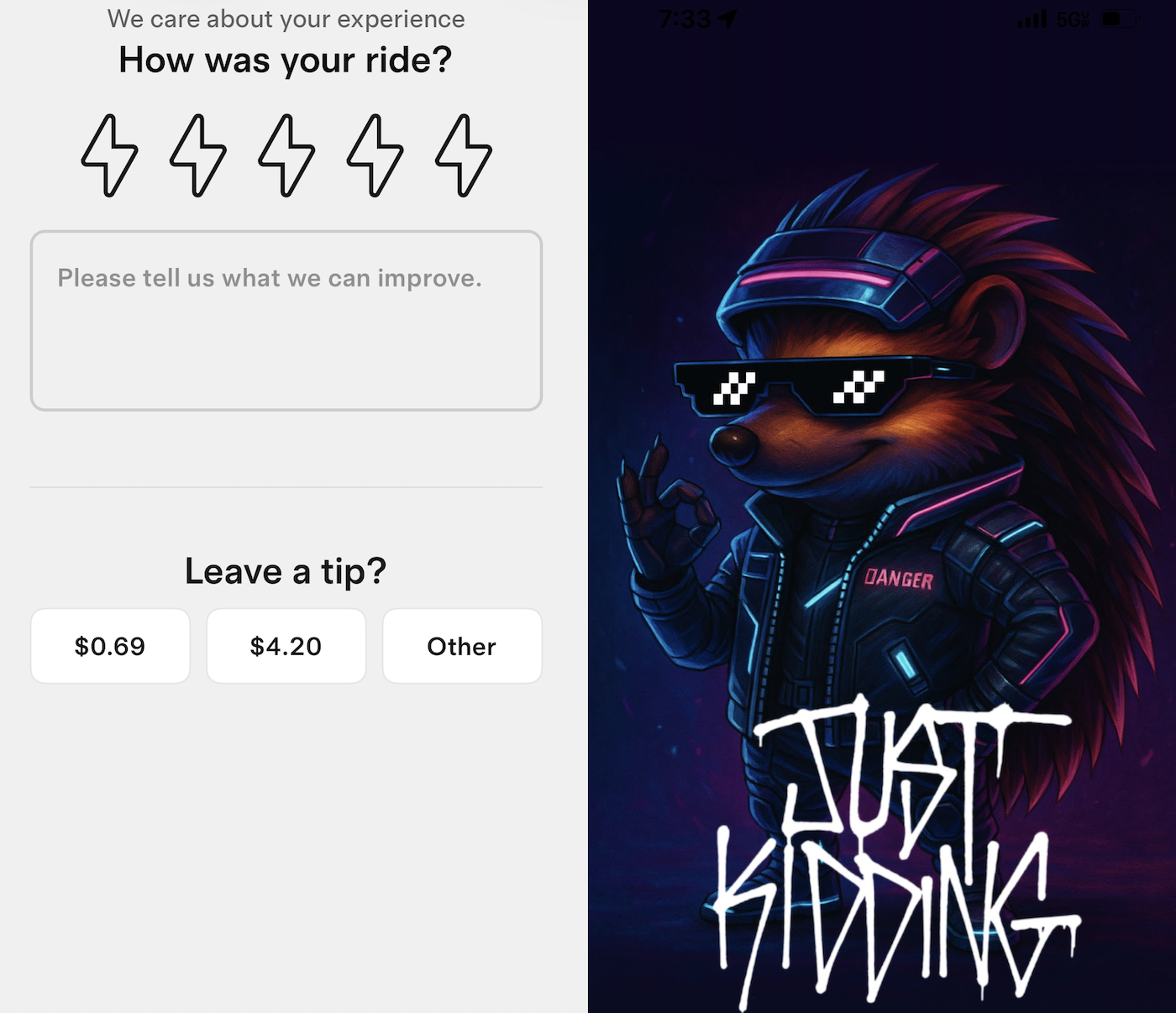
Customers, for their part, get a novel ride in a brand-new Model Y at a discount to what they’d pay for a ride in a likely older Tesla on Uber. (Notably, several of my regular Tesla Uber drivers in the Bay Area used Full Self-Driving while shepherding me around, a practice that Uber CEO Dara Khosrowshahi approves of.)
The Robotaxi app feels a bit clunky and lacks basic features like the ability to add a stop. To send an elderly relative home after my drop-off, I had to request a completely new ride just as I was getting out. After I requested it, the same Robotaxi drove down the road about a telephone pole away and forced us to walk to it. I asked the safety monitor why he didn’t just pick us up, but he deferred to the car. As a side note, everyone I spoke with who doesn’t drive a Tesla hates the door handles and finds them unintuitive — this relative included — not a great look for a car that’s meant for the public.
Robotaxi also has restrictions on the minimum age of passengers allowed, only recently lowering the rider age (with a guardian) to 8 from 12, meaning it won’t work for people with young kids.

It can’t be understated that, at least for now, there’s still another human in the car. While it’s cool to know that the driver is not actually driving you, he (the safety monitors were mostly men) is still in the car. One even brought his own air freshener.
While some of the drivers are happy to chat, it’s clear most of them are abiding by Tesla’s directives not to talk with customers, which makes for an odd dynamic.
When I mindlessly asked one driver if he was having a busy day, he responded that he really couldn’t say. Absolutely none of them would tell me how often they’ve had to intervene, though I experienced only one intervention, when a driver overrode the computer to take what he thought would be a faster route. Afterward, the autopilot wouldn’t reengage, so he drove the car like normal.
A note saying, “Vehicle is finding a safe location to pull over,” remained for the rest of the ride.
Waymo is perhaps the Platonic ideal of a robotaxi service: no driver, just an easy-to-use app and a near flawless ride.
You order a car and a driverless Jaguar I-PACE will pick you up and take you to where you’re going — as long as that’s within the San Francisco Peninsula, which spans from Golden Gate Bridge through downtown San Francisco and Google’s headquarters in Menlo Park and ending in San Jose. If you want to eat dinner in Oakland, you’re out of luck.
Adult riders can bring along guests of any age, as long as children have the appropriate car seat or booster gear. My children and older relatives alike were floored by the experience of riding in a Waymo. The steering wheel, commanded by the fully autonomous driving tech, turns itself in a scene that first feels like the Haunted Mansion but becomes less creepy as the Waymo Driver — what the company calls its driverless tech — expertly navigates through gnarly traffic situations, including sudden jaywalkers and street construction.
Perhaps equally magical: wait times were low. I rarely had to wait more than 5 or 10 minutes, except when a No Kings protest caused the company to restrict service in that area. (One may recall people lighting Waymos on fire during the anti-ICE protests in Los Angeles last year.)

Lower wait times are likely because its current Bay Area fleet numbers over 1,000. (That’s twice Tesla’s fleet, in about half the area.) Nationwide, Waymo has more than 3,000 vehicles publicly available, through which it completes a half million paid rides per week. That’s way more than Tesla or Zoox, but it’s also just 0.2% of what Uber, which said last quarter it does 40 million rides per day, does.
While Waymo is great for local travel, it’s more limited when it comes to long distances. I tried to hail a ride from the Presidio National Park in the north down to San Jose in the South Bay, about 55 miles away. The Waymo app estimated that a ride that should take about an hour would actually take more than three hours, since I didn’t yet have approval to take highways, which is only available to a subset of Waymo users so far. In this case, I opted for a Robotaxi.

I’ve also been told the highways aren’t so pleasant with Waymos since they go the speed limit. On city streets, Waymos have had the odd upshot of making other vehicles go the speed limit. Such behavior is less welcome on highways, where actually going 65 miles per hour can feel dangerous when others are going more like 80.
Zoox is a purpose-built AV that looks not unlike a glass toaster, and is the most futuristic of the bunch. Unlike Waymo or Tesla’s Robotaxi, it has no steering wheel or gas pedal.
It also has the most limited coverage area. Currently open to the public in Las Vegas and to limited users in the Bay Area, it has plans to expand to Austin and Miami.
In San Francisco, its coverage area now spans eastern San Francisco, from North Beach to Noe Valley, and includes both the Mission and Chinatown. That’s good if you live and work in downtown San Francisco, but will only become useful to others when its service area expands. The service is also limited by its hours (8 a.m. to 11 p.m.) and number of vehicles (100 robotaxis on public roads across its four markets), which can mean long wait times. Like Tesla’s Robotaxi, children also have to be 8 and up to ride with an adult.
In San Francisco, it mostly works just like a regular ride-hailing service: you request a ride in the app, it gives you a suggested nearby pickup spot, and it delivers you — and up to three guests — to your destination. (In Vegas, the service only goes to select destinations along the Strip.)

Despite these drawbacks, Zoox is also the most compelling. For now, as the company awaits regulatory approval, rides are free. If it happens to run where you need to go, you can’t beat that price.
More importantly and permanently, the experience of riding in Zoox is perhaps the most promising in the long run. Since it’s designed for autonomous ride-hailing and not a car retrofitted for it, the vehicle capitalizes on all available space for passengers (with no empty buckled front seat like with Waymo or filled seat like with Tesla). It’s set up as two benches facing one another, so up to four people can sit and have a conversation. The upright chairs, high ceilings, and ample legroom give it the airy feeling of a nice, personal office rather than a vehicle. It doesn’t yet offer Wi-Fi, but does offer cupholders and wireless charging pads.
To get inside, you go through double doors that open when you’re near (and press a button on the app), and you feel like you’re walking into a CVS. The feature also helps prevent a big problem with taxis in general: users opening doors onto pedestrians, bikers, or other vehicles. You take a small step up and you’re inside rather than having to get down and into a regular car — a posture you begin to resent after taking a few Zoox.
Annoyingly, none of the autonomous services yet have permission to go to the airport — one of the best use cases for taxis.
What makes this time different?
Josie-Dee Li got off the waitlist for Waymos in San Francisco in 2023. Since then, Tesla’s Robotaxi has become available in the Bay and Amazon’s Zoox has opened up shop, with her home in the Mission squarely in its coverage area. She now relies on all three services for a good chunk of her transportation.
For Li, who works on charging electric and autonomous trucks for a living, it’s part fascination with a technology futurists have been promising for approximately forever, but it’s also part utilitarian.
“If public transportation’s not fast, easy, convenient, or maybe safe, then definitely I’ll take a car,” Li told me as we waited for a Zoox. Safety is also part of the utility for her.
“ I 100% think it’s safer. I feel safer as a rider in an autonomous vehicle, as a driver around other AVs, because they’re driving the speed limit, they stop for people crossing the street. I feel safer as a biker, as a walker, like crossing the street with a crosswalk sign at a red light. There could be a crazy human driver that doesn’t look at the red light and hits me, but a Waymo or whatever AV would never do that. So I feel safer on all accounts.”

Of course, a lack of safety was precisely what derailed previous self-driving efforts. Uber’s 2018 fatal crash in Arizona forced it to halt testing and triggered years of scrutiny, ultimately contributing to the company’s decision to sell its autonomous unit. More recently, Cruise’s 2023 pedestrian accident in San Francisco — and the fallout over how it disclosed the incident — led regulators to suspend its permits, effectively shutting down its robotaxi operations.
Now, though, things seem different.
The technology itself, thanks in large part to advances in AI, has come a long way since those earlier trials. There’s also much more data testifying to their relative safety. These days more people are using the services in more markets, causing consumers to build their lives around the tech.
Uber is back in the autonomous race — this time through partnerships with AV and autonomous ride-hailing services. After shuttering Cruise, GM has pivoted toward using autonomous technology for personal-use vehicles. And some of the deepest pockets in tech — Google, Amazon, Tesla — are bankrolling this round of autonomous cars, suggesting they won’t easily be deterred.
Of course, it’s inevitable that someone will die again in a robotaxi accident. But it feels like it will be less likely to spell the end of that service.
“I do think we’re a little past the stage where one bad incident can kill a company,” Harry Campbell, founder of The Driverless Digest, told Sherwood News.
Earlier this year, Bay Area Rapid Transit approved a contingency plan that would sharply reduce train frequency and hours of operation to address a budget deficit driven in part by lower ridership. BART ridership remains at roughly half of its prepandemic levels. While robotaxi usage is still too limited to have meaningfully affected public transit, a decline in transit service going forward could push more riders toward alternatives, including robotaxis.
People like Li are readjusting their lives to include robotaxis. Pedestrians and drivers are becoming accustomed to Waymos and the knowledge that if you pull out in front of them, they’ll stop.

At the same time, autonomous vehicles are starting to expand far beyond ride-sharing, as they mold not only the future of human transport but also how goods move around the planet. Already, driverless semitrucks and ships are creeping into the supply chain.
Silicon Valley historian O’Mara said she thinks we could be heading for a tipping point.
“ I wasn’t surprised that it’s taken so long for this to roll out,” she said of the more than a decade of technologists proclaiming that self-driving was near. “Streets are complicated. The world is complicated.
“Now it has come to pass, and on the one hand, it’s remarkable. On the other hand, it’s still kind of limited.”
This “limited” phase is the messy reality of scaling physical AI. Unlike the internet, which was able to scale much more quickly, autonomous expansion is a street-by-street grind. In every new city the technology touches, the cycle of “uncanny” novelty will reset: the viral videos, the local pushback, and the technical glitches. But San Francisco suggests that if these tech giants have the capital to be persistent, the weirdness eventually settles into a dull utility.
It isn’t that the technology has become flawless; the awkward drop-offs and “edge cases” prove it is still very much a work in progress. It’s just that we eventually stop paying attention. We stop staring into empty driver’s seats and start treating these cars like any other piece of infrastructure: occasionally annoying, but increasingly mundane.
The driverless car is coming — not because it has mastered the world, but because we are learning how to live with it.