
Tech
US-NEW YEAR
(Kena Betancur/Getty Images)

Robotaxis are the new millennial lifestyle subsidy

Get ’em while they’re cheap.

The so-called millennial lifestyle subsidy — an era when (then) young people enjoyed cheap products and services thanks to deep-pocketed venture capitalists — came to a close at the start of the decade. Tech-adjacent services like Uber and Lyft, once priced below their true cost, became noticeably more expensive as the companies graduated from chasing customers to chasing profits.

Now, a different version of that subsidy may be emerging — and once again, it revolves around ride-hailing: robotaxis. Autonomous taxi services are popping up in cities across the country. The situation is most advanced in the Bay Area, where customers can currently choose between Google-owned Waymo, Tesla’s Robotaxi, and Amazon’s Zoox to get to where they’re going.

And the prices for these services can seem surprisingly cheap. On a recent trip to the Bay Area, Tesla Robotaxi rides were consistently cheaper than comparable trips on Uber. (As of now, the roughly 500 Tesla Robotaxis operating in the Bay Area all have safety monitors, since Tesla hasn’t gone through the hoops required for autonomous permitting, though the plan is eventually to remove them.) Waymos were moderately more expensive but not notably so when you consider the $75,000 Jaguar I-PACE you’re riding that’s toting around another $120,000 worth of added lidar and other gear. For now, Zoox is free.

(Millennial editor’s note: a millennial lifestyle subsidy can really be claimed by anyone of any generational cohort. "Millennial" is more a loss-leading state of mind at this point.)
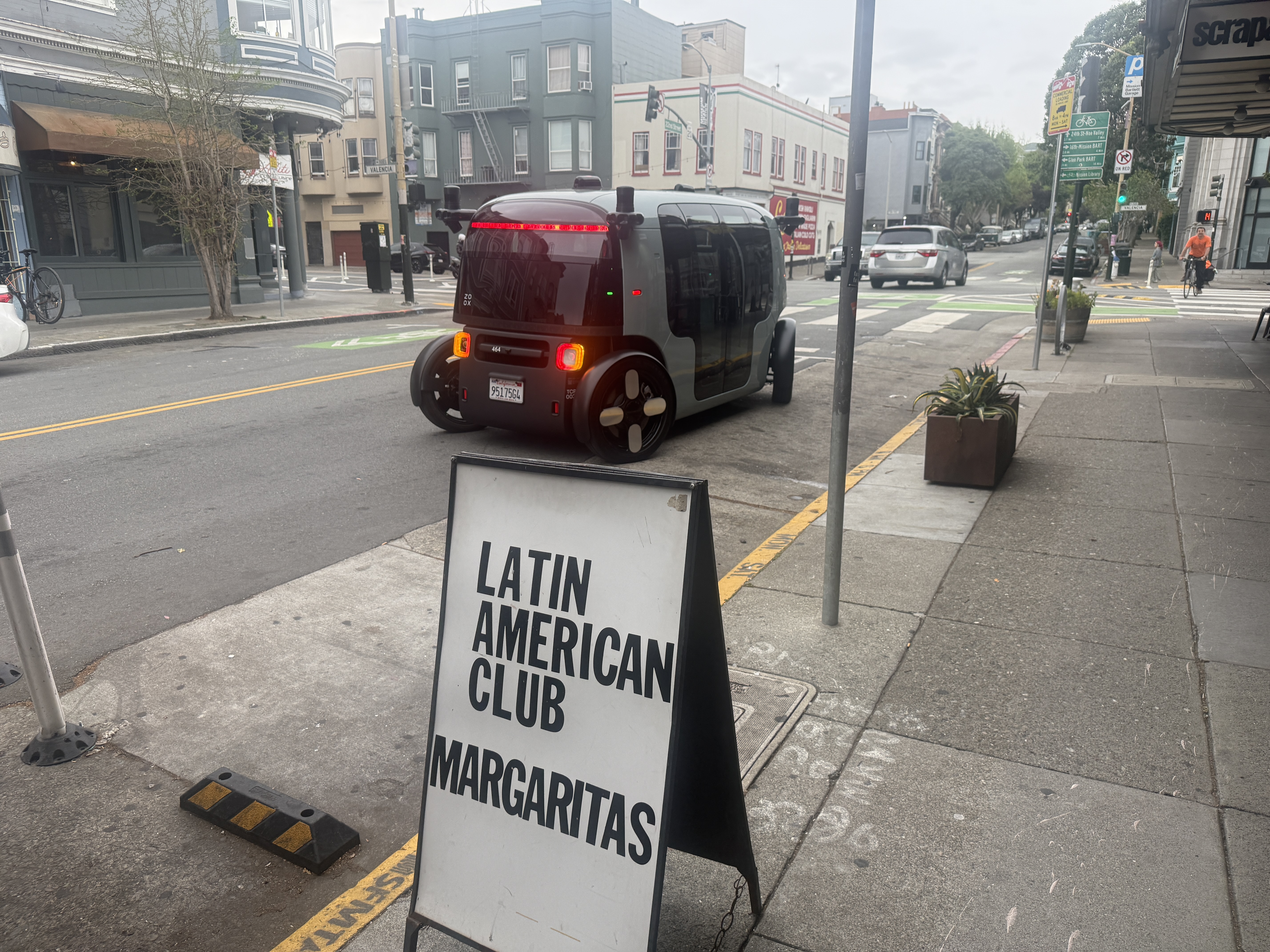
Zoox margarita
Amazon’s Zoox looking a bit like a glass toaster (Rani Molla/Sherwood News)

“From a consumer point of view, it’s definitely the golden era of AV rides, very similar to like 10 years ago with Uber and Lyft,” Harry Campbell, founder of The Driverless Digest, told Sherwood News. “We don’t know what the true cost is, but you’re definitely getting a great deal on these rides.”

While the cost of AVs is expected to keep going down, he said current prices are probably lower than they should be.

“I kind of joke with my friends and say, ‘Take these rides while you can.’”

What should it cost to ride in a robotaxi?

Data from Morgan Stanley Research shows that the cost per mile for Waymo and Tesla Robotaxis is already cheaper than traditional ride-hailing costs.

For example, Morgan Stanley Research estimates that Waymos cost about $1.36 per mile to operate versus $0.74 for Tesla, when factoring in depreciation, cleaning, maintenance, charging, mobile operators, insurance, and parking. Meanwhile, new pricing data shared with Sherwood from ride-share comparison app Obi shows that Waymo is charging about $9.58 per mile while Tesla is charging $4.35. So it seems the companies are charging a premium over their costs.

However, Morgan Stanley’s calculations don’t include the roughly $30 an hour Tesla safety monitors are paid to sit in the driver’s seat, according to analyst Andrew Percoco, who explained that the data is meant to show the company costs once the autonomous ride-hailing services are actually autonomous.

“We don’t assume that someone sitting in the front seat is going to be the way that they scale this business,” Percoco told Sherwood.

Nor does the data take into consideration the substantial up-front costs required to build autonomous driving systems. There’s a reason why these projects are backed by some of the wealthiest companies in the world — Google, Tesla, Amazon — which can afford to burn some cash on their path to future profitability.

And finally, it feels like there should be a premium for riding not just in a new car, but in a glimpse of the future. You have Waymo’s very expensive lidar and radar sensors whirling atop the car. Robotaxis are modified 2026 Model Ys — much newer than something you’d get with Lyft. Zoox, a purpose-built AV that looks like a glass toaster on wheels, could be from another planet.

Also, you don’t have to tip a robot, which is a novelty in itself.
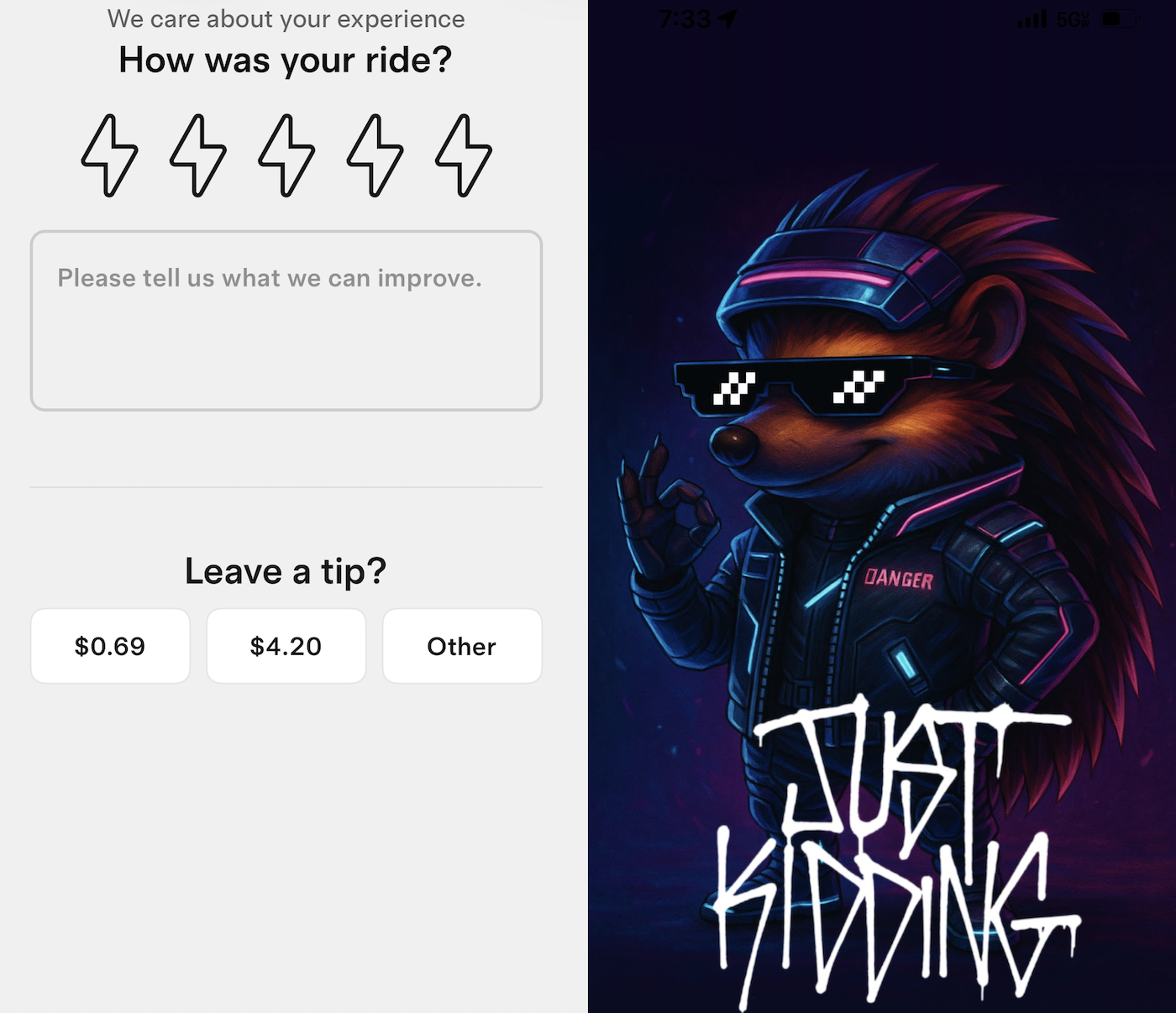
Side-by-side screenshots of what it’s like when you try and tip Tesla’s Robotaxi.
What it’s like when you try to tip on Tesla’s Robotaxi app

Obi CEO Ashwini Anburajan sees Tesla’s pricing as a version of the millennial subsidy in action.

“There was a generation like me that grew up on very, very cheap rides and has sticker shock every time we get in a car,” Anburajan said. “So it’s exciting to take a Tesla.”

She also thinks Tesla’s relatively low prices are a good move for Tesla, both in terms of data collection and branding.

“Right now it’s a smart play. If your cars are in demand, there are long wait times, there’s brand visibility, there’s brand loyalty, engagement, and excitement — that’s a playbook that’s been used by Uber and Lyft when they first came out and it worked. And people stuck with that brand, as it grew more expensive because they were reliant on the service,” she said.

Price per mile for Tesla’s Robotaxi jumped 34% in April compared with the end of 2025, per Obi data, after jumping 25% from the prior period.

But even with these recent price hikes, Anburajan thinks the relatively low-cost strategy will continue to pay off.

“People care about two things with ride-share: price and safety. And price comes first.”

More Tech

See all Tech
$0

Tesla’s federal tax bill last year was once again $0, Reuters reports. While past losses and green energy credits helped shrink the bill, Reuters found that Tesla also leaned on a classic corporate maneuver: offshore profit-shifting. By routing intellectual property rights through paper-only subsidiaries in the Netherlands and Singapore, Tesla effectively parked $18 billion in profits overseas between 2023 and early 2025. The entirely legal setup saved Tesla an estimated $400 million in US taxes. Not bad for a company whose CEO is not a fan of “shady” tax loopholes.

tech

Report: NSA is currently using Anthropic’s unreleased Mythos model

According to the Pentagon, Anthropic’s AI tools are a national security supply chain risk, and have been banned for defense applications.

But a new report says the National Security Agency, which operates as a part of the Pentagon, is currently busy using Anthropic’s new, unreleased AI model, Mythos.

Axios reports that Mythos’ reputed advanced offensive cyber capabilities have compelled the NSA to begin using it, despite the public blacklisting from the Pentagon, which Anthropic is suing the US government over.

Anthropic has granted access to a small number of trusted partners to test and prepare for the expected explosion of vulnerabilities to be discovered using the new AI model. UK intelligence agencies have also reportedly gained access to Mythos.

Anthropic CEO Dario Amodei reportedly visited the White House last week to try and resolve the dispute on allowing wider use of the company’s technology in the federal government.

Axios reports that Mythos’ reputed advanced offensive cyber capabilities have compelled the NSA to begin using it, despite the public blacklisting from the Pentagon, which Anthropic is suing the US government over.

Anthropic has granted access to a small number of trusted partners to test and prepare for the expected explosion of vulnerabilities to be discovered using the new AI model. UK intelligence agencies have also reportedly gained access to Mythos.

Anthropic CEO Dario Amodei reportedly visited the White House last week to try and resolve the dispute on allowing wider use of the company’s technology in the federal government.

tech
Jon Keegan

Anthropic launches “Claude Design,” sending shares of Figma and Adobe down

Anthropic has been slowly and steadily gaining a leading share in the enterprise AI market by focusing on coding, spreadsheets, and other common productivity and workplace apps.

Now it’s going after design apps.

Today Anthropic launched Claude Design, a dedicated app powered by its latest model, Claude Opus 4.7, that lets users use text prompts to build website designs, user interface prototypes, presentations, and marketing materials.

Shares of Figma and Adobe sank on the news.

While Claude has previously had the ability to create designs and user interfaces, breaking it out into a dedicated app signals a major new piece of its enterprise strategy alongside its popular Claude Code product.

Today Anthropic launched Claude Design, a dedicated app powered by its latest model, Claude Opus 4.7, that lets users use text prompts to build website designs, user interface prototypes, presentations, and marketing materials.

Shares of Figma and Adobe sank on the news.

While Claude has previously had the ability to create designs and user interfaces, breaking it out into a dedicated app signals a major new piece of its enterprise strategy alongside its popular Claude Code product.

tech
Rani Molla

Apple’s China iPhone shipments surged 20% in Q1 even as overall smartphone shipments fell

Apple’s iPhone shipments in China jumped 20% last quarter, even as the country’s overall smartphone market fell 4%, according to new data from Counterpoint Research. Rising memory costs have pushed prices higher across the industry, weighing on demand.

Apple appears poised to ride out the broader smartphone slump. Its strength at the less price-sensitive high end of the market and its unusual leverage over suppliers, which helps keep costs in check, give it an edge over rivals.

Greater China remains a critical region for Apple, making up about 18% of its total revenue in the fourth quarter. The company accounted for 19% of China’s smartphone market in the first quarter, up from 15% a year earlier, per Counterpoint.

Latest Stories

Sherwood Media, LLC produces fresh and unique perspectives on topical financial news and is a fully owned subsidiary of Robinhood Markets, Inc., and any views expressed here do not necessarily reflect the views of any other Robinhood affiliate, including Robinhood Markets, Inc., Robinhood Financial LLC, Robinhood Securities, LLC, Robinhood Crypto, LLC, Robinhood Derivatives, LLC, or Robinhood Money, LLC. Futures and event contracts are offered through Robinhood Derivatives, LLC.

