
Tech
TikTok ban support
Sherwood News

TikTok bites back against ban

The Chinese owner of the social media app starts its appeal against a US-wide ban today

This morning, a US federal appeals court will hear the case for keeping TikTok — almost 5 months after the Senate voted overwhelmingly in favor of legislation which, at present, will see the popular social media app face a total nationwide ban if Chinese parent company ByteDance doesn’t sell its controlling stake by January 19, 2025. 

Tok of the town

A three-judge panel in Washington DC will hear ByteDance’s appeal against the bill later today, where company representatives — as well as 8 TikTok creators — will try to block the law, per the BBC. Technically, three different legal challenges will be heard: one from ByteDance, one from creators, and one from a conservative nonprofit organization. The crux of each argument will be different, but each is likely to incorporate the issue of free speech rights for the app’s more than 170 million US users.

Lawyers from the Department of Justice will then make the case for the ban, on the grounds of what initially led to the law’s passing earlier this year: concerns that data from TikTok’s US users could be collected and exploited by the Chinese government, posing a national security risk.

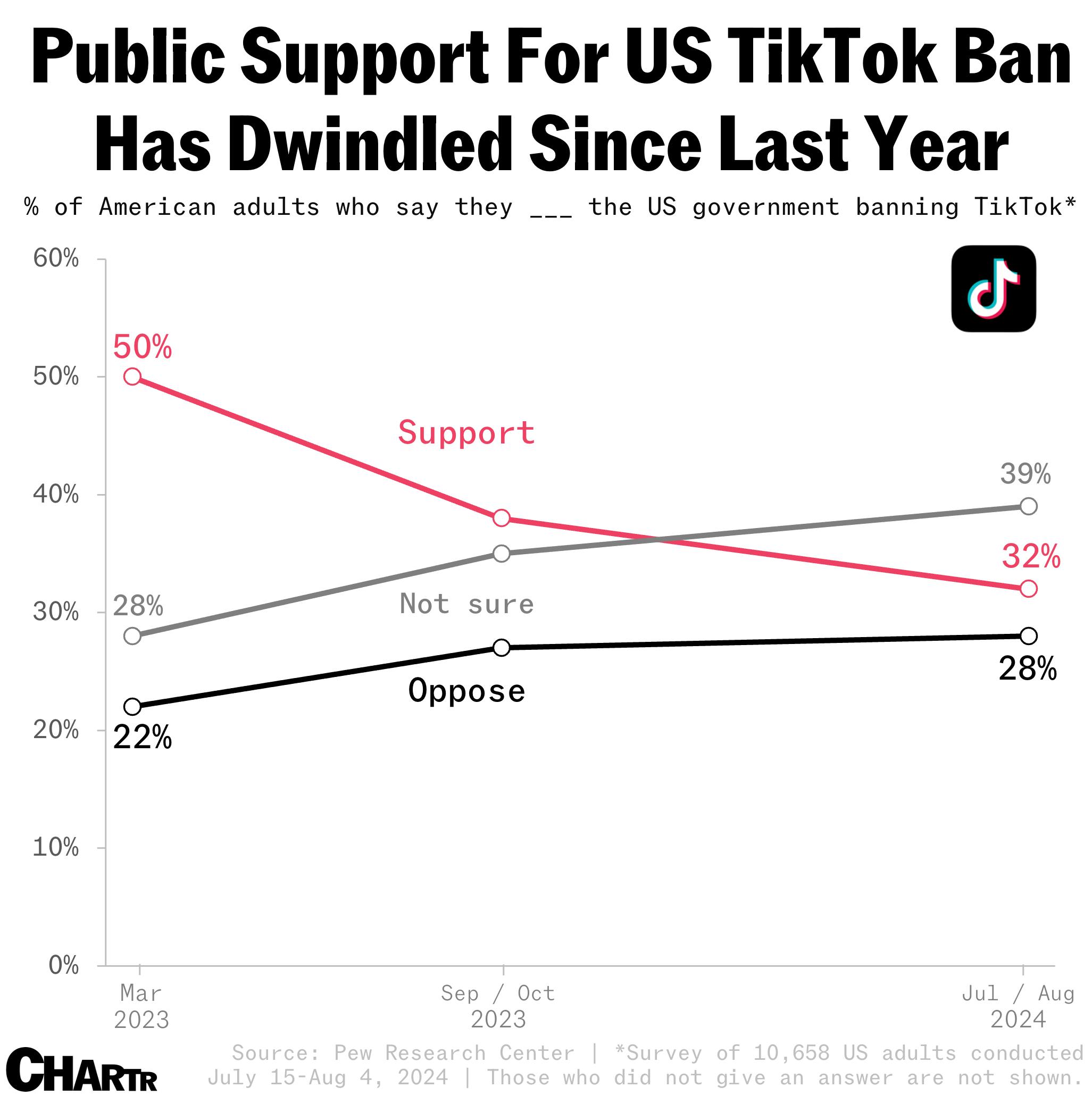
For what it’s worth, the public’s view on the issue has changed somewhat since then. A recent survey from Pew Research found that support for the ban fell from 50% in March 2023 to just 32% last month, concurrent with a relative increase in those opposing the ban, which now stands at 28%.

The idea of a TikTok ban has been kicked about the halls of Washington for years, first stealing headlines back in the summer of 2020 during President Trump’s White House tenure, before getting dropped by President Biden in 2021... then picked back up by Biden again, who officially signed the ban bill in April of this year.

More Tech

See all Tech
Republican Presidential Nominee Former President Trump Holds Rally In Butler, Pennsylvania

Tesla investors don’t want Elon Musk involved in politics

The Tesla CEO is spending big on the GOP in midterm elections.

tech

Report: China’s “Manhattan Project” built an advanced EUV chip fab prototype

The most advanced chipmaking process in the world is currently owned by one company: Dutch chipmaker ASML.

The process, known as extreme ultraviolet lithography (EUV), allows for the smallest, most complex semiconductors to be etched onto silicon chips.

These advanced chips are used in a huge number of crucial industries such as AI, mobile phones, and weapons manufacturing.

A new report from Reuters says that China has completed a factory-sized prototype of an EUV chip fab, a first that could have huge ramifications for the balance of power in the global technology race.

The prototype was built in a high-security facility in Shenzhen by former ASML employees and made use of secondary markets to acquire older, used ASML parts, according to the report. Despite a goal of delivering working chips by 2028, sources say China is likely a couple years behind that schedule.

ASML’s $250 million EUV machines are used to manufacture advanced chips for Nvidia, Advanced Micro Devices, and for chips made by TSMC.

ASML shares were down about 4.8% as of 12 p.m. ET.

These advanced chips are used in a huge number of crucial industries such as AI, mobile phones, and weapons manufacturing.

A new report from Reuters says that China has completed a factory-sized prototype of an EUV chip fab, a first that could have huge ramifications for the balance of power in the global technology race.

The prototype was built in a high-security facility in Shenzhen by former ASML employees and made use of secondary markets to acquire older, used ASML parts, according to the report. Despite a goal of delivering working chips by 2028, sources say China is likely a couple years behind that schedule.

ASML’s $250 million EUV machines are used to manufacture advanced chips for Nvidia, Advanced Micro Devices, and for chips made by TSMC.

ASML shares were down about 4.8% as of 12 p.m. ET.

tech

Google is reportedly working with Meta to expand software support for its AI chips

Nvidia dominates the market for AI chips. But its advantage is not limited to hardware.

The company has a growing suite of software tools that are usually paired with its chips, optimized to get the most out of the GPUs crunching the data.

Any challengers to Nvidia’s dominance will need to make it easy for developers to walk away from the Nvidia software-hardware lock-in. That’s what Google and Meta are teaming up to do.

A new report from Reuters says Google is working on an initiative code-named “TorchTPU,” which aims to make it easier for AI developers who use the ubiquitous, open-source PyTorch software framework to switch the hardware layer to Google’s tensor processing units (TPUs).

Meta is a huge backer of the PyTorch project, so the company is teaming up with Google to help develop its TorchTPU software, per the report.

Last month, it was reported that Google is planning on selling TPUs worth “billions of dollars” to Meta, which follows other Big Tech players who are hedging their bets against Nvidia’s dominance.

Any challengers to Nvidia’s dominance will need to make it easy for developers to walk away from the Nvidia software-hardware lock-in. That’s what Google and Meta are teaming up to do.

A new report from Reuters says Google is working on an initiative code-named “TorchTPU,” which aims to make it easier for AI developers who use the ubiquitous, open-source PyTorch software framework to switch the hardware layer to Google’s tensor processing units (TPUs).

Meta is a huge backer of the PyTorch project, so the company is teaming up with Google to help develop its TorchTPU software, per the report.

Last month, it was reported that Google is planning on selling TPUs worth “billions of dollars” to Meta, which follows other Big Tech players who are hedging their bets against Nvidia’s dominance.

$100B

Waymo, Alphabet’s autonomous driving subsidiary, is in talks to raise more than $15 billion in a funding round that would value the company near $100 billion, Bloomberg reports. That’s more than double the valuation from its last round in October 2024, reflecting its lead in driverless ride-hailing.

Latest Stories

Sherwood Media, LLC produces fresh and unique perspectives on topical financial news and is a fully owned subsidiary of Robinhood Markets, Inc., and any views expressed here do not necessarily reflect the views of any other Robinhood affiliate, including Robinhood Markets, Inc., Robinhood Financial LLC, Robinhood Securities, LLC, Robinhood Crypto, LLC, or Robinhood Money, LLC.