
Tech
Large group of people surrounding an oversized megaphone
(Getty Images)
👍👍👍👍👍👍

Social-media giants tell the EU they’ll increase efforts to tackle hate speech, for sure

Meta, TikTok, X, Snap, and others signed a new EU Code of Conduct.

Tom Jones

This week, Facebook, Instagram, TikTok, X, YouTube, Twitch, LinkedIn, Snapchat — OK, basically every huge name in social media — all signed a new Code of Conduct from the European Commission covering illegal hate speech online.

The platforms committed to updated standards around monitoring illegal hate speech on their apps, agreeing to provide information about the outcomes of actions they take and hand over data on just how wide the reach of any offending content was. Sounds sensible in theory, except that (as The Verge noted) the pledges are entirely voluntary, and the companies making them won’t face penalties if they opt out later.

Flagging

The timing is interesting, given that conversations around content moderation are bubbling away as intensely as ever at the biggest social-media sites — not least at Meta, where Mark Zuckerberg recently announced decisions to ditch its third-party fact-checking program, simplify content policies, and move the content-moderation department to Texas.

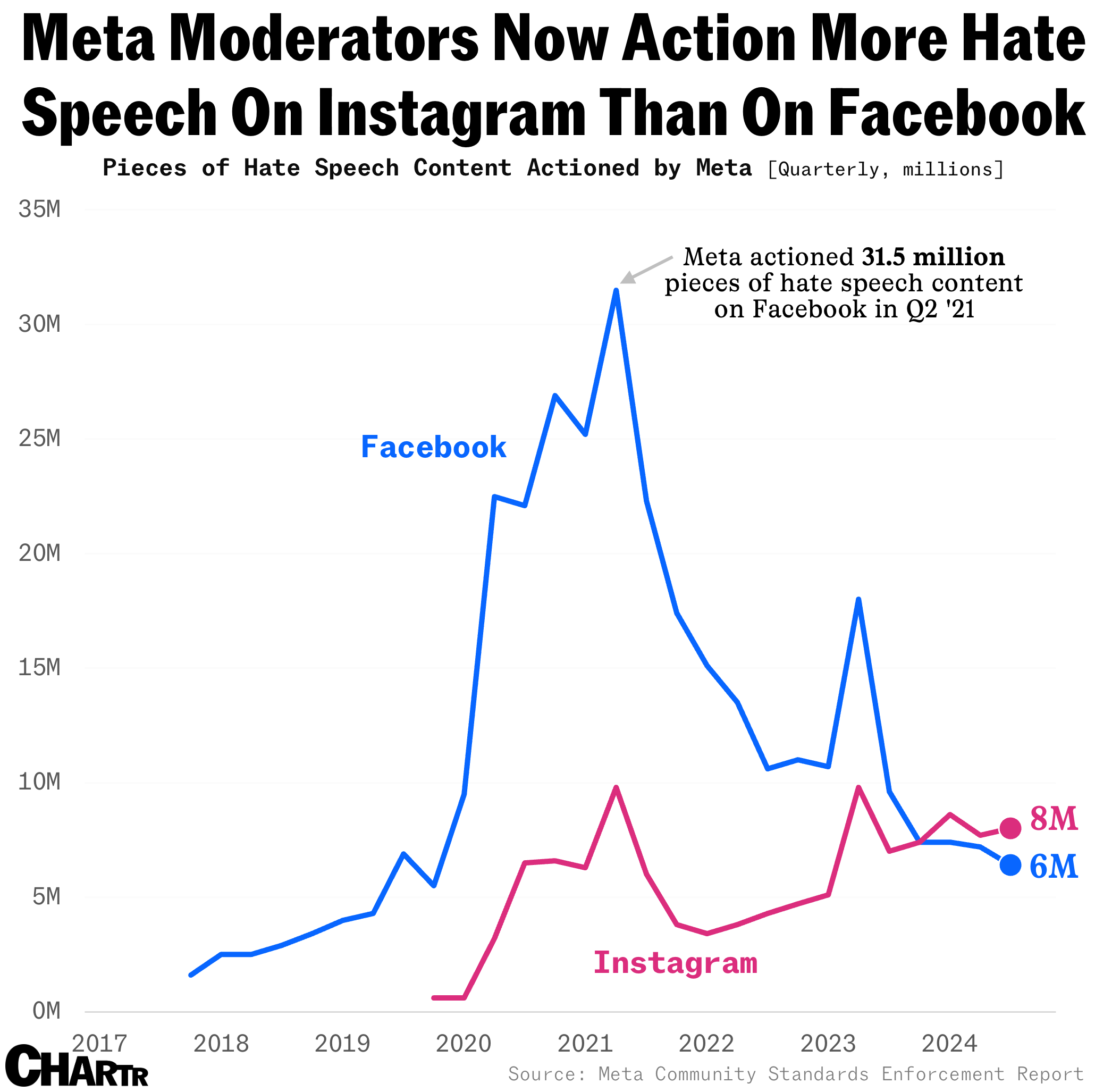
According to its most recent Community Standards Enforcement Report (a publication tracking the company’s efforts to make its platforms “safe and inclusive”), Meta now takes more action against hate speech content on Instagram than it does on Facebook, with 8 million pieces actioned on the former in Q3 2024.
Facebook & Instagram Hate Speech
Sherwood News

Interestingly, the amount of content its moderators actioned on Facebook is down ~75% from the 2021 peak. It’s unclear whether there’s less hate speech being posted on Facebook recently, or whether Meta’s just doing less about it now.


More Tech

See all Tech
tech

FCC bans new Chinese drones and components from DJI and Autel Robotics

Yesterday, the Federal Communications Commission (FCC) banned new drones and critical components from the market-leading Chinese drone manufacturer DJI, and smaller firm Autel Robotics, calling the foreign made drones “an unacceptable national security risk.”

The ban covers all drones and related components from any foreign manufacturer. DJI dominates the worldwide (nonmilitary) drone market, with a market share greater than 90%, according to some estimates.

In addition to hobbyists, the quadcopter-style drones made by DJI are used heavily by a wide variety of businesses including agriculture, infrastructure inspection, real estate, and also by first responders. Blocking foreign drones leaves many critical industries without a viable US-made alternative, as the industry has struggled to develop new supply chains that don’t come from China and match the quality of DJI’s hardware and software.

Shares of Florida-based drone builder Unusual Machines are up over 8% in early trading. Donald Trump Jr. is an investor and advisor to the company.

DJI has said its drones do not present a security risk, and welcome a national security review, noting that their drones can be used without an internet connection, and all data is saved locally.

FCC Chair Brendan Carr said:

“I welcome this Executive Branch national security determination, and I am pleased that the FCC has now added foreign drones and related components, which pose an unacceptable national security risk, to the FCC’s Covered List. Following President Trump’s leadership, the FCC will work closely with U.S. drone makers to unleash American drone dominance.”

The ban covers all drones and related components from any foreign manufacturer. DJI dominates the worldwide (nonmilitary) drone market, with a market share greater than 90%, according to some estimates.

In addition to hobbyists, the quadcopter-style drones made by DJI are used heavily by a wide variety of businesses including agriculture, infrastructure inspection, real estate, and also by first responders. Blocking foreign drones leaves many critical industries without a viable US-made alternative, as the industry has struggled to develop new supply chains that don’t come from China and match the quality of DJI’s hardware and software.

Shares of Florida-based drone builder Unusual Machines are up over 8% in early trading. Donald Trump Jr. is an investor and advisor to the company.

DJI has said its drones do not present a security risk, and welcome a national security review, noting that their drones can be used without an internet connection, and all data is saved locally.

FCC Chair Brendan Carr said:

“I welcome this Executive Branch national security determination, and I am pleased that the FCC has now added foreign drones and related components, which pose an unacceptable national security risk, to the FCC’s Covered List. Following President Trump’s leadership, the FCC will work closely with U.S. drone makers to unleash American drone dominance.”

tech

Tesla’s EU sales fell nearly 40% in the first 11 months of 2025

From January through November this year, Tesla sales fell 39% to 129,000 in the European Union compared with the first 11 months of 2024, according to new data from the European Automobile Manufacturers’ Association, known as ACEA. In that same time, sales of Chinese competitor BYD grew 240% to 110,000. BYD first outsold Tesla there this spring, but Tesla is still outpacing BYD for the year.

Overall, sales of battery electric vehicles in the EU rose 28%.

Tesla has struggled throughout this year in Europe, its third-biggest market — something CEO Elon Musk has blamed on Europe’s lack of regulatory approval for its Full Self-Driving tech, though the decline likely has more to do with competition from China.

tech
Jon Keegan

Pentagon adds xAI’s Grok to its AI platform

Grok is going to war.

Today the Pentagon announced that xAI’s controversial Grok chatbot will be added to GenAI.mil, the Department of Defense’s “bespoke AI platform.”

Launched earlier this month, GenAI.mil joins Google’s Gemini on the platform, which the Pentagon says will usher in an “AI-driven culture change” at the agency.

Federal workers have had access to Grok since the White House ordered the chatbot added to the GSA’s approved AI vendor list in August.

xAI has had some embarrassing episodes as it scrambles to monetize Grok, after spending billions on its Colossus data centers. Just this summer, several examples emerged of Grok responding to user queries with antisemitic tropes, and even praising Hitler.

Launched earlier this month, GenAI.mil joins Google’s Gemini on the platform, which the Pentagon says will usher in an “AI-driven culture change” at the agency.

Federal workers have had access to Grok since the White House ordered the chatbot added to the GSA’s approved AI vendor list in August.

xAI has had some embarrassing episodes as it scrambles to monetize Grok, after spending billions on its Colossus data centers. Just this summer, several examples emerged of Grok responding to user queries with antisemitic tropes, and even praising Hitler.

tech
Jon Keegan

Alphabet acquires data center company Intersect for $4.75 billion

Google parent Alphabet announced a deal to acquire data center and energy infrastructure builder Intersect. Alphabet already held a minority stake and a partnership with the company. The acquisition is for $4.75 billion in cash.

According to Alphabet CEO, Sundar Pichai: “Intersect will help us expand capacity, operate more nimbly in building new power generation in lockstep with new data center load, and reimagine energy solutions to drive US innovation and leadership. We look forward to welcoming Sheldon and the Intersect team.”

The deal is expected to close in the first half of 2026.

tech
Rani Molla

Tesla might get to a 1,000 Robotaxis in the Bay Area this year after all

Tesla has registered 1,655 ride-hailing vehicles in California, up from just 28 when it launched the service in August, according to California Public Utilities Commission data cited by Business Insider. That growth suggests Tesla — which currently has about 130 Robotaxis operating with a driver using Full Self-Driving in the Bay Area — could realistically hit CEO Elon Musk’s target of 1,000 vehicles in the region by the end of the year.

Registered vehicles aren’t the same as an active fleet, but the increase signals that Tesla is gearing up for significant expansion.

Google’s Waymo remains in the lead, with nearly 2,000 driverless vehicles registered across its two California markets, including more than 1,000 operating in the Bay Area and 700 in Los Angeles.

It’s less clear whether Tesla can meet Musk’s other goals, including deploying 500 Robotaxis in Austin, where just 32 vehicles are currently operating, or removing safety monitors by year’s end. Only two of those Austin vehicles are currently testing without drivers.

Registered vehicles aren’t the same as an active fleet, but the increase signals that Tesla is gearing up for significant expansion.

Google’s Waymo remains in the lead, with nearly 2,000 driverless vehicles registered across its two California markets, including more than 1,000 operating in the Bay Area and 700 in Los Angeles.

It’s less clear whether Tesla can meet Musk’s other goals, including deploying 500 Robotaxis in Austin, where just 32 vehicles are currently operating, or removing safety monitors by year’s end. Only two of those Austin vehicles are currently testing without drivers.

Latest Stories

Sherwood Media, LLC produces fresh and unique perspectives on topical financial news and is a fully owned subsidiary of Robinhood Markets, Inc., and any views expressed here do not necessarily reflect the views of any other Robinhood affiliate, including Robinhood Markets, Inc., Robinhood Financial LLC, Robinhood Securities, LLC, Robinhood Crypto, LLC, or Robinhood Money, LLC.