Tech
In this photo illustration, the Stack Overflow logo is seen...
The Stack Overflow logo seen displayed on a smartphone screen (Thomas Fuller/Getty Images)
isn’t it aironic?

Stack Overflow’s forum is dead thanks to AI, but the company’s still kicking... thanks to AI

The platform is raking in millions of dollars in revenue, with AI an ironic new source of revenue.

Claire Yubin Oh

When Elon Musk described Stack Overflow’s plight as “death by LLM” in July 2023, he wasn’t exaggerating.

Having been the go-to resource for developers looking for technical help for a long time, Stack Overflow neared the peak of its powers during the pandemic, with coders seeking the evergreen information on the company’s popular Q&A forum. But amid a wave of powerful code-writing AI assistants like ChatGPT, Cursor, Claude, Google’s Gemini, and Microsoft’s Copilot, traffic to the site has plummeted.

Last month, Stack Overflow recorded just 6,866 questions — roughly equal to the typical volume when the site first launched back in 2008.
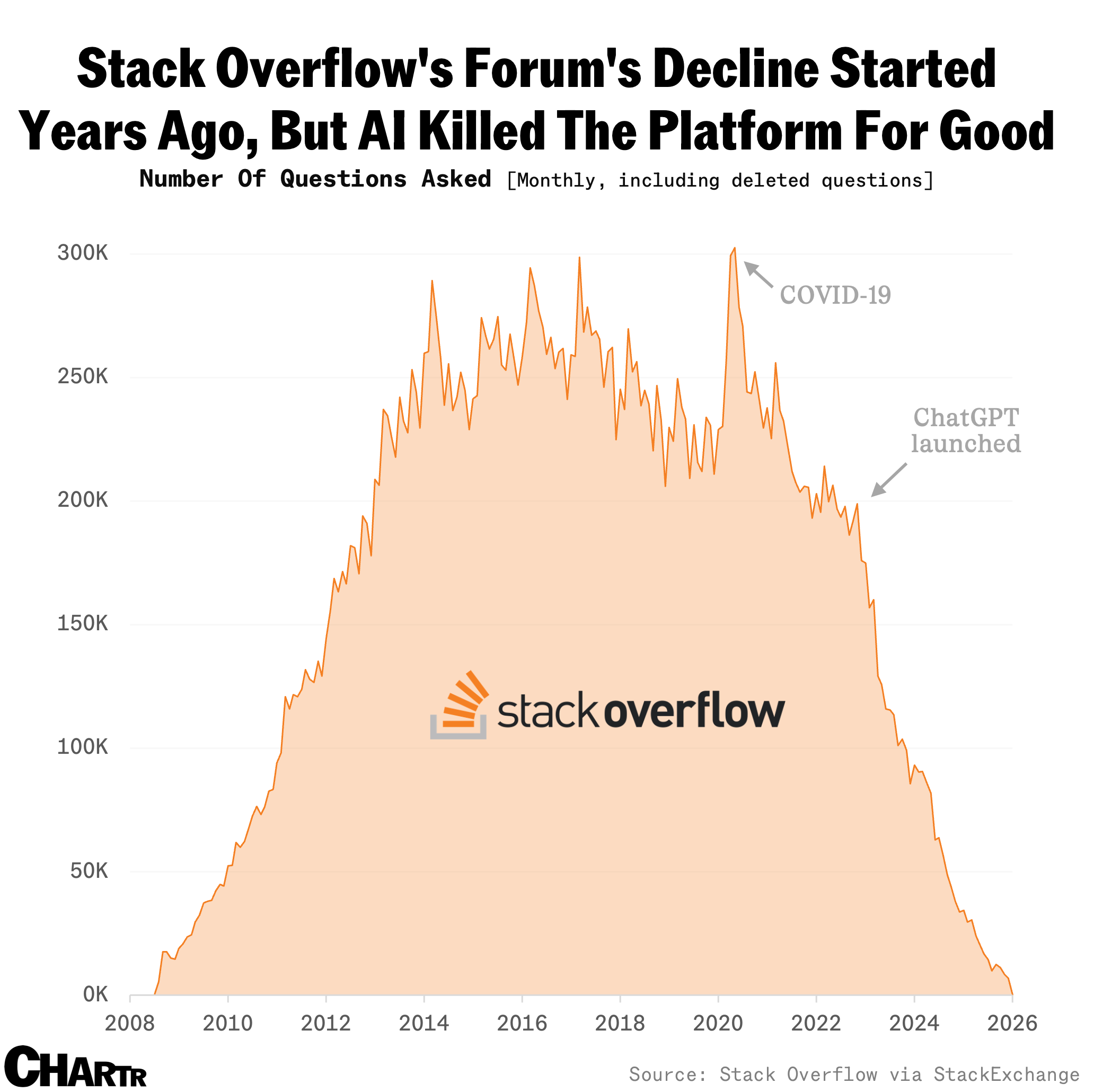
Stack overflow’s traffic
Sherwood News

But while Stack Overflow the Q&A forum looks dead, Stack Overflow the company looks to be limping along.

Unlike Chegg and other knowledge hubs that have fallen victim to generative AI, Stack Overflow has found a way to monetize its enormous back catalog of content. Indeed, even with engagement falling off a cliff since ChatGPT’s 2022 debut, the company’s annual revenue has roughly doubled to $115 million. Losses have slimmed, too, from $84 million in FY2023 to $22 million as of the last fiscal year, as desperate cost-cutting efforts, including mass layoffs, helped boost the bottom line.

Once dependent on ads across its buzzy forum, Stack Overflow now primarily makes money from enterprise solutions like “Stack Internal,” which provides a generative-AI add-on powered by the millions of questions and answers on the site through the years. Stack Internal is now used by 25,000 companies around the world. It also licenses its data to AI companies, in a Reddit-like model — a platform that made more than $200 million from licensing user-generated content in 2024. 

Put simply, Stack Overflows new niche is the trust built by its old community and their expertise. In the words of CEO Prashanth Chandrasekar last December:

...when we saw the questions decline in early 2023, what we realized is that pretty much all those declines were with very simple questions. The complex questions still get asked on Stack because there’s no other place. If the LLMs are only as good as the data, which is typically human curated, we’re one of the best places for that, if not the best for technology.

Large language models want data about coding problems and how to solve them. Stack Overflow has a big digital warehouse full of that, but it’s increasingly aging, as queries move into private chat windows with LLM models... which need huge chunks of data to work. Stack Overflow has become a fascinating canary in tech’s new, circular coal mine.


More Tech

See all Tech
tech

Report: Amazon’s AI bots have been behind multiple AWS outages

Amazon’s AI tool Kiro, which launched in July and can code autonomously, was behind a 13-hour interruption to Amazon Web Services in December, according to reporting by the Financial Times.

The FT reports that the company’s AI tools have caused AWS service disruptions at least twice in recent months.

In the December outage, which Amazon called an “extremely limited event” that did not have an impact on customer-facing service, engineers allowed Kiro to make changes and the tool opted to “delete and recreate the environment.”

Amazon has a closely tracked internal target that 80% of its developers use AI to code once a week, employees told the FT. The company says the December incident was a “user access control issue” and not an issue with Kiro’s permissions.

AWS accounted for 57% of Amazon’s operating profit in 2025. In December, following a larger outage months earlier, AWS and Google announced a partnership to attempt to prevent massive network outages.

Update, February 20, 5:50 p.m. ET: In a statement to Sherwood News, an AWS spokesperson disputed the report, writing:

“These brief events were the result of user error—specifically misconfigured access controls—not AI. The December service interruption was an extremely limited event when a single service (AWS Cost Explorer—which helps customers visualize, understand, and manage AWS costs and usage over time) in one of our two Regions in Mainland China was affected. This event didn't impact compute, storage, database, AI technologies, or any other of the hundreds of services that we run. We are not aware of any related customer inquiries resulting from this isolated interruption. Following these events, we implemented numerous additional safeguards, including mandatory peer review for production access, enhanced training on AI-assisted troubleshooting, and resource protection measures. Kiro puts developers in control—users need to configure which actions Kiro can take, and by default, Kiro requests authorization before taking any action.”

In the December outage, which Amazon called an “extremely limited event” that did not have an impact on customer-facing service, engineers allowed Kiro to make changes and the tool opted to “delete and recreate the environment.”

Amazon has a closely tracked internal target that 80% of its developers use AI to code once a week, employees told the FT. The company says the December incident was a “user access control issue” and not an issue with Kiro’s permissions.

AWS accounted for 57% of Amazon’s operating profit in 2025. In December, following a larger outage months earlier, AWS and Google announced a partnership to attempt to prevent massive network outages.

Update, February 20, 5:50 p.m. ET: In a statement to Sherwood News, an AWS spokesperson disputed the report, writing:

“These brief events were the result of user error—specifically misconfigured access controls—not AI. The December service interruption was an extremely limited event when a single service (AWS Cost Explorer—which helps customers visualize, understand, and manage AWS costs and usage over time) in one of our two Regions in Mainland China was affected. This event didn't impact compute, storage, database, AI technologies, or any other of the hundreds of services that we run. We are not aware of any related customer inquiries resulting from this isolated interruption. Following these events, we implemented numerous additional safeguards, including mandatory peer review for production access, enhanced training on AI-assisted troubleshooting, and resource protection measures. Kiro puts developers in control—users need to configure which actions Kiro can take, and by default, Kiro requests authorization before taking any action.”

$830B

OpenAI is finalizing commitments on a funding round that could climb beyond $100 billion at a valuation of $830 billion, according to a report from The Information.

Per The Information, SoftBank is expected to invest $30 billion into the ChatGPT maker, spread across the year in three installments of $10 billion. Up to $50 billion could come from Amazon and $30 billion from Nvidia (up from the $20 billion Bloomberg reported earlier this month). An additional investment in the low billions could come from Microsoft.

OpenAI was last valued at $500 billion following a fundraising round completed in October. Earlier this month, its rival Anthropic took in $30 billion from investors including Microsoft and Nvidia at a $380 billion valuation.

tech

Tesla’s 45 Austin Robotaxis now have 14 crashes on the books since launching in June

Since launching in June 2025, Tesla’s 45 Austin Robotaxis have been involved in 14 crashes, per Electrek reporting citing National Highway Traffic Safety Administration data.

Electrek analysis found that the vehicles have traveled roughly 800,000 paid miles in that time period, amounting to a crash every 57,000 miles. According to the NHTSA, US drivers crash once every 500,000 miles on average.

The article says Tesla submitted five new crash reports in January of this year that happened in December and January. Electrek wrote:

“The new crashes include a collision with a fixed object at 17 mph while the vehicle was driving straight, a crash with a bus while the Tesla was stationary, a collision with a heavy truck at 4 mph, and two separate incidents where the Tesla backed into objects, one into a pole or tree at 1 mph and another into a fixed object at 2 mph.”

Tesla updated a previously reported crash that was originally filed as only having damaged property to include a passenger’s hospitalization.

Last month, Tesla shares climbed after CEO Elon Musk said in a post on X that the company’s Austin Robotaxis had begun operating without a safety monitor.

The article says Tesla submitted five new crash reports in January of this year that happened in December and January. Electrek wrote:

“The new crashes include a collision with a fixed object at 17 mph while the vehicle was driving straight, a crash with a bus while the Tesla was stationary, a collision with a heavy truck at 4 mph, and two separate incidents where the Tesla backed into objects, one into a pole or tree at 1 mph and another into a fixed object at 2 mph.”

Tesla updated a previously reported crash that was originally filed as only having damaged property to include a passenger’s hospitalization.

Last month, Tesla shares climbed after CEO Elon Musk said in a post on X that the company’s Austin Robotaxis had begun operating without a safety monitor.

tech
Jon Keegan

Ahead of IPO, Anthropic adds veteran executive and former Trump administration official to board

Anthropic is moving to put the pieces in place for a successful IPO this year.

Today, the company announced that Chris Liddel would join its board of directors.

Liddel is an seasoned executive who previously served as CFO for Microsoft, GM, and International Paper.

Liddel also comes with experience in government, having served as the deputy White House chief of staff during the first Trump administration.

Ties to the Trump world could be helpful for Anthropic as it pushes to enter the public market. Its reportedly not on the greatest terms with the current administration, as the startup has pushed back on using its Claude AI for surveillance applications.

Liddel is an seasoned executive who previously served as CFO for Microsoft, GM, and International Paper.

Liddel also comes with experience in government, having served as the deputy White House chief of staff during the first Trump administration.

Ties to the Trump world could be helpful for Anthropic as it pushes to enter the public market. Its reportedly not on the greatest terms with the current administration, as the startup has pushed back on using its Claude AI for surveillance applications.

tech
Rani Molla

Meta is bringing back facial recognition for its smart glasses

Meta is reviving its highly controversial facial recognition efforts, with plans to incorporate the tech into its smart glasses as soon as this year, The New York Times reports.

In 2021, around the time Facebook rebranded as Meta, the company shut down the facial recognition software it had used to tag people in photos, saying it needed to “find the right balance.”

Now, according to an internal memo reviewed by the Times, Meta seems to feel that it’s at least found the right moment, noting that the fraught and crowded political climate could allow the feature to attract less scrutiny.

“We will launch during a dynamic political environment where many civil society groups that we would expect to attack us would have their resources focused on other concerns,” the document reads.

The tech, called “Name Tag” internally, would let smart glass wearers identify and surface information about people they see with the glasses by using Meta’s artificial intelligence assistant.

Now, according to an internal memo reviewed by the Times, Meta seems to feel that it’s at least found the right moment, noting that the fraught and crowded political climate could allow the feature to attract less scrutiny.

“We will launch during a dynamic political environment where many civil society groups that we would expect to attack us would have their resources focused on other concerns,” the document reads.

The tech, called “Name Tag” internally, would let smart glass wearers identify and surface information about people they see with the glasses by using Meta’s artificial intelligence assistant.

Latest Stories

Sherwood Media, LLC produces fresh and unique perspectives on topical financial news and is a fully owned subsidiary of Robinhood Markets, Inc., and any views expressed here do not necessarily reflect the views of any other Robinhood affiliate, including Robinhood Markets, Inc., Robinhood Financial LLC, Robinhood Securities, LLC, Robinhood Crypto, LLC, or Robinhood Money, LLC.