
Tech
Self Driving Taxi Company Waymo Voluntarily Issues Software Recall Over Cars Not Stopping For School Buses
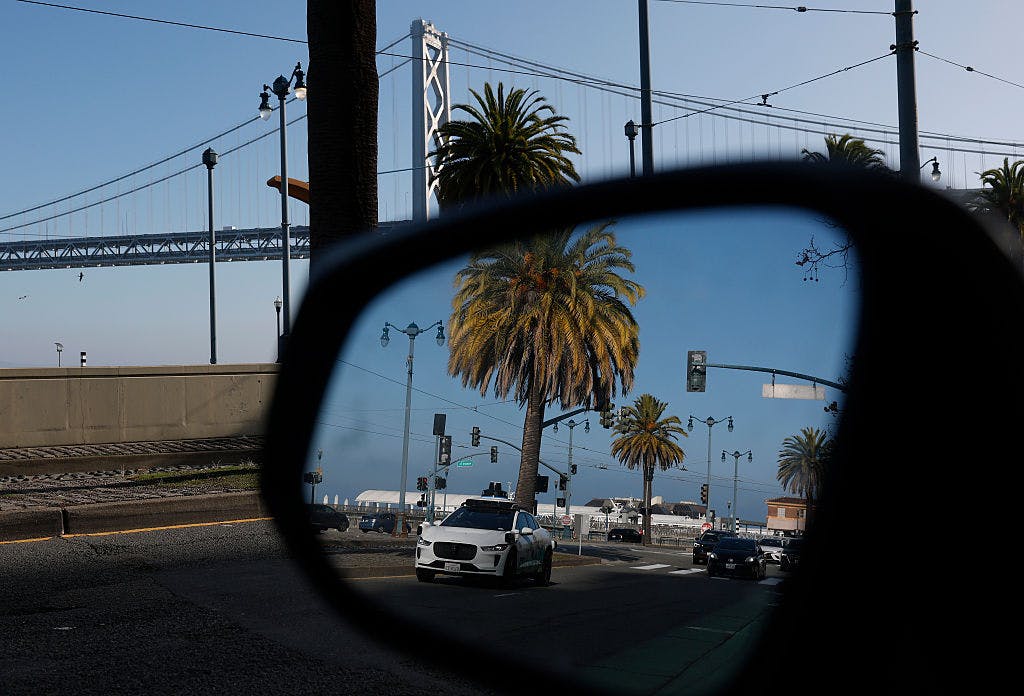
A Waymo robotaxi in a side-view mirror in San Francisco, California (Justin Sullivan/Getty Images)

Tesla’s Robotaxi is way cheaper than Uber, Lyft, or Waymo — but you’ll have to wait a lot longer for one

New data from ride-share comparison app Obi shows how much cheaper and less available Tesla’s autonomous ride-share service is.

Rani Molla

The average price of a Tesla Robotaxi ride in the San Francisco Bay Area late last year was $8.17 — about half the cost of comparable routes with Lyft, Uber, or Google’s driverless Waymo, according to new data from ride-share comparison app Obi.

However, wait times for Tesla’s Robotaxis, which operate in the Bay Area with a driver, are roughly 3x to 5x longer than those of competing services. Tesla customers wait an average of nearly 16 minutes for their cheaper ride, compared to about three to six minutes for other services.

For this study, Obi analyzed more than 94,000 simulated ride requests from November and December across the four companies, using technical tools including APIs. The data came from a local database and includes hourly information on ride requests, prices, and estimated arrival times.

As was the case with Uber and Lyft in their early days, Tesla’s low prices appear aimed more at attracting customers than turning a profit. Robotaxi prices initially launched at an intentionally provocative $4.20 and rose to the equally tongue-in-cheek $6.90 before transitioning to industry-standard dynamic pricing. CEO Elon Musk has said Robotaxi rides would eventually cost about as much as a bus ticket.

 “Its a way to gather more data, and get more individuals in the cars and familiar with the brand,” Obi CEO Ashwini Anburajan told Sherwood News. “Theyre positioning themselves as a low-cost option in the market.”

Pricing is also central to Tesla’s broader narrative. By relying solely on cameras instead of costly lidar sensors used by competitors like Waymo, Tesla can afford to charge less.

While it remains unclear what Tesla Robotaxi rides will ultimately cost once the business matures, low prices are a powerful way to attract customers. Obi also surveyed consumers in markets where autonomous vehicles are available and found that pricing was their top pain point, with 45% calling it a major ride-share issue in 2026. That said, the next biggest problem was wait times, cited by 34% of respondents and an area where Tesla lags its rivals.

Tesla’s long wait times stem largely from its small fleet, which has ramped up far more slowly than the company promised. During the study period, just over 100 Tesla Robotaxis were in service in the Bay Area; today that number is closer to 170 — well short of Musk’s most recent promise to deploy 1,000 vehicles in the region by the end of 2025.

“Its not something that they can sustain if they want to be in the market competitively,” Anburajan said. “Ride-share is an impatient industry with consumers — wait times matter significantly.”

Waymo’s wait times outside peak demand have fallen since Obi first conducted its ride-share pricing and ETA study last spring, and are now often comparable to Uber and Lyft.

At the same time, the 30% to 40% price premium Waymo once commanded over traditional ride-hailers has narrowed significantly, nearly disappearing for longer trips. That shift reflects both Waymo lowering prices and Uber and Lyft raising theirs, per the report.

Competition in the Bay Area has also grown in that time.

Tesla expanded its service there in July, and Amazon’s Zoox entered the market in November, offering a free, limited-destination service to the public. Uber and Lucid have also begun testing their own robotaxi service, which is expected to become publicly available later this year.

The data points to a familiar trade-off in ride-hailing: riders care deeply about price, but only up to a point. Cheaper fares can lure customers in, but long wait times quickly erode that advantage. As competition intensifies across both autonomous and traditional services, success may hinge less on undercutting rivals and more on delivering a ride that’s both affordable and timely.


More Tech

See all Tech
tech

Meta pushes deeper into AI robots with acquisition

Meta just bought robotics AI startup Assured Robot Intelligence, Bloomberg reports, doubling down on its push into humanoid tech. The team will join Meta’s Superintelligence Labs to build models that let robots “understand, predict and adapt to human behaviors in complex environments.”

The goal, Bloomberg says, is to be the Android of robots: building the software and hardware foundation others can use.


The move comes right after China forced Meta to let go of its acquisition of agentic AI startup, Manus.

CEO Mark Zuckerberg joins Tesla’s Elon Musk and Amazon’s Jeff Bezos in racing into AI-powered robots.

CEO Mark Zuckerberg joins Tesla’s Elon Musk and Amazon’s Jeff Bezos in racing into AI-powered robots.

tech

Apple’s capital spending is heading the opposite direction of Big Tech

The big story in Big Tech has been just how much they’re spending on capex to furnish their AI futures. Not only are Alphabet, Amazon, Meta, and Microsoft spending more than ever, they’re also spending more than they said they would just a quarter earlier. In total, their 2026 capital expenditure bill is now slated to surge beyond $700 billion.

Apple, by contrast, continues to take a different approach. The company has lagged peers in developing its own frontier AI models and has leaned more on partnerships. The strategy certainly doesn’t seem to be hurting Apple yet. The company posted record revenue in the March quarter that beat analysts’ expectations this week, even without a robust AI offering.

Apple’s capex actually fell in the March quarter. Its payments for acquisition of property, plant, and equipment totaled about $1.9 billion in its fiscal second quarter, down 36% from roughly $3 billion a year earlier. So on a year-over-year basis, Apple’s capex declined while everyone else’s jumped sharply.

Tesla’s related party transactions in 2025

Elon Musk’s companies more than doubled their spending on each other last year

And that’s before Tesla invested $2 billion in xAI, which it has since converted to a stake in SpaceX.

tech

Tim Cook: Popular Mac mini and Mac Studio will be constrained for “several months”

Apple may have missed out on the first wave of generative AI when it comes to software, but its hardware is another story.

The current OpenClaw craze — where users run their own AI agents on a dedicated computer in their homes, and chat with it via messaging apps — has made the once sleepy Mac mini and pro-level Mac Studio an unlikely hit.

Reports of shortages are not lost on Apple.

During this week’s earnings call, outgoing CEO Tim Cook acknowledged the supply constraint of the popular desktops:

“On the Mac mini and the Mac Studio, both of these are amazing platforms for AI and agentic tools, and the customer recognition of that is happening faster than what we had predicted. And so we saw higher-than-expected demand.”

Cook noted that the Mac mini was the top-selling desktop computer in China last quarter, where the DIY agentic AI boom is especially popular. In addition to strong customer demand, Cook cited supply chain constraints adding to the problem, which “may take several months to reach supply/demand balance.”

The Mac mini is one of the products that Apple will be making in the US starting later this year.

Reports of shortages are not lost on Apple.

During this week’s earnings call, outgoing CEO Tim Cook acknowledged the supply constraint of the popular desktops:

“On the Mac mini and the Mac Studio, both of these are amazing platforms for AI and agentic tools, and the customer recognition of that is happening faster than what we had predicted. And so we saw higher-than-expected demand.”

Cook noted that the Mac mini was the top-selling desktop computer in China last quarter, where the DIY agentic AI boom is especially popular. In addition to strong customer demand, Cook cited supply chain constraints adding to the problem, which “may take several months to reach supply/demand balance.”

The Mac mini is one of the products that Apple will be making in the US starting later this year.

tech

Apple’s iPhone is the top-selling smartphone in urban China

Apple’s second-quarter earnings beat expectations and underscore its growing strength in China, where it is closing in on the top spot in the smartphone market.

“We are thrilled with the performance in Greater China,” CEO Tim Cook said, noting that the iPhone was “the top-selling model in urban China.” Cook first called the iPhone the rather than a top-selling model there during the company’s first-quarter earnings earlier this year.

Data from IDC and Counterpoint Research shows Apple accounted for 19% of smartphone shipments in China in the first calendar quarter of 2026, just behind Huawei at 20%. Analysts say Apple is poised to take the lead soon, helped in part by rising memory chip costs, which are pushing up competitors’ prices.

Apple’s China revenue rose 28% in the March quarter, ahead of analyst estimates, and is up 33% in the first half of the year.

Data from IDC and Counterpoint Research shows Apple accounted for 19% of smartphone shipments in China in the first calendar quarter of 2026, just behind Huawei at 20%. Analysts say Apple is poised to take the lead soon, helped in part by rising memory chip costs, which are pushing up competitors’ prices.

Apple’s China revenue rose 28% in the March quarter, ahead of analyst estimates, and is up 33% in the first half of the year.

Latest Stories

Sherwood Media, LLC produces fresh and unique perspectives on topical financial news and is a fully owned subsidiary of Robinhood Markets, Inc., and any views expressed here do not necessarily reflect the views of any other Robinhood affiliate, including Robinhood Markets, Inc., Robinhood Financial LLC, Robinhood Securities, LLC, Robinhood Crypto, LLC, Robinhood Derivatives, LLC, or Robinhood Money, LLC. Futures and event contracts are offered through Robinhood Derivatives, LLC.
