

Tech
A robot on top of a pile of discarded robot parts
Getty Images

Three-quarters of founders in the latest Y Combinator cohort are working on AI startups

Riding a wave that’s created trillion-dollar companies, AI startups are hoping to stick out from the crowd

If you want to understand the extent to which artificial intelligence (AI) has gripped Silicon Valley, look no further than the latest cohort of Y Combinator.

For nearly two decades, Y Combinator has been America’s pre-eminent startup factory, churning out dozens of unicorns (startups worth > $1 billion) including Airbnb, Stripe, Coinbase, and DoorDash. Getting accepted into one of its bi-annual programs has become an aspiration for an entire generation of coders and founders, who subscribe to Y Combinator’s advice to “build something people want”.

And using AI has now become hard-coded into a majority of those ambitions. Of the 208 startups currently listed in the YC S24 startup directory, a staggering 156 or 75% — are working on AI-related products.

That’s more than any cohort in history, and it follows the news that nearly half of all US venture capital investment went to AI companies last quarter.

With stiff competition to get into Y Combinator, it’s unclear if that fact represents: Y Combinator deliberately selecting startups that are working in the space, more founders choosing to work in AI, or if more startups are actually just saying that their product is AI-related because they think that’s what investors or customers want to hear. It’s probably a combination of all three.
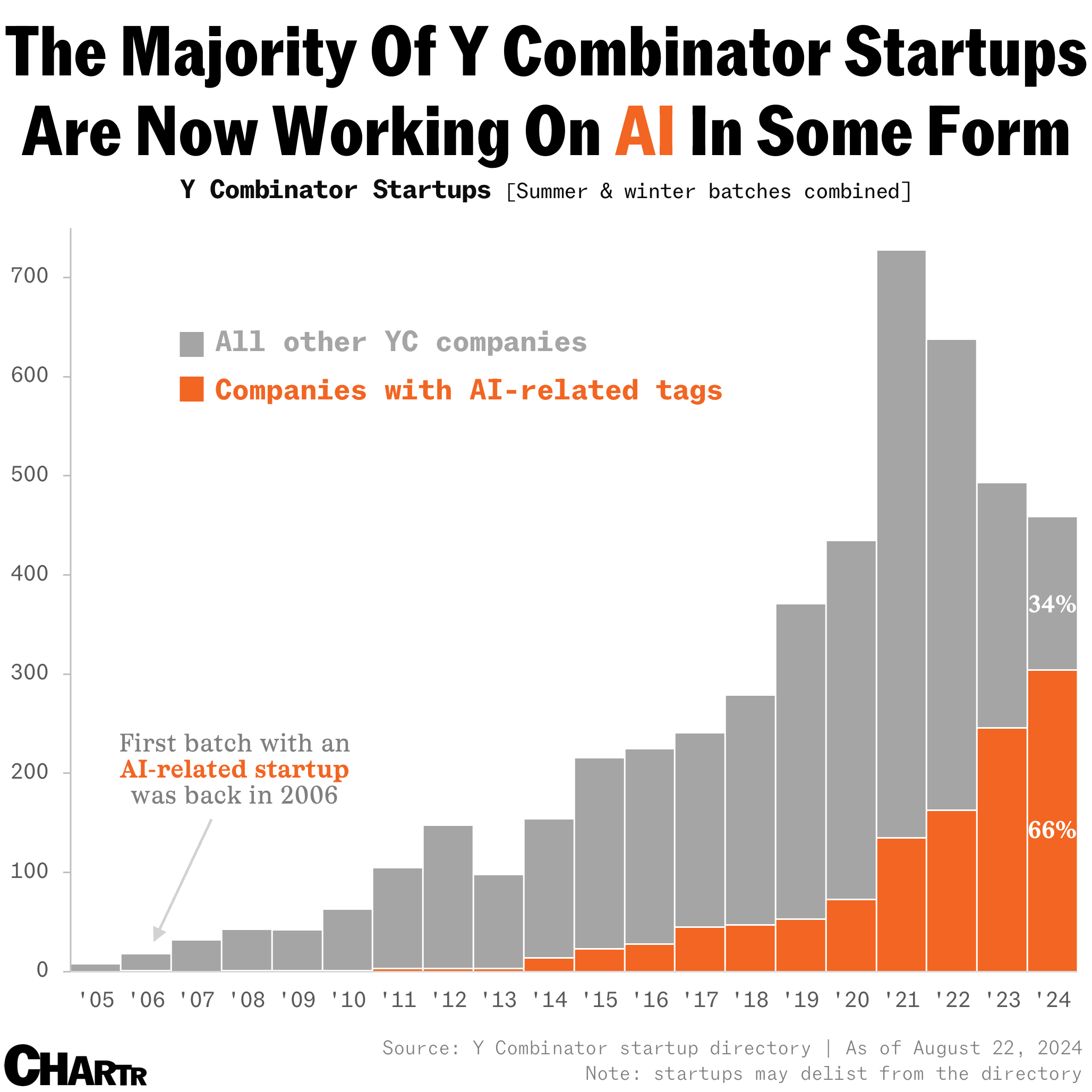
Share of Y Combinator startups working on AI
Sherwood News

So, what are all these companies trying to build? Well, there’s an AI-powered interior designer (Rastro), a GenAI interviewer for business interviews (Mindely), a “Conversational AI Sidekick for Kids” (Genie), a tool for making hit songs with AI (Sonauto), and a startup that wants to automate “taking orders at drive-thrus with a voice AI” (Lilac Labs).

Interestingly, you can track tech hype cycles throughout YC’s history. In 2022, when “Crypto / Web 3” was the hottest thing to work on, 33 YC startups were working in the space — in both of the most recent batches there was only 1.

More Tech

See all Tech
Tesla Light Show In Nanning

Tesla deliveries drop for second straight year; stock on pace to match longest losing streak ever

BYD outsold Tesla in battery electric vehicles for the first time in 2025.

tech
Rani Molla

Rather than fully cracking down on scam ads, Meta worked to make them harder to find

In its latest piece on Meta’s scam ads, Reuters found that the social media giant didn’t just remove fraudulent ads from its platforms — it also worked to make them harder for governments and journalists to find.

Fearing that Japanese regulators would require universal advertiser verification — a measure Meta estimated would cost roughly $2 billion to implement and potentially reduce its revenue by nearly 5% — the company took steps to make scam ads less “discoverable” to “regulators, investigators and journalists,” according to internal documents reviewed by Reuters.

“So successful was the search-result cleanup that Meta, the documents show, added the tactic to a ‘general global playbook’ it has deployed against regulatory scrutiny in other markets, including the United States, Europe, India, Australia, Brazil and Thailand,” Reuters wrote.

Previous Reuters reporting found Meta internally projected that about 10% of its 2024 revenue would come from ads tied to scams and banned goods, though the company later said that estimate was overly broad. Reuters also reported the rate was double in China.

“So successful was the search-result cleanup that Meta, the documents show, added the tactic to a ‘general global playbook’ it has deployed against regulatory scrutiny in other markets, including the United States, Europe, India, Australia, Brazil and Thailand,” Reuters wrote.

Previous Reuters reporting found Meta internally projected that about 10% of its 2024 revenue would come from ads tied to scams and banned goods, though the company later said that estimate was overly broad. Reuters also reported the rate was double in China.

tech
Rani Molla

Michael Burry, the “Big Short” investor who called Tesla “ridiculously overvalued,” is not currently shorting Tesla

Earlier this month, “The Big Short” investor Michael Burry said Tesla has been “ridiculously overvalued” for “a good long time” — and reiterated that message in a post on X on Tuesday. But the once prominent Tesla short seller isn’t currently betting against the stock.

Asked directly whether he would short Tesla now, Burry replied simply: “I am not short.”

Tesla is expected to report a double-digit decline in fourth-quarter deliveries this week.

tech
Rani Molla

SoftBank becomes OpenAI’s biggest backer after fully funding $40 billion investment

SoftBank has fully funded its $40 billion investment in OpenAI, overtaking Microsoft as the company’s largest financial backer, CNBC reports. The deal was contingent on OpenAI transitioning to a for-profit public benefit corporation, which it did in September.

However, longtime partner Microsoft retains substantial influence over OpenAI with its roughly $13 billion investment, which translates to a stake worth about 27% of the startup’s valuation — which has been cited as high as $830 billion — as well as exclusive cloud and commercial licensing rights tied to Azure.

tech
Rani Molla

Tesla-compiled estimates show Q4 deliveries expected to fall 15% from last year

A Tesla-compiled average of analyst estimates pegs fourth-quarter deliveries at 422,850, which would mark a 15% slump from the 495,570 the company delivered in the same quarter last year, if realized. The full-year estimate of 1.6 million vehicles would represent an 8% decline from 2024 and the second annual decline for the EV company. The estimates are notably lower than the consensus estimates compiled by Bloomberg and FactSet, which have been declining over the past month.

The market-implied odds derived from event contracts show that most traders think Tesla deliveries will be more than 410,000 but less than 420,000 in the quarter ending December.

(Event contracts are offered through Robinhood Derivatives, LLC — probabilities referenced or sourced from KalshiEx LLC or ForecastEx LLC.)

While Tesla typically shares its compilation of analyst estimates with institutional investors, this is the first time the company has shared those numbers on its own website. Tesla’s numbers include estimates from Daiwa, DB, Wedbush, OpCo, Canaccord, Baird, Wolfe, Exane, GS, RBC, Evercore ISI, Barclays, Wells Fargo, Morgan Stanley, UBS, Jefferies, Needham & Co., HSBC, Cantor Fitzgerald, and William Blair.

Actual numbers are expected Friday.

Latest Stories

Sherwood Media, LLC produces fresh and unique perspectives on topical financial news and is a fully owned subsidiary of Robinhood Markets, Inc., and any views expressed here do not necessarily reflect the views of any other Robinhood affiliate, including Robinhood Markets, Inc., Robinhood Financial LLC, Robinhood Securities, LLC, Robinhood Crypto, LLC, or Robinhood Money, LLC.
