
Tech
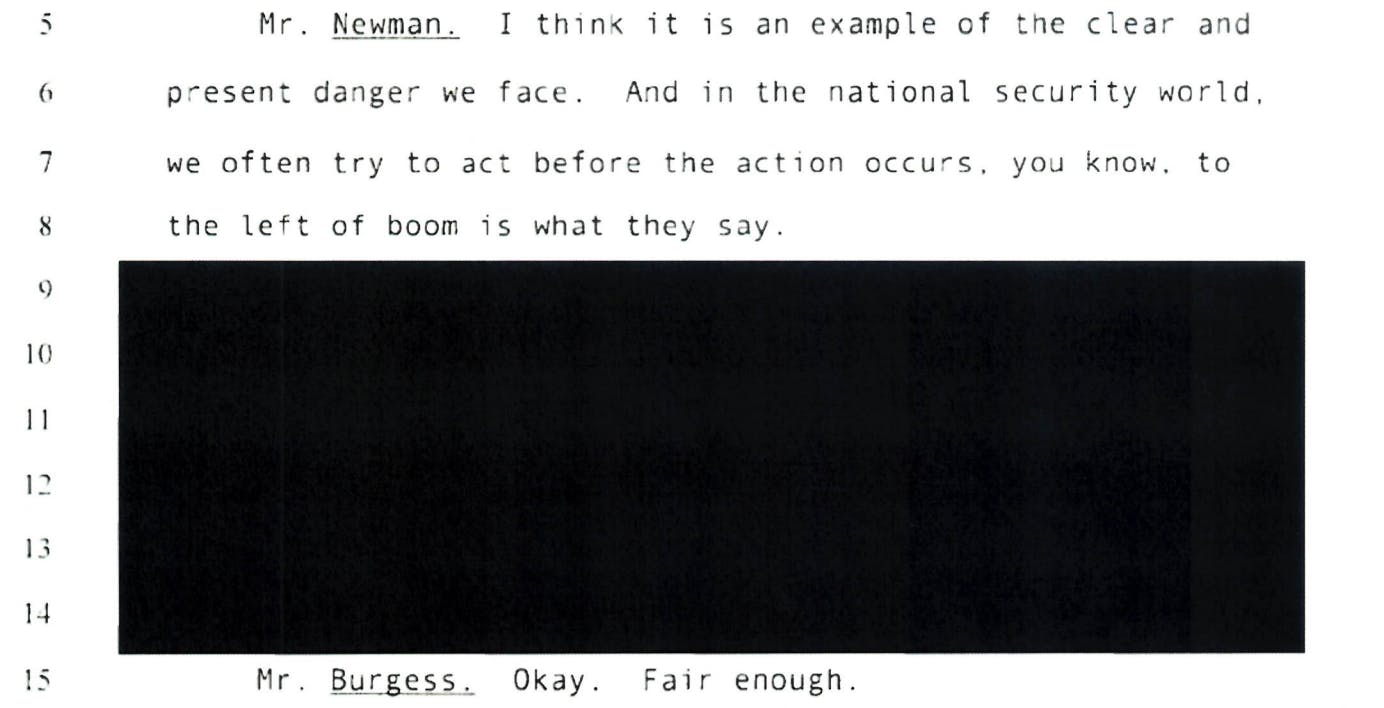
Redacted element of a transcript
US Court of Appeals for DC Circuit
Classified

Here’s the transcript of the secret briefing that kicked off the TikTok law

Matt Phillips

It’s hard for Americans — or American politicians — to agree on much of anything these days.

But, following a classified briefing on the potential national security threat posed by TikTok on March 7, the House Energy and Commerce Committee voted unanimously to advance an incredibly contentious legislation that posed a threat to TikTok, one of the most popular forms of communication in the country. (Even after TikTok sent a urgent sounding push alert to its users' phones, directing them to call Congress and generating a flood of calls to Representatives.)

It was a remarkably rapid, unified and some might say courageous decision in a legislative body not known for such things.

The unanimous committee vote gave a jolt of momentum to the bill which passed the next week in a landslide vote by the full house. The Senate passed it the next month and President Biden signed it soon afterward.

Remarkably, we now have a transcript of that classified March 7 meeting that supercharged the journey of that bill into law.

Read the transcript here.

TikTok and its parent are fighting the law in court. And as part of that civil litigation, the government filed yesterday, a heavily redacted transcript of the briefing which was delivered, in part, by a representative of the Office of the Director of National Intelligence — identified only as Jonathan — and David Newman, a national security official at the Department of Justice, as well as others.

As you might imagine, the government has taken pains to efface any blockbuster revelations that might have been included in the classified testimony. Several pages are nothing more than large black rectangles. Elsewhere, there are merely tantalizing hints of what was said.

But in its court filing introducing the transcript, the government stressed that even providing this level of disclosure of a classified briefing is highly unusual. They argued, essentially, that the government was bending over backward to provide some transparency because of the stakes of the case.

“The government is unaware of any past circumstance in which classified testimony by the intelligence community at a classified hearing before Congress has been shared with a court for consideration in connection with civil litigation,” wrote Justice Department attorneys.

The disclosures — or lack of disclosure, depending on your perspective — reflect the unusual nature of the limited access to classified information in this case. Those limits pertain not only to the public, but also to TikTok and its attorneys which are not allowed to see the classified material either.

Unlike in a criminal case, where a defendant has some rights to see the classified evidence being presented against them, TikTok’s efforts to fight the ban is a civil matter, where it has no rights to see such classified material, says Alan Rozenshtein, an associate professor of Law at the University of Minnesota Law School and a senior editor at Lawfare, the national security law publication.

“The court is being asked to uphold this law on the basis of evidence that it cannot disclose to the litigants or to the public,” he said.

More Tech

See all Tech
tech

Meta will surpass Google in ad revenue this year, new industry data shows

In a world supported by digital ad dollars, Meta may soon be king. The Instagram owner’s net digital ad revenues are expected to hit $243.5 billion in 2026, surpassing Google’s projected $239.5 billion, according to new data from eMarketer.

The shift is happening as Big Tech companies, including Meta and Google, are increasing their spending on AI in hopes that AI will grow their top and bottom lines.

On the company’s last earnings call, Meta CFO Susan Li credited AI with driving performance gains, and said that growth will continue: “We expect the set of investments we’re making in 2026 will enable us to drive further gains as we continue to integrate AI across all layers of the marketing and customer engagement funnel.”

“In surpassing Google, Meta has essentially had many of its core strategies validated,” said Max Willens, principal analyst at eMarketer. “Meta has long understood that scale, network effects, and habits are more important than anything else in digital media. It has carefully built and defended the advantages it has in all three areas.”

JAPAN-FOOD-DRINK-SCIENCE-REASEARCH-MSG-AJINOMOTO

What does delicious Asian food seasoning have to do with a potential bottleneck for AI chips?

Japanese food flavoring company Ajinomoto, which commercialized MSG, also makes a key component in AI chips. It’s having trouble scaling to meet demand.

tech

Report: Microsoft looks to remake Copilot in the image of OpenClaw

Microsoft is feeling the heat from all corners of the tech world as it tries to infuse its productivity apps with useful AI tools.

OpenAI, Anthropic, and now open-source OpenClaw are enabling powerful agentic AI that can do work on your computer for you — including productivity functions like managing emails, spreadsheets, and slide decks.

This is obviously an area where Microsoft needs to compete, or it will be left in the dust by AI startups.

The Information reports that Microsoft is indeed realizing this, and is now trying to reboot its many Copilot tools to act more like the extremely popular DIY agentic AI tool OpenClaw.

OpenClaw is usually set up running on a dedicated personal computer, and given access to all of a user’s permissions and logins. The user issues orders to OpenClaw through messaging apps like Telegram or WhatsApp, and the agent goes off and completes tasks in the background, notifying you when they’re done. But many users have had security disasters with the setup, so Microsoft is looking to borrow the popular concept but implement the strict security controls needed for use in enterprise environments.

According to the report, Microsoft CEO Satya Nadella has made revamping 365 Copilot a top priority.

This is obviously an area where Microsoft needs to compete, or it will be left in the dust by AI startups.

The Information reports that Microsoft is indeed realizing this, and is now trying to reboot its many Copilot tools to act more like the extremely popular DIY agentic AI tool OpenClaw.

OpenClaw is usually set up running on a dedicated personal computer, and given access to all of a user’s permissions and logins. The user issues orders to OpenClaw through messaging apps like Telegram or WhatsApp, and the agent goes off and completes tasks in the background, notifying you when they’re done. But many users have had security disasters with the setup, so Microsoft is looking to borrow the popular concept but implement the strict security controls needed for use in enterprise environments.

According to the report, Microsoft CEO Satya Nadella has made revamping 365 Copilot a top priority.

tech

Tesla competitor Slate closes $650 million funding round and says 2026 production is “on time and on budget”

Tesla competitor Slate Auto said it closed a $650 million Series C funding round led by TWG Global, giving it the “operating capital to reach the next stage of development.” Slate’s new CEO, Peter Faricy, says it has more than 160,000 reservations, up from 150,000 in December, and is “on time and on budget” to deliver its first mid-$20,000 electric trucks to customers by the end of 2026.

Latest Stories

Sherwood Media, LLC produces fresh and unique perspectives on topical financial news and is a fully owned subsidiary of Robinhood Markets, Inc., and any views expressed here do not necessarily reflect the views of any other Robinhood affiliate, including Robinhood Markets, Inc., Robinhood Financial LLC, Robinhood Securities, LLC, Robinhood Crypto, LLC, Robinhood Derivatives, LLC, or Robinhood Money, LLC. Futures and event contracts are offered through Robinhood Derivatives, LLC.

