
Tech
Computer terminal on fire on table (Digital Composite)
Getty Images
PEAK PC

While the world goes mad for AI, the humble PC is being left behind

Consumers aren’t rushing to buy “AI PCs”... yet.

Claire Yubin Oh

Personal-computer companies HP and Dell have had a tough week, with both stocks down more than 10% on Wednesday after it became clear that people, and businesses, still aren’t buying PCs like they used to... even if they have the word “AI” in their name.

With so many other technology-enabled categories getting a boost from AI, some investors had hoped there might be a rose-tinted AI future for the two tech companies. Indeed, both Dell and HP shares rode some of the AI wave this year: Dell shares had gained 87% and HP was up 30% before the release of the Q3 reports. That optimism isn’t flowing through to results, with both offering gloomy forecasts for the rest of the year.

Recovery mode

After the peak in PC sales during the stay-at-home(-and-work) pandemic years, the industry saw a massive eight straight quarters of annual declines, per data from the International Data Corporation, as millions of people who might have gone out to buy a PC had already done so.
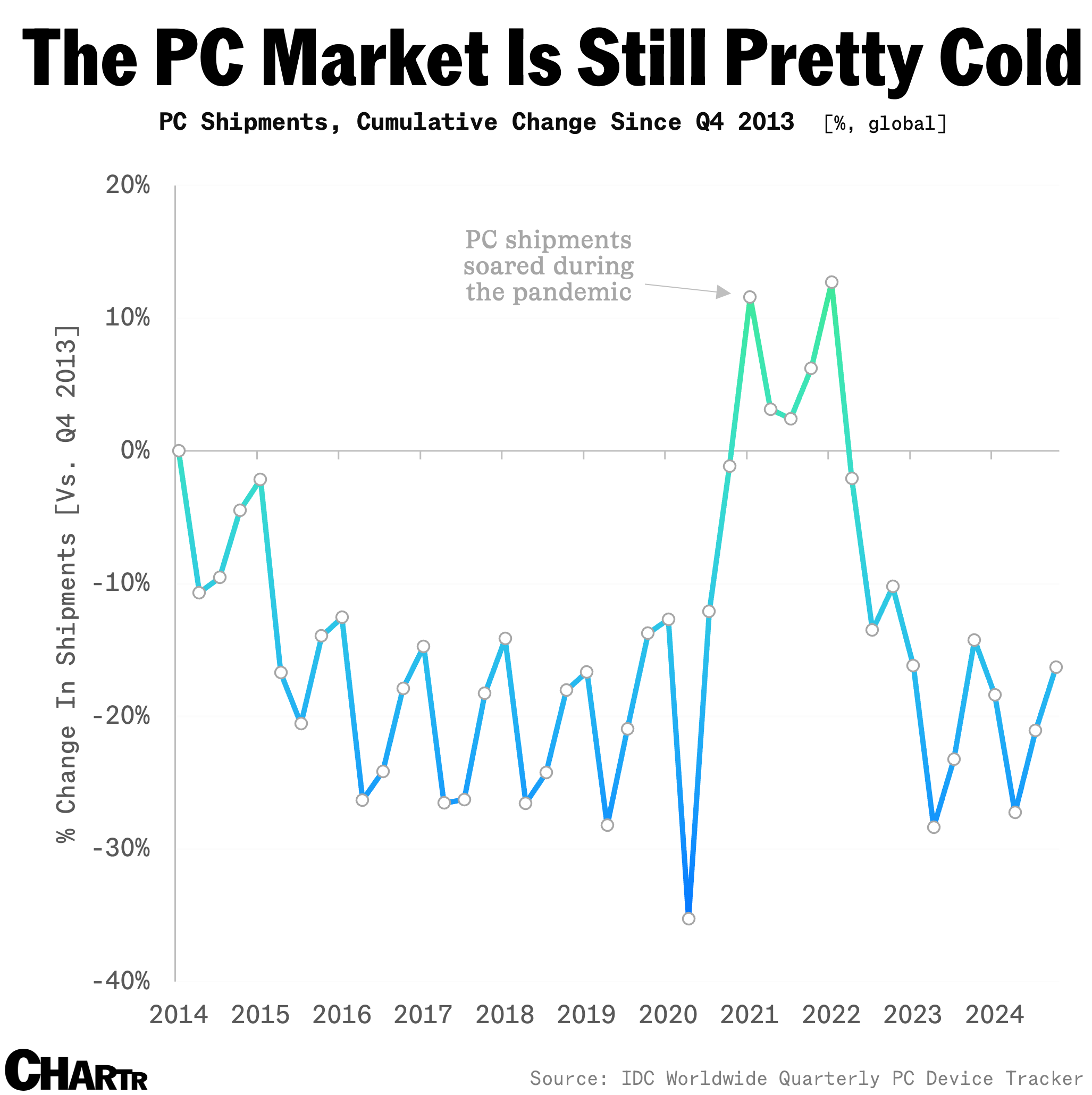
PC Shipments
Sherwood News

The market showed some green shoots of growth at the start of 2024 — a time when both companies began to double down on their AI initiatives. HP and Dell released plans for PCs that can do AI tasks on device hardware, rather than just connecting to AI tools via the internet, including HP’s so-called “the world’s highest performance AI PC”. Per Barron’s, some 15% of HP’s sales were AI PCs in their first quarter on the market — but they seem to be mostly replacing older hardware rather than driving net new demand. Dell’s chief operating officer said on the company’s earnings call that “the PC refresh continues to move out.”

So far, there doesn’t seem to be enough of a reason for consumers to shell out for a new AI PC. Instead, the “less sexy but arguably more important commercial refresh cycle” has been leading the industry’s performance in the background of the market’s AI PC hype, said Ryan Reith, vice president of IDC’s Worldwide Device Trackers.


More Tech

See all Tech
$1

Barclays says autonomous couriers — think sidewalk robots and drones — could push delivery costs down to as little as $1 per order, from between $5 and $7 today and closer to $9 for traditional deliveries in high-labor-cost markets. If robots save $4 on every delivery, and enough companies start using them, the food delivery industry, including companies like DoorDash and Uber, could end up with $16 billion in extra profit every year, according to Barclays.

The catch: we’re nowhere near that world yet. Robots and drones handle less than 1% of deliveries today. Even by 2035, Barclays only sees penetration hitting around 10%.

Google’s Wing and Amazon have also been trying to crack last-mile product delivery — a reminder that this is part of a broader race to automate the most expensive leg of e-commerce.

$10B

Uber has long had an asset-light business model: it provided the ride-hailing platform, and its contract workers brought their own vehicles. That’s changing as Uber positions itself at the center of the robotaxi era.

The Financial Times estimates that Uber has committed more than $10 billion to buying robotaxi fleets ($7.5 billion) and investing in the companies that make them ($2.5 billion). That includes yesterday’s announcement that its expanding its investment in Lucid, a deal worth about $2 billion, with plans to buy 35,000 vehicles.

This shift pits Uber against industry leaders like Google’s Waymo and Tesla, whose models involve company-owned vehicles running on proprietary platforms. While these autonomous fleets eliminate the need for drivers, they introduce new capital-intensive requirements for charging, cleaning, storage, and repair.

tech
Jon Keegan

Report: US Treasury wants to get a look at Anthropic’s Mythos model

Anthropic’s relationship with the US government is complicated — and the Treasury Department is reportedly looking to make it even more so.

The Pentagon has officially deemed the startup a national security supply chain risk after it refused to allow its Claude AI to be used for any and all national security applications, including domestic surveillance and autonomous killing.

But since Anthropic’s unusual announcement of its next model, Mythos, other parts of the US government want to get their hands on it.

Bloomberg reports that the US Treasury is interested in getting access to Mythos for its own security testing. Last week, Treasury Secretary Scott Bessent summoned top Wall Street CEOs to Washington to discuss the cybersecurity implications of the new model.

Mythos has not yet been released to the public, as Anthropic has deemed its potential offensive cybersecurity capabilities to be too dangerous for wide release, and has opted to share the powerful new model only with a group of leading tech companies.

Anthropic wants these early access partners to test out the model, hoping to secure any major vulnerabilities before a public release. OpenAI also shared a forthcoming AI-powered cybersecurity tool with a select group of partners to shore up defenses in light of advances in detecting vulnerabilities.

European regulators were apparently left out of the loop from the Mythos announcement, and are also eager to test the new model.

But since Anthropic’s unusual announcement of its next model, Mythos, other parts of the US government want to get their hands on it.

Bloomberg reports that the US Treasury is interested in getting access to Mythos for its own security testing. Last week, Treasury Secretary Scott Bessent summoned top Wall Street CEOs to Washington to discuss the cybersecurity implications of the new model.

Mythos has not yet been released to the public, as Anthropic has deemed its potential offensive cybersecurity capabilities to be too dangerous for wide release, and has opted to share the powerful new model only with a group of leading tech companies.

Anthropic wants these early access partners to test out the model, hoping to secure any major vulnerabilities before a public release. OpenAI also shared a forthcoming AI-powered cybersecurity tool with a select group of partners to shore up defenses in light of advances in detecting vulnerabilities.

European regulators were apparently left out of the loop from the Mythos announcement, and are also eager to test the new model.

Latest Stories

Sherwood Media, LLC produces fresh and unique perspectives on topical financial news and is a fully owned subsidiary of Robinhood Markets, Inc., and any views expressed here do not necessarily reflect the views of any other Robinhood affiliate, including Robinhood Markets, Inc., Robinhood Financial LLC, Robinhood Securities, LLC, Robinhood Crypto, LLC, Robinhood Derivatives, LLC, or Robinhood Money, LLC. Futures and event contracts are offered through Robinhood Derivatives, LLC.
