Tech
Elon Musk Plans To Develop Town Named Snailbrook Near His Planned Austin, Texas SpaceX And Boring Co. Facilities
An aerial view of Elon Musk's Snailbrook community under construction on March 13, 2023 in Bastrop County, Texas. (Brandon Bell/Getty Images)

X’s new home is a bodega and 15 trailers in a trench coat

Some things are smaller in Texas.

In July, Elon Musk announced the company formerly known as Twitter would be moving to Austin. Not quite.

According to Forbes, which cites court documents, Bastrop County, Texas, will be the new home of X now that it has closed up shop in San Francisco. It’s 40 minutes outside Austin, depending on traffic, which there’s a lot more of these days.

The rural location is outside the city of Bastrop, which has a population of about 10,000. It’s the home of SpaceX’s Starlink facility as well as the headquarters location for the Boring Company, Musk’s drilling outfit.

Elon Musk company town Snailbrook site overview
YouTube screenshot from Joe Tegtmeyer video in July

July drone footage from Joe Tegtmeyer, a YouTuber who documents developments at Musk’s businesses, shows a new facility being constructed next to the Hyperloop Plaza that will likely house X employees. Currently, X is hiring “safety agents” in Bastrop who will be “responsible for helping our users successfully and safely use our platform” by “combating spam and fraud, and providing support to our customers.”

Forbes, citing X’s real estate director, said X has 188 employees in Texas and will eventually base its Austin employees in Bastrop. Fortune earlier this month said San Francisco employees have been shuttling to offices an hour away in San Jose and Palo Alto and fear they may have to move to Bastrop to keep their jobs. The report said fewer than 500 engineers are left at X.

Musk is in the process of building a company town for his employees in Bastrop County called Snailbrook, named after the Boring Co’s slow-going mascot. The plan, according to reporting last year from the Wall Street Journal, is to build at least 110 homes and potentially incorporate the town.
Elon Musk Plans To Develop Town Named Snailbrook Near His Planned Austin, Texas SpaceX And Boring Co. Facilities
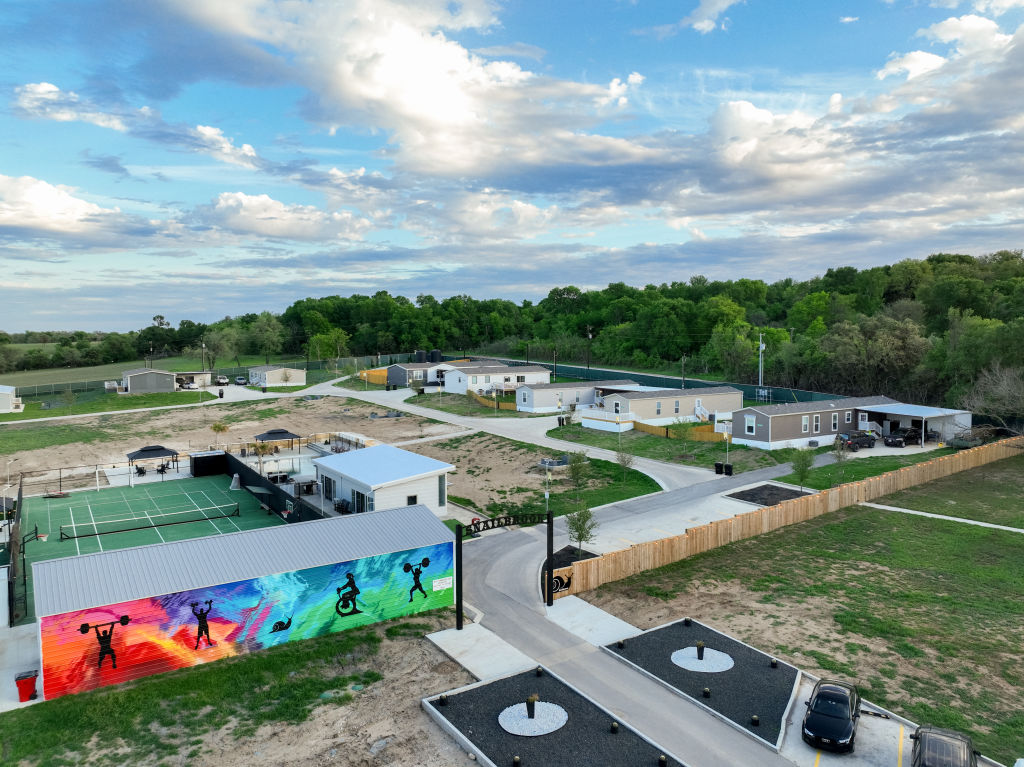
This is what the residential area of Musk’s town looked like last year. Not much has changed. (Brandon Bell/Getty Images)

Construction hasn’t started on those homes yet, Chap Ambrose, a Bastrop County resident whose property abuts the plots, told me. So far the company town consists of roughly 15 residential trailers, as well as a center of commerce called Hyperloop Plaza, which includes a bodega, pickleball courts, a his-and-hers salon, and a pub that looks like an unfinished garage man-cave. The development where X will be is not quite bustling just yet. The nearby city of Bastrop, though, has been getting a lot of new restaurants in the last few years, a city official told me, while the county has been overrun by new residential development.

Bastrop County’s population has jumped 17% in the last four years, and 2.5% in the last year, according to data from Placer.ai. That’s more than double the percentage growth of Austin, one of the fastest growing cities in the country, in that time. Traffic in the county has also swelled in the past few years, thanks to Musk companies’ development.


More Tech

See all Tech
Multicolor Sticks

OpenAI is shipping everything. Anthropic is perfecting one thing.

The two AI titans are in a race to grow revenues, but they have very different strategies for releasing products. And one approach appears to be winning out.

73%

Here’s another sign Anthropic’s enterprise tools are killing it: The AI firm now captures 73% of all spending among companies buying AI tools for the first time, Axios reports, citing data from Ramp, a fintech company that provides corporate cards and expense management software. That’s up from 50% in January, when it was tied with OpenAI.

As we’ve noted, Big Tech is pivoting from experimentation to revenue — and enterprise is where that shift is playing out.

tech

Microsoft considers suing Amazon and OpenAI over $50 billion deal

Microsoft may be about to take its biggest AI partner to court, the Financial Times reports.

Microsoft, a longtime backer of OpenAI, is weighing legal action over the latter’s $50 billion deal with Amazon tied to its new Frontier AI product, arguing it could violate a key clause in their exclusive cloud deal requiring OpenAI’s models to run through Azure. Amazon and OpenAI say they’ve found a workaround. Microsoft executives disagree.

“We know our contract,” a source told the FT. “We will sue them if they breach it. If Amazon and OpenAI want to take a bet on the creativity of their contractual lawyers, I would back us, not them.”

OpenAI, which is eyeing an IPO this year and under pressure to generate more revenue, is trying to loosen Microsoft’s grip as it scales, while Microsoft increasingly sees OpenAI as both a partner and competitor.

“We know our contract,” a source told the FT. “We will sue them if they breach it. If Amazon and OpenAI want to take a bet on the creativity of their contractual lawyers, I would back us, not them.”

OpenAI, which is eyeing an IPO this year and under pressure to generate more revenue, is trying to loosen Microsoft’s grip as it scales, while Microsoft increasingly sees OpenAI as both a partner and competitor.

tech

Morgan Stanley says robotaxis could help Tesla sell more cars

Morgan Stanley analysts think Tesla’s robotaxi push could boost more than just a new business line — it could help sell more cars and software, too.

After visiting Giga Texas, analysts said they’re more optimistic about Tesla’s progress toward an unsupervised robotaxi rollout, with improvements in tricky pickup and drop-off scenarios where Tesla doesn’t have as much data from consumer usage. For now, the vast majority of its vehicles still have human supervisors in the front seat, but the analysts say the service is helping Tesla.

“Incremental unsupervised robotaxi miles driven improve the underlying autonomy model, which accelerates the path to personal unsupervised FSD [Full Self-Driving]. This, in turn supports higher FSD attach rates, improves auto demand, and cash flow generation.”

In other words, the more robotaxis drive, the better Tesla’s self-driving gets — and that could make its Full Self-Driving software more appealing and its cars easier to sell, in addition to improving its robotaxi service. Note that Tesla’s vehicle deliveries, which accounts for the lion’s share of the company’s revenue, have dropped two years in a row.

Morgan Stanley also sees a cost advantage. It estimates Tesla’s robotaxis could cost about $0.81 per mile to run today — cheaper than traditional ride-hailing and rival autonomous services — with costs falling further as purpose-built vehicles like the Cybercab scale.

Morgan Stanley maintained its equal-weight rating and $415 price target, about 4% above where the stock is currently trading.

Latest Stories

Sherwood Media, LLC produces fresh and unique perspectives on topical financial news and is a fully owned subsidiary of Robinhood Markets, Inc., and any views expressed here do not necessarily reflect the views of any other Robinhood affiliate, including Robinhood Markets, Inc., Robinhood Financial LLC, Robinhood Securities, LLC, Robinhood Crypto, LLC, Robinhood Derivatives, LLC, or Robinhood Money, LLC. Futures and event contracts are offered through Robinhood Derivatives, LLC.